
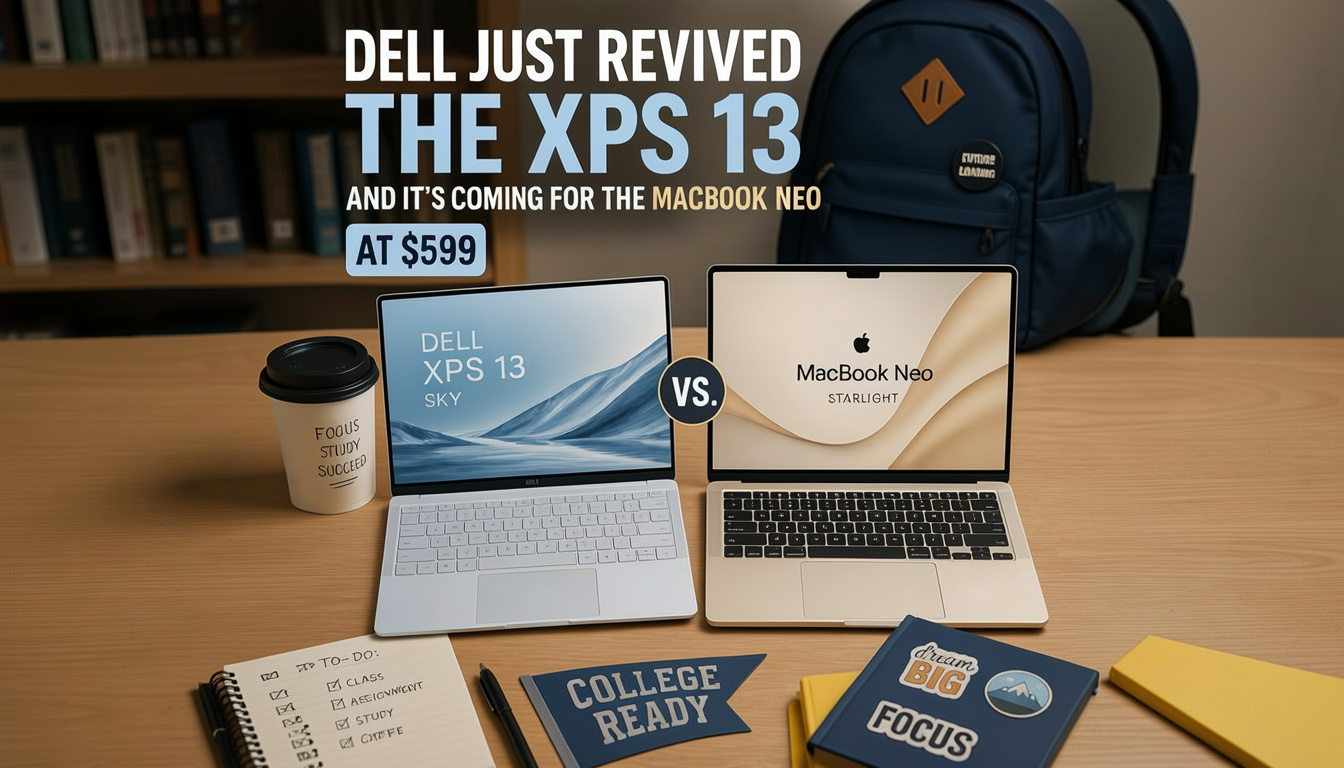
Remember when Dell quietly killed the XPS lineup last year? Well, it’s back — and this time Dell is going straight after Apple’s most popular laptop.
Dell officially announced the return of the XPS 13 on June 1st, 2026, with a launch date set for July. The timing is deliberate. There’s a promotional student price of $599 that runs through September — right in the heart of back-to-school season — and that number isn’t a coincidence. It matches the starting price of Apple’s MacBook Neo dollar for dollar. In fact, Dell’s own COO Jeff Clarke reportedly called out the MacBook Neo by name during a press briefing. That’s not subtle positioning. That’s a direct challenge.
Whether the XPS 13 can actually back it up is a different question.
Dell’s Thinnest XPS Ever Is Surprisingly Affordable
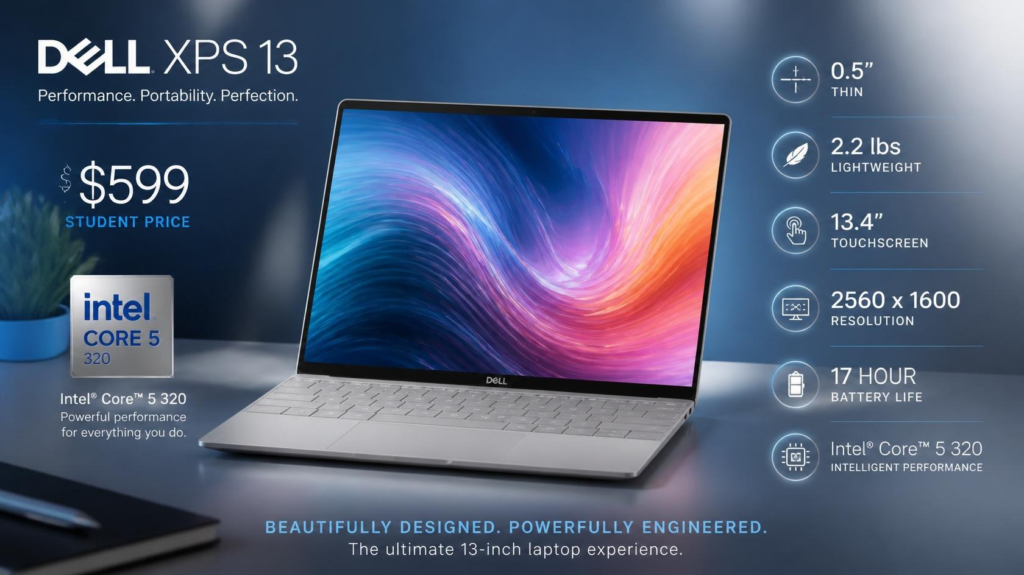
At 0.5 inches thick and just 2.2 pounds, the new XPS 13 is the slimmest, lightest machine Dell has ever put the XPS name on. To put that in perspective, it’s roughly the weight of a large hardcover novel. Students hauling it between lectures all day aren’t going to feel it.
The base configuration ships with a six-core Intel Core 5 320 processor — part of Intel’s newer “Wildcat Lake” family — paired with 512GB of storage. The promotional $599 price is available to students through September; after that, or for everyone else, the laptop starts at $699. Higher-end versions with Intel’s upcoming Panther Lake chips and Thunderbolt 4 connectivity are coming later, and those will scale up to 32GB of RAM.
The $599 price point is competitive on paper, but context matters. Students shopping Apple can actually get the MacBook Neo for $100 less through Apple’s own education pricing — bringing it down to $499. So Dell’s student deal isn’t quite the knockout blow the headline price suggests.
Why the XPS 13’s Return Actually Matters
Dell scrapped the XPS brand entirely in 2025, which felt like a genuine loss. The XPS line had spent years earning a reputation as some of the best-designed Windows laptops money could buy — consistently praised for build quality, sharp displays, and premium feel. Killing it felt like Dell waving the white flag on the premium laptop market.
The relaunch, which started with the XPS 14 and XPS 16 at CES earlier this year, was already a signal that Dell had reconsidered. But the XPS 13 matters most because it’s the entry point — the one students, first-time laptop buyers, and budget-conscious professionals actually consider.
And right now, that market is fiercely contested. Apple’s MacBook Neo has been a surprise hit, proving there’s a massive appetite for thin, capable, well-priced laptops from people who don’t need professional-grade power. Dell is betting that a lot of those potential buyers would choose a Windows machine if the design and price were right.
What You Actually Get: The Full Spec Breakdown
Here’s where things get interesting — and a little complicated.
Every configuration of the XPS 13, regardless of price, comes with a genuinely impressive display. The 13.4-inch touchscreen runs at 2560 x 1600 resolution with a variable refresh rate between 30Hz and 120Hz, 500 nits of brightness, and full DCI-P3 color coverage. That’s a content creator-quality panel on a budget laptop, and it’s one area where the XPS 13 clearly has the edge over the base MacBook Neo, which ships with a non-touch display.
The keyboard is backlit — something the MacBook Neo base model lacks — and Dell is claiming up to 17 hours of battery life under streaming conditions. That’s enough to get through a full day of classes, according to Dell’s own reps, though real-world results will depend heavily on what you’re actually doing.
On the connectivity side, the XPS 13 keeps it minimal: just two USB-C ports and no 3.5mm headphone jack. Not even on the higher-end configurations. If you’re someone who uses wired headphones, budget for a dongle. It’s a tradeoff that made sense on the $1,200+ XPS 13 of a few years ago when thinness was the premium. It feels like a tougher sell at $599.
The 8GB RAM Problem Nobody Wants to Talk About
Let’s be direct: 8GB of RAM on a Windows 11 laptop in 2026 is a genuine concern.
Windows has always been more memory-hungry than macOS. Apple’s ARM-based chips handle 8GB with remarkable efficiency because of how tightly the software and hardware are integrated. Windows on Intel doesn’t have that same advantage. Anyone who opens a dozen browser tabs, runs a cloud app or two, and keeps Spotify in the background knows that 8GB on Windows starts showing strain faster than you’d expect.
The MacBook Neo ships with 16GB of unified memory at its base tier, which immediately puts the XPS 13’s entry configuration at a disadvantage in raw multitasking headroom. Dell will likely offer higher RAM configurations eventually, but the base model — the one most students will buy — starts at 8GB. That’s a real asterisk on an otherwise appealing package.
The higher-end Panther Lake models arriving later this year will go up to 32GB, but those will almost certainly cost significantly more than $699.
A Bigger, Beefier XPS Is Also Coming
While the XPS 13 grabs the headlines, Dell quietly teased something even more interesting at Computex this week: the return of an XPS laptop with discrete graphics.
Details are sparse, but Dell confirmed it’ll pack some level of NVIDIA RTX GPU, an extra-bright tandem OLED display, a dedicated HDMI port, and a full-size SD card slot. That last part alone will make photographers and videographers sit up and pay attention — two features Apple’s MacBook Pro famously dropped and then brought back after years of user complaints.
This unnamed model sounds like it’s being positioned higher up the stack, aimed at creative professionals and power users rather than students. If the display and GPU are as capable as the tease suggests, it could be a compelling alternative to the MacBook Pro 14 — a laptop that starts at $1,599 and doesn’t include a discrete GPU at that price either.
What This Means for the Windows Laptop Market
Dell’s aggressive pricing and transparent MacBook comparisons signal something broader happening in the Windows space right now.
For years, premium Windows laptops felt like they were competing with each other rather than with Apple. Manufacturers defaulted to high prices, complex SKU lineups, and bloated software. Apple owned the “simple, premium, just works” lane almost entirely.
The XPS 13 relaunch — along with similar moves from other PC makers — suggests that’s changing. Windows hardware companies have noticed that Apple’s MacBook Neo succeeded precisely because it was simple, well-priced, and well-designed. They’re responding in kind.
Whether Dell can actually deliver on the promise at $699 — or whether the 8GB RAM compromise and missing headphone jack undercut the experience — will only become clear once reviewers and students get the machine in their hands in July. But the intention is clear: Dell wants back in the conversation for the laptop you actually want to carry every day.
Frequently Asked Questions
Q: Is the Dell XPS 13 2026 available right now?
Not yet. Dell announced it on June 1st, 2026, with a July 2026 launch date. The $599 promotional price for students runs through September, after which the base price rises to $699 for all buyers.
Q: How does the Dell XPS 13 compare to the MacBook Neo?
The XPS 13 matches the MacBook Neo’s $599 starting price (for students) and edges it out on display quality with a higher-resolution touchscreen and backlit keyboard. However, the MacBook Neo ships with 16GB of memory versus 8GB on the base XPS 13, and Apple’s education pricing brings the Neo down to $499 — $100 less than Dell’s student deal.
Q: Will the XPS 13 get a version with more RAM?
Yes. Dell has confirmed that higher-end configurations with Intel Panther Lake processors and up to 32GB of RAM are planned for later in 2026. Those models will also include Thunderbolt 4. Pricing for those configurations hasn’t been announced yet.
The Bottom Line: Dell Is Back, But the Work Starts Now
The return of the XPS 13 is genuinely good news for anyone shopping for a Windows laptop. More competition at the $599–$699 price point means manufacturers have to try harder, and the XPS 13 — with its exceptional display, ultralight chassis, and competitive pricing — is trying harder than most.
But Dell walked into this fight knowing the comparison everyone would make, and the 8GB RAM ceiling on the base model hands Apple a talking point it didn’t need to work for. The display will win admirers. The thinness will turn heads. The missing headphone jack will frustrate some buyers. And the RAM will be the thing reviewers keep coming back to.
If Dell can prove in real-world use that Windows 11 runs comfortably on 8GB with the Wildcat Lake chip — or if it quickly rolls out an affordable 16GB configuration — the XPS 13 could be a legitimate MacBook Neo rival. If not, it’ll be a beautiful laptop that lost the spec sheet battle before the first sale.
July can’t come soon enough.