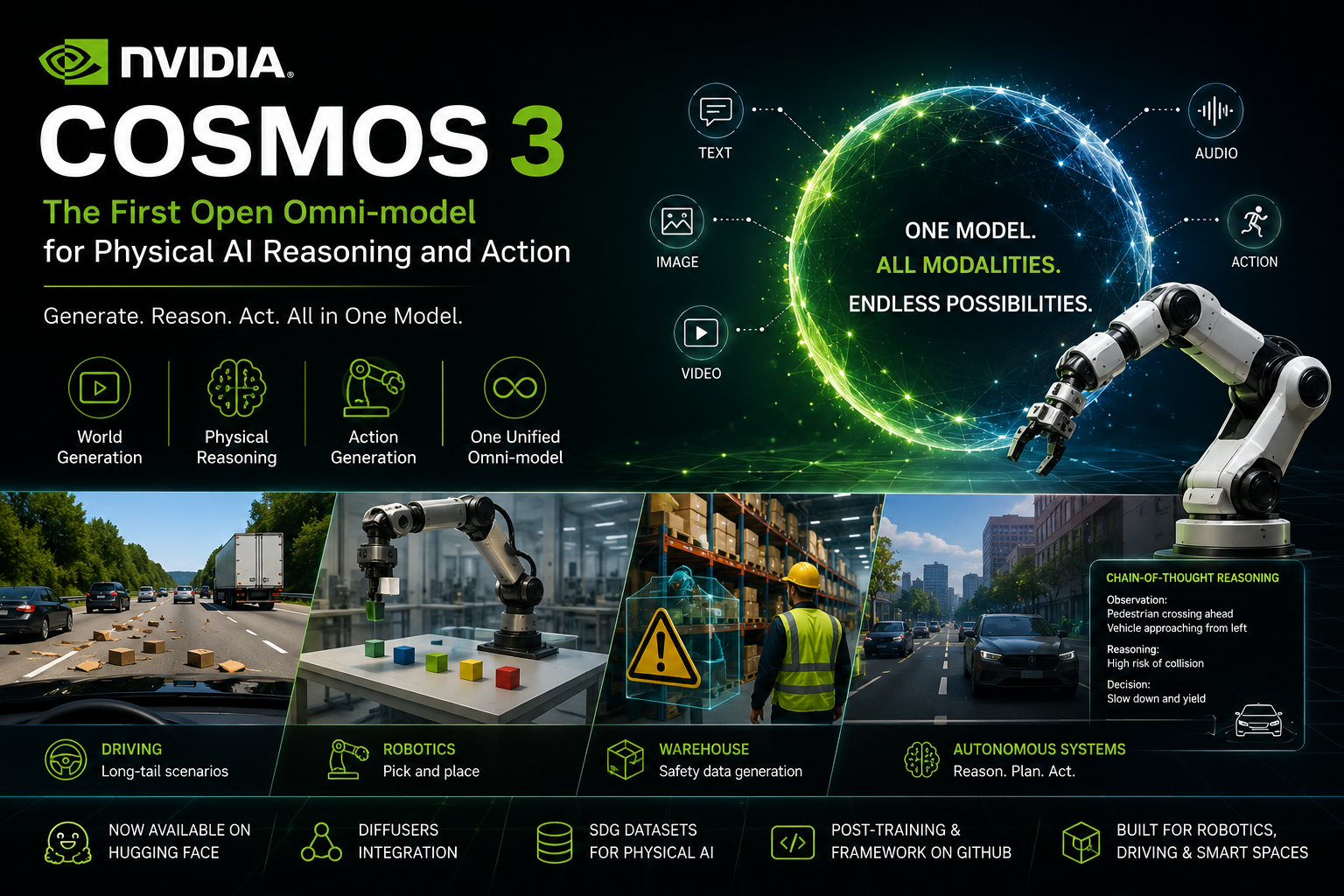
On June 1, 2026, NVIDIA unveiled Cosmos 3, its most ambitious AI model yet. And unlike most AI announcements that sound exciting but are hard to use in the real world, this one ships today — available for free on Hugging Face. Whether you’re building self-driving cars, warehouse robots, or smart physical environments, Cosmos 3 is designed to be the foundation that powers all of it.
What Exactly Is NVIDIA Cosmos 3?
Up until now, physical AI developers had a frustrating problem. If you wanted a model to understand a scene, you used one model. If you wanted it to generate a video simulation, you switched to another. If you needed it to produce robot action instructions, that was a third model entirely.
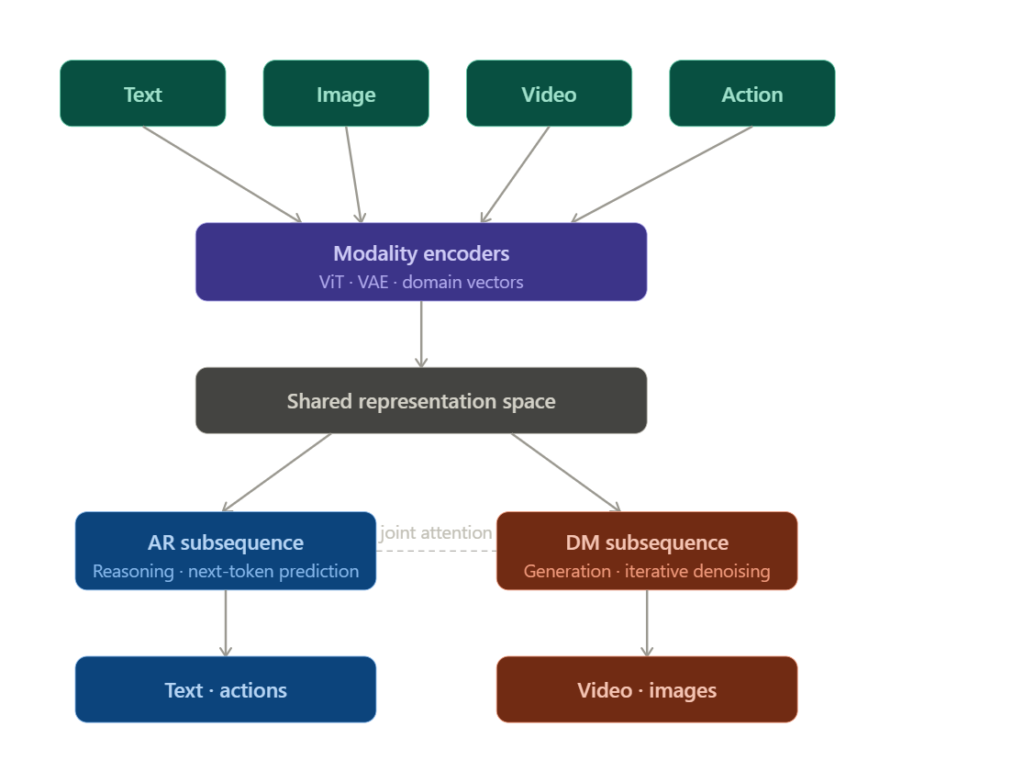
Cosmos 3 tears down that wall. It’s a single unified model — what NVIDIA calls an omni-model — that handles all three tasks inside one architecture. Think of it like upgrading from three separate appliances to a single all-in-one machine that’s better at each job than its predecessors.
The model is built on something called a Mixture-of-Transformers (MoT) architecture. Without getting too deep into the technical weeds: the model splits work between two internal systems. One handles reasoning and understanding (figuring out what’s happening in a scene). The other handles generation (creating what happens next). Both systems share information with each other in real time, which is why the model can seamlessly switch between acting like a smart video generator, a visual AI assistant, or a robot controller — without any extra engineering work on your end.
Why Does This Actually Matter?
Here’s a scenario to make this concrete. Say you’re a robotics engineer training a robot to sort packages in a fulfillment center. Previously, you’d need:
- A video generation model to create synthetic training footage
- A reasoning model to evaluate the robot’s decisions
- A policy model to generate the action sequences the robot should follow
Each model had its own quirks, its own input formats, and its own inference pipeline to manage. That’s a lot of moving parts — and a lot of places for things to go wrong.
With Cosmos 3, you feed in your scenario once and get all of that back from a single model in a single pass. Less infrastructure. Less cost. Fewer headaches.
And this isn’t just a robotics story. Autonomous vehicle companies can use Cosmos 3 to generate rare, dangerous driving scenarios — like debris suddenly appearing on a highway — that would be impossible or illegal to test in the real world. Safety teams in smart buildings can simulate warehouse accidents before they happen. The applications are genuinely wide-ranging.
Two Model Sizes: Pick Your Power Level
NVIDIA is shipping Cosmos 3 in two flavors, designed for different budgets and use cases.
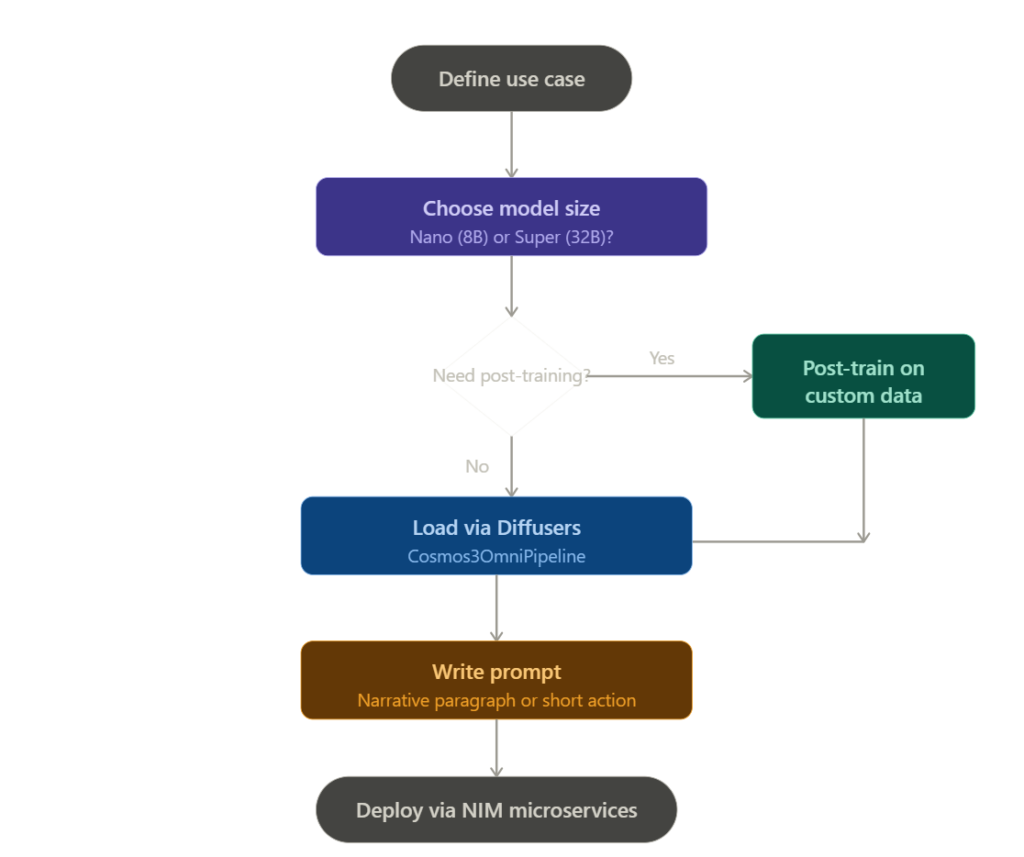
Cosmos 3 Nano is the smaller, faster option — built on an 8 billion parameter foundation. It’s optimized to run on workstation-grade hardware like the NVIDIA RTX PRO 6000 GPU, making it accessible to individual researchers and smaller teams who don’t have access to a data center. For most developers experimenting with physical AI, this will be the starting point.
Cosmos 3 Super steps up to 32 billion parameters and is aimed at large-scale synthetic data generation and serious research workloads. It runs on NVIDIA’s Hopper and Blackwell GPU families — so yes, you’ll need enterprise hardware. But the output quality and capability jump significantly.
Both models are available now at nvidia/Cosmos3-Nano and nvidia/Cosmos3-Super on Hugging Face, complete with model cards, licensing details, and documentation.
Key Capabilities at a Glance
Cosmos 3 supports a surprisingly broad set of input-output combinations:
- Text or images → video: Describe a scene in plain English, and Cosmos 3 generates a realistic, physically plausible video of it
- Video → text: Ask the model to describe or reason about what’s happening in a video clip
- Actions + images → video: Show the model a robot’s starting position and its planned actions, and it generates what the scene will look like afterward (useful for forward planning)
- Video → actions: Feed in a video and the model figures out what actions a robot would need to take to produce that result (great for learning from demonstrations)
- Image + text → video and actions together: Full policy generation — give it a goal, get back both a predicted video and an action sequence
This flexibility is what makes Cosmos 3 a genuine foundation model for physical AI, rather than a single-purpose tool.
Getting Started Is Surprisingly Simple
NVIDIA integrated Cosmos 3 directly into the popular Hugging Face Diffusers library. If you’ve ever used Diffusers before, the interface will feel immediately familiar. You load the model with Cosmos3OmniPipeline, write a detailed prompt, and run inference — a few lines of Python is all it takes to generate your first image or video.
For best results, NVIDIA recommends writing prompts as narrative paragraphs for video generation. Something like describing a vehicle traveling on a highway when debris suddenly appears reads like a short story, and the model responds in kind with a cinematic, physically realistic output. For robot action prompts, brevity works better — short, spatially clear instructions like “place the pot to the left of the purple item.”
NVIDIA also published a full prompt engineering guide on GitHub for developers who want to squeeze more quality out of their generations.
Free Datasets Included — A Big Deal for the Community
Arguably one of the most underappreciated parts of this launch is the set of synthetic data generation (SDG) datasets NVIDIA is releasing alongside the model. These are ready-to-use datasets covering robotics, physics simulation, human motion, autonomous driving, warehouse safety, and spatial reasoning — all generated by NVIDIA’s internal teams using tools like Isaac Sim.
For researchers and startups that don’t have the budget to collect massive real-world datasets, this is a significant gift. Training world foundation models requires enormous amounts of high-quality data, and NVIDIA just handed the community a substantial head start.
What This Means for the Future of Robotics and AI
The launch of Cosmos 3 signals something important about where physical AI is heading. The field has historically been fragmented — different teams building different models for different parts of the problem. What NVIDIA is doing with Cosmos 3 is attempting to unify those pieces into a coherent, trainable whole.
More importantly, NVIDIA is releasing this as an open model. That’s a strategic move. It means developers, researchers, and companies can post-train Cosmos 3 on their own specific robots, environments, and tasks — and NVIDIA provides the scripts to do exactly that on GitHub. The result is a model that gets more capable and more specialized the more the community builds on it.
Combined with NVIDIA’s NIM microservices for deployment, Cosmos 3 is designed to scale from a researcher’s workstation all the way to production infrastructure. The path from “interesting demo” to “deployed in a real factory” just got a lot shorter.
Frequently Asked Questions
Q: Is NVIDIA Cosmos 3 free to use?
Both Cosmos 3 Nano and Cosmos 3 Super are available on Hugging Face. Like many large model releases, you’ll need to review and accept NVIDIA’s licensing terms before downloading — particularly if you intend to use the models commercially. Check the model cards on Hugging Face for the latest licensing details.
Q: What kind of hardware do I need to run Cosmos 3?
Cosmos 3 Nano is designed to run on workstation-class GPUs like the NVIDIA RTX PRO 6000, making it more accessible for individual developers. Cosmos 3 Super requires NVIDIA Hopper or Blackwell architecture GPUs, which are enterprise-grade. If you don’t have the hardware, you can also access both models via NVIDIA’s NIM microservices cloud offering.
Q: How is Cosmos 3 different from regular video generation models like Sora or Runway?
Standard video generation models produce realistic-looking video, but they don’t understand physical causality or generate actionable outputs for robots. Cosmos 3 is specifically trained on physical AI scenarios — it can reason about motion, generate robot action sequences, and model cause-and-effect in physical environments. It’s built for robotics and autonomous systems, not entertainment or creative video production.
NVIDIA Cosmos 3 isn’t just another impressive demo. It’s a practical, open, deployable model that solves a real problem physical AI developers face every day — the fragmentation of tools. By combining world simulation, physical reasoning, and action generation into a single architecture, NVIDIA has built something that could genuinely accelerate the development of real-world robotics and autonomous systems.
The fact that it ships today, works with familiar tools like Diffusers, and comes bundled with free training datasets makes it even harder to dismiss. This is one of those releases worth paying close attention to — because the robots being trained on it today might be working alongside us sooner than we think.