

Imagine building a high-security vault, but accidentally leaving a side door wide open — one that anyone with the right knowledge can waltz through. That’s essentially what happened with a newly disclosed security flaw that security researchers are calling BadHost.
The bug lives inside a software package called Starlette — something most everyday people have never heard of, but one that quietly powers a massive chunk of the modern AI internet. We’re talking about millions of AI tools, APIs, and Python-based services that could be sitting exposed right now, leaking sensitive credentials and private data to anyone who knows where to look.This isn’t a theoretical threat. Researchers say they’ve already found real servers leaking real data. And if you’re building with AI tools, using AI-powered services, or just curious about the state of AI security in 2026 — this story is worth understanding.
What Is Starlette, and Why Does It Matter?
Before we get into the vulnerability itself, it helps to understand what Starlette actually is.
Starlette is an open source Python framework that handles a huge volume of web requests quickly and efficiently. Think of it as the engine under the hood of many web services — it processes incoming traffic, routes requests to the right place, and keeps things running smoothly at scale.
Here’s the thing: Starlette gets downloaded 325 million times per week. That’s not a typo. It’s one of the most depended-upon packages in the Python ecosystem, and it’s the foundation that major frameworks like FastAPI are built on.
FastAPI, in turn, is one of the go-to choices for developers building AI services, model APIs, and backend tools right now. So when a flaw shows up in Starlette, the blast radius is enormous.
So What Exactly Is the BadHost Bug?
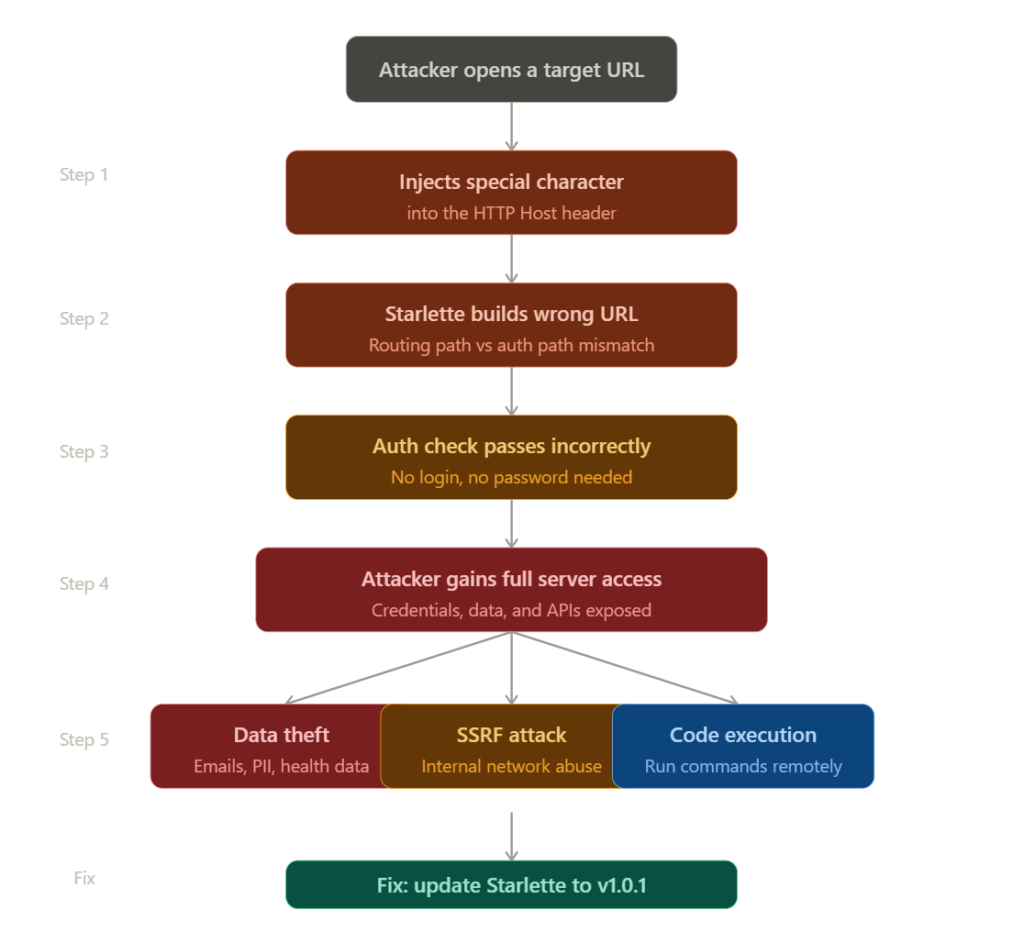
Here’s where it gets interesting — and a little alarming.
The vulnerability, officially tracked as CVE-2026-48710, was nicknamed BadHost by the researchers who found it. And the name is fitting, because the bug lives in how Starlette handles something called the HTTP Host header.
Every time your browser (or an app) talks to a web server, it sends a small piece of information called a Host header — basically just saying “hey, I’m trying to reach this specific address.” Normally, servers validate that value and make sure it’s legitimate. Starlette doesn’t.
The one-character trick that breaks everything
Here’s the wild part: attackers can inject a single special character into that Host header, and Starlette gets confused. It ends up building the wrong URL internally — one that bypasses whatever authentication checks are in place.
So a server that’s supposed to say “you need to log in to access this” ends up saying “sure, come on in” instead. No password needed.
Security researchers from the firm X41 D-Sec, who discovered the flaw, described it plainly: the routing system uses one version of the URL path, but the part of the code that checks authentication looks at a different, manipulated version. Those two things should always match. They don’t.
Which AI Tools Are Affected?
This is where the scope gets genuinely staggering.
Because so many packages depend on Starlette under the hood, BadHost doesn’t just affect Starlette itself. Other major tools caught in the crossfire include:
- FastAPI — one of the most popular frameworks for building AI APIs in Python
- vLLM — a high-performance inference engine for running large language models
- LiteLLM — a unified API layer used to connect to OpenAI, Anthropic, Gemini, and others
- Text Generation Inference — a backend used to serve models at scale
- Various MCP (Model Context Protocol) servers — the backbone that lets AI agents access email, calendars, databases, and third-party accounts
That last one is especially concerning. MCP servers store credentials for all the external services an AI agent can access. Breach one of those, and an attacker potentially gets the keys to a user’s entire digital life — email, cloud storage, even internal company tools.
What Data Is Actually Exposed Right Now?
Researchers ran a scanner across publicly accessible servers and found some genuinely alarming things already sitting open on the internet. Here’s a snapshot of what they found exposed:
- Clinical trial databases from biopharma AI companies
- Live personal identity data from identity verification services
- Full email access — read, send, and delete — via compromised SaaS connectors
- Candidate resumes and hiring data from HR platforms
- AWS cloud infrastructure details including distributed traces and metrics
- SSH access to IoT and industrial devices
- Personal health and finance data including nutrition logs and expense records
This is not a list of hypothetical risks. This is what was found on real, live servers connected to the open internet.
How Easy Is It to Exploit?
Frustratingly easy. Security researchers describe it as “trivial to exploit,” which in security speak means even a moderately skilled attacker can pull it off without needing sophisticated tools or deep expertise.
The attack also works against most servers that aren’t sitting behind a properly configured firewall — which, in practice, describes a lot of development environments, internal tools, and smaller deployments that never expected to be internet-facing targets.
BadHost carries an official severity score of 7 out of 10, but two separate security firms have said that number significantly understates the real-world damage it can cause — especially given how many AI and ML services depend on the affected packages.
What’s the Fix?
The good news: a patch exists. Starlette version 1.0.1, released recently, addresses the vulnerability. If you or your team are running anything that depends on Starlette, the single most important thing you can do right now is update to 1.0.1 or later.
Security firms X41 D-Sec and Nemesis have also published a free online scanner that can check whether a given server is still running a vulnerable version of Starlette. If you’re a developer, sysadmin, or platform engineer, running that scanner on your infrastructure is a good first step even before you upgrade.
What if you can’t update immediately?
If for some reason an immediate update isn’t possible, placing your servers behind a properly configured firewall — one that validates and filters incoming Host headers — can significantly reduce your exposure while you work on a proper fix. But consider that a temporary measure, not a solution.
Why This Matters Beyond Just One Bug
BadHost is a good reminder of something the tech industry often forgets: the AI boom is running on top of software infrastructure that was built fast, not always securely.
Developers and startups racing to ship AI products are reaching for battle-tested open source packages — which is smart! — but they’re also inheriting any security debt those packages carry. When something as foundational as Starlette has a flaw, the damage doesn’t stay contained. It ripples through the entire ecosystem.
This is especially true for AI agents, which by design have access to more external systems and data than a typical web app. An AI assistant that can read your email, check your calendar, and query your database is incredibly useful. It’s also an incredibly valuable target if the server running it isn’t locked down.
Key Takeaways
- BadHost (CVE-2026-48710) is a critical flaw in Starlette, a Python package downloaded 325 million times per week.
- It lets attackers bypass authentication with a single character injected into an HTTP header.
- Affected tools include FastAPI, vLLM, LiteLLM, and many MCP servers used by AI agents.
- Real-world scanners have already found live servers leaking sensitive data including emails, health records, and cloud credentials.
- The fix is to update Starlette to version 1.0.1 immediately.
- Use the free scanner from X41 D-Sec and Nemesis to check your servers.
FAQ
Q: I’m not a developer — should I be worried about BadHost? A: If you use AI-powered tools or services (think AI assistants, productivity apps with AI features, or business tools using AI agents), there’s a chance the service you’re using runs on vulnerable infrastructure. The best thing you can do is check with the providers of those tools and ask if they’ve patched. Most reputable companies will update quickly.
Q: How do I know if a tool I use depends on Starlette? A: If you’re a developer, check your requirements.txt or pyproject.toml for Starlette, FastAPI, vLLM, or LiteLLM as dependencies. If you’re an end user, you’d need to ask the vendor directly. When in doubt, ask.
Q: Is this being actively exploited right now? A: Security researchers have confirmed that vulnerable servers are publicly accessible and exposing real data. Whether attackers are actively exploiting BadHost specifically in the wild has not been fully confirmed, but given how trivial the exploit is, the window to act is narrow. Update now, ask questions later.
Conclusion
BadHost isn’t just another bug report that gets lost in the weekly noise of CVE disclosures. It’s a stark illustration of how fragile the foundation of the AI ecosystem can be — and how quickly a single overlooked flaw in a deeply embedded package can put millions of services at risk.
The fix is straightforward. Update Starlette, run the scanner, and verify your infrastructure. But the broader lesson is one the entire industry should take seriously: as AI agents get more powerful and more connected, securing the pipes they run through becomes just as important as training the models themselves.