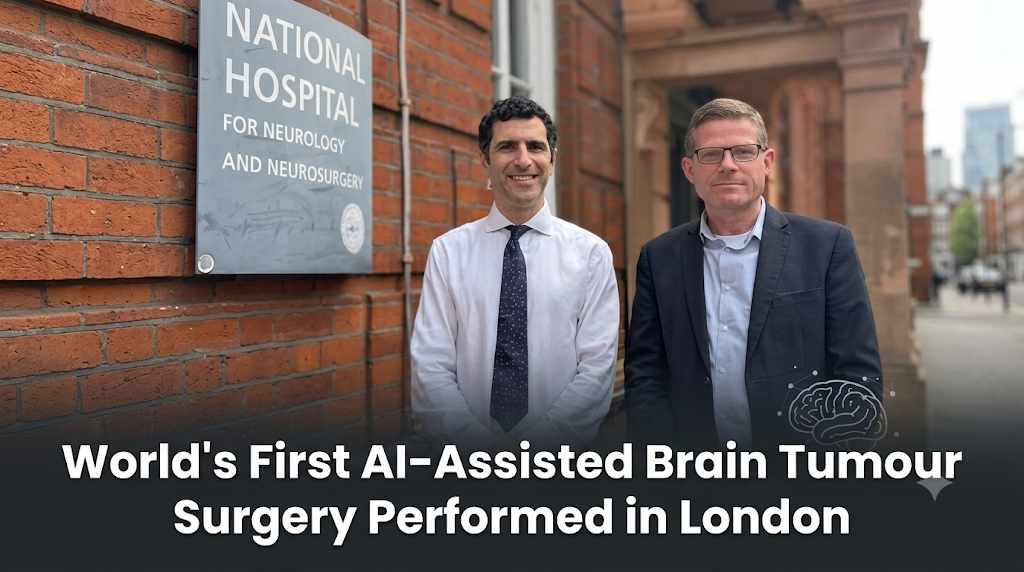
A team of neurosurgeons in London has carried out what is being described as the world’s first successful brain tumour surgery assisted by artificial intelligence, restoring a patient’s eyesight in the process.
The procedure took place in May at the National Hospital for Neurology and Neurosurgery (NHNN), a facility within University College London Hospitals NHS Foundation Trust. News of the operation was withheld until this week to allow the patient time to recover.
The patient, 48-year-old Rhys Hibbert from Bedfordshire, had been living with a small tumour — just 11mm across — on his pituitary gland since his diagnosis in 2024. He was initially treated without surgery, but his condition deteriorated over time, bringing on serious hormonal disruption and worsening vision. Left untreated, doctors warned, he was at risk of losing his sight entirely.
Following the operation, Hibbert’s recovery was rapid. He regained full clarity of vision and was walking unaided — without glasses or a cane — within a week. He has since gone back to his job as a customer service manager and says his visual field now feels remarkably wide and clear.
He noted the symbolism of the achievement taking place at NHNN, which holds the distinction of being the first hospital in the world purpose-built for neurosurgery, dating back to 1859.
How the AI Was Used
During the operation, surgeons stayed fully in charge of every decision and every movement. What was new was a supporting AI system that processed the live video feed from the surgical camera in real time, flagging delicate structures — nerves, blood vessels and other critical anatomy — that needed to be steered clear of near the tumour site. The system marks these structures with color-coded overlays so the surgical team can spot them instantly.
This region of the brain is notoriously unforgiving: the pituitary gland sits close to blood vessels and the nerves responsible for vision, and even a millimetre of deviation can lead to blindness, stroke, or worse.
The technology had previously only been tested in research settings. This marked its debut use on an actual patient.
Dr. Sophia Bano of UCL, who leads the technical side of the project, explained that the system was trained on a large library of recorded surgeries — giving it exposure to a volume of surgical scenarios that would take a human surgeon a career to accumulate. She said the goal is for it to assist in spotting critical anatomy, instruments, and tissue interactions as they happen, giving surgeons an extra layer of support during high-stakes procedures.
Part of a Wider Trial
The surgery was carried out as part of a clinical trial funded by the National Institute for Health and Care Research (NIHR). Prof. Mike Lewis, the NIHR’s scientific director for innovation, called it a pioneering step that demonstrates how advanced AI tools can support — rather than replace — skilled surgeons, with the aim of improving outcomes for patients.