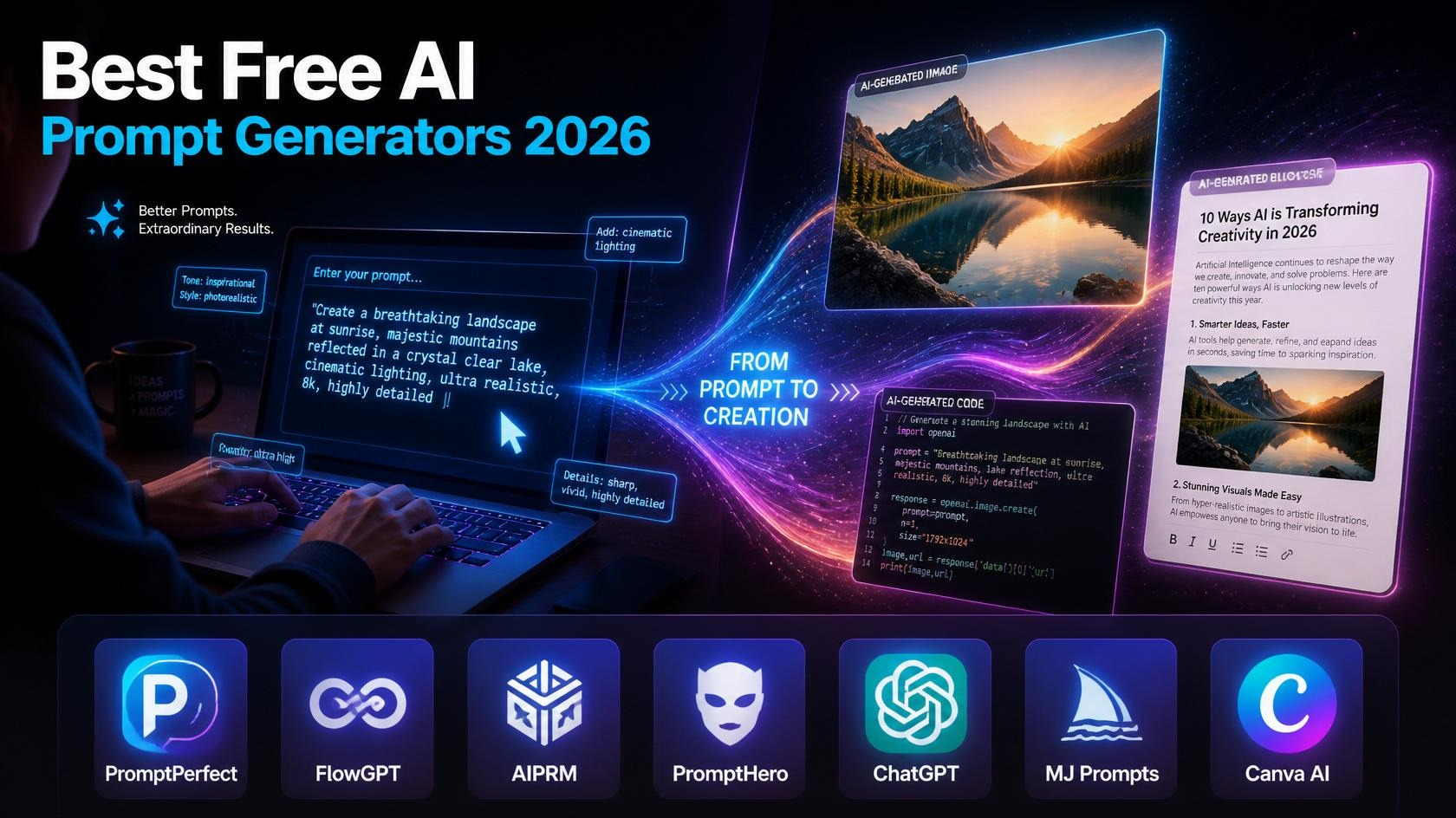
An AI prompt generator is a tool that helps you write better instructions for AI systems like ChatGPT, DALL·E, Midjourney, Stable Diffusion, and others. Think of it this way: AI models are incredibly powerful, but they respond to what you tell them. If you give vague instructions, you get vague results. If you give precise, well-structured prompts, you get outputs that genuinely blow you away. Prompt generators either:
- Enhance your prompt — Take your rough idea and rewrite it in a way the AI understands better
- Build prompts from templates — Give you a proven structure to fill in
- Suggest prompts from a library — Show you what’s working for other users
- Optimize prompts for specific AI tools — Since ChatGPT, Midjourney, and Stable Diffusion all respond differently
We’ve tested and reviewed the best free AI prompt generators in 2026, so you can stop guessing and start getting results that actually impress you.
Let’s get into it.
Table of Contents
- What Are AI Prompt Generators?
- How Do AI Prompt Generators Work?
- Why Prompt Engineering Actually Matters
- Benefits of Using AI Prompt Generators
- Best Free AI Prompt Generators in 2026
- PromptPerfect
- FlowGPT
- AIPRM
- PromptHero
- ChatGPT (Self-Prompting Method)
- Midjourney Prompt Generator
- Canva AI Prompt Tools
- Originality.ai Prompt Helper
- AI Prompt Tools for Image Generation
- Prompt Tools for Students and Marketers
- Free vs. Paid AI Prompt Tools — What’s the Difference?
- Tips for Creating Better AI Prompts
- FAQ
- Conclusion
1. What Are AI Prompt Generators?
An AI prompt generator is a tool that helps you write better instructions for AI systems like ChatGPT, DALL·E, Midjourney, Stable Diffusion, and others.
Think of it this way: AI models are incredibly powerful, but they respond to what you tell them. If you give vague instructions, you get vague results. If you give precise, well-structured prompts, you get outputs that genuinely blow you away.
Prompt generators either:
- Enhance your prompt — Take your rough idea and rewrite it in a way the AI understands better
- Build prompts from templates — Give you a proven structure to fill in
- Suggest prompts from a library — Show you what’s working for other users
- Optimize prompts for specific AI tools — Since ChatGPT, Midjourney, and Stable Diffusion all respond differently
They’re essentially translators between your idea and what the AI needs to hear.
2. How Do AI Prompt Generators Work?
Most prompt generators use one of two approaches:
Template-based systems work like fill-in-the-blank forms. You choose a category (e.g., “write a blog post”), fill in a few details (topic, tone, audience), and the tool assembles a structured prompt proven to work well with AI models.
AI-powered enhancers use their own language model to analyze your rough prompt and rewrite it with better context, specificity, and structure. Tools like PromptPerfect fall into this category — they literally use AI to improve your AI prompts.
For image generation specifically, prompt tools add style descriptors, lighting terms, camera angles, and artistic references that dramatically change the quality of outputs from tools like Midjourney or DALL·E.
The result in both cases? You spend less time trying to figure out why the AI isn’t understanding you, and more time actually using the outputs.
3. Why Prompt Engineering Actually Matters
Prompt engineering has gone from a niche skill to one of the most valuable digital competencies you can have in 2026. Here’s why:
- AI is only as good as your instructions. A poorly written prompt gives you a generic, off-target result. A well-crafted one gives you something publication-ready.
- It saves time. Instead of going back and forth with an AI for 10 iterations, a good prompt gets you there in one or two tries.
- It applies to every AI tool. Whether you’re using ChatGPT for writing, Midjourney for images, GitHub Copilot for code, or Gemini for research — better prompts mean better results everywhere.
- It’s a competitive advantage. Marketers, developers, and creators who write good prompts consistently outperform those who don’t, because they extract more value from the same tools.
- It’s a learnable skill — and prompt generator tools make it significantly easier to learn.
4. Benefits of Using AI Prompt Generators
Here’s what you actually gain by using dedicated prompt tools:
- Faster outputs — Stop wasting time rewriting bad prompts; get it right the first time
- Better quality results — Structured prompts consistently outperform casual ones
- Learning by example — Seeing well-crafted prompts teaches you to write better ones yourself
- Access to expert templates — Prompts written by professional prompt engineers, available for free
- Tool-specific optimization — Some prompts work great for ChatGPT but need adjustment for Claude or Gemini
- Consistency — Maintain a consistent output style across all your AI-generated content
- Great for teams — Share prompt libraries so your whole team gets consistent AI results
5. Best Free AI Prompt Generators in 2026
Here are the top tools, reviewed honestly with real details on features, pricing, and what each one is best for.
1.PromptPerfect
PromptPerfect is one of the most sophisticated and genuinely impressive prompt optimization tools available today — and it’s built by Jina AI, a serious AI research company with deep expertise in language models.
Here’s the core problem it solves: most people write prompts the way they’d send a text message — casual, vague, and missing all the context that AI models actually need to produce great results. PromptPerfect bridges that gap automatically. You paste in your rough, half-formed prompt idea, tell it which AI model you’re targeting, and it rewrites the entire thing using best-practice prompt engineering principles — in seconds.
What makes it stand out from simple template tools is that it doesn’t just fill in a blank structure. It actually analyzes your specific request and enhances it intelligently — adding specificity, context, formatting instructions, and the right vocabulary for the target model. It even has a prompt debugging mode that tells you why a prompt isn’t working and what to change, which is something no other free tool currently offers at this level.
Whether you’re crafting a detailed ChatGPT prompt for a marketing campaign, building an intricate Midjourney visual prompt for AI art, or trying to get cleaner outputs from Stable Diffusion — PromptPerfect handles all of it from one clean interface. It’s like having a professional prompt engineer on call, 24/7, for free.
Key Features:
- Multi-model prompt optimization (ChatGPT, GPT-4, Midjourney, Stable Diffusion, Cohere)
- Auto-optimize toggle that instantly rewrites your prompt
- Prompt debugging — identifies why a prompt isn’t performing
- Side-by-side comparison of original vs. optimized prompt
- API access for developers
- Prompt history and saved prompts
Pros:
- Genuinely improves prompt quality with AI assistance
- Works across multiple models, not just ChatGPT
- Clean, intuitive interface
- Teaches you good prompt structure through examples
- Great for both text and image prompts
Cons:
- Free plan has limited daily optimizations
- Some advanced debugging features require paid plan
- Optimization quality varies by niche/topic
Pricing: Free plan with limited daily usage. Pro plan from $9.99/month.
Best Use Case: Writers, marketers, and developers who want to consistently get better outputs from any AI tool — without guessing.
Beginner Friendly: ⭐⭐⭐⭐⭐ — Very easy to use; just paste your prompt and click optimize.
2.FlowGPT
FlowGPT is something genuinely different from the other tools on this list — and once you spend five minutes on it, you’ll understand why it has millions of active users.
Rather than building a prompt for you from scratch, FlowGPT gives you access to a massive, constantly growing library of prompts that real people have already written, tested, and refined. Think of it like a GitHub for AI prompts — a community-driven platform where the best prompts rise to the top through upvotes, usage stats, and community engagement.
The breadth of what’s available here is staggering. Need a prompt that turns ChatGPT into a professional copywriter? There are hundreds. Want a prompt that makes it act as a strict code reviewer, a therapy-style journaling coach, a Socratic debate partner, or a meal plan generator for specific dietary needs? All there, ready to use in one click. The categories span everything from coding, marketing, education, and business to creative writing, productivity, gaming, and beyond.
What makes FlowGPT especially valuable for beginners is that you learn by reading. Browsing high-quality prompts trains your eye for what good prompting looks like — the structure, the specificity, the way roles and constraints are defined. You’re not just borrowing prompts; you’re absorbing the logic behind them. And with the in-platform chat feature, you can test any prompt without even leaving the site. For completely free access to a world-class prompt library, FlowGPT is genuinely hard to beat.
Key Features:
- Massive library of community-shared prompts
- Categories: writing, coding, marketing, education, creativity, business
- Upvoting system so the best prompts rise to the top
- In-platform AI chat to test prompts immediately
- “Remix” prompts to customize them for your use case
- Creator profiles and follower system
- Regular trending prompts feed
Pros:
- Completely free to browse and use
- Huge variety of use cases covered
- Community-vetted prompts save enormous time
- Great for discovering prompts you’d never think of yourself
- In-platform testing means you don’t need to switch tabs
Cons:
- Quality varies — some community prompts are better than others
- Interface can feel cluttered
- No AI-powered optimization of your custom prompts
Pricing: Free. Premium membership available for additional features.
Best Use Case: Anyone who wants a ready-made library of proven prompts for ChatGPT — especially beginners who don’t know where to start.
Beginner Friendly: ⭐⭐⭐⭐⭐ — Browse, pick, and use. As simple as it gets.
3.AIPRM for ChatGPT
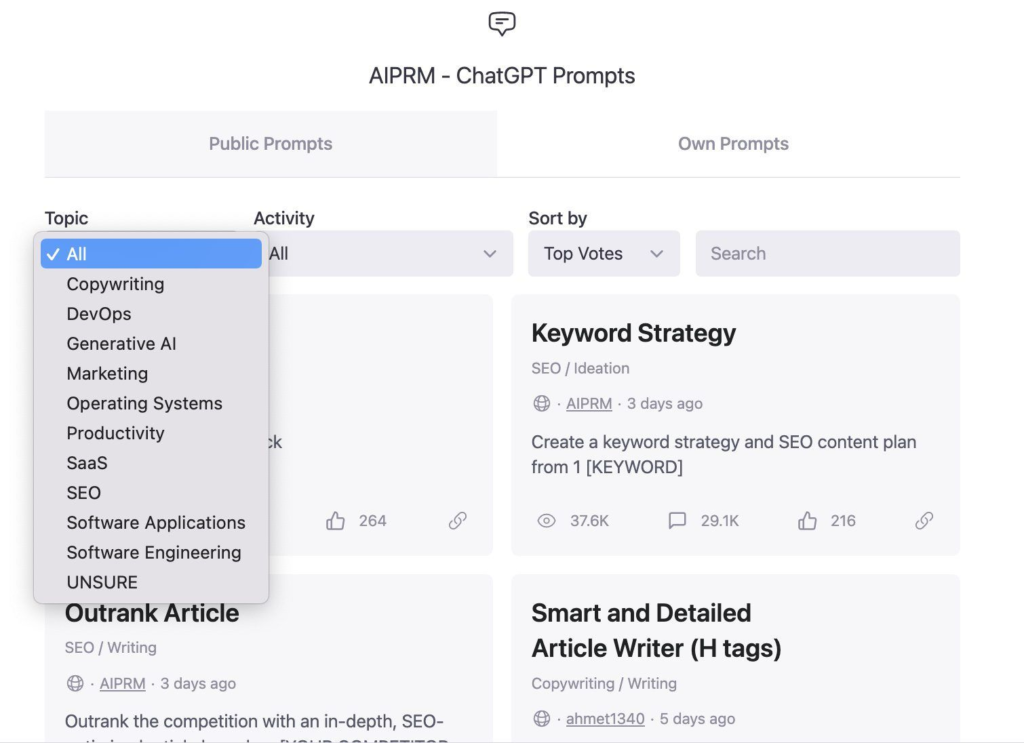
AIPRM takes a brilliantly simple approach to prompt engineering: instead of making you go to a separate website, it brings the prompt library directly inside ChatGPT itself. Install it as a Chrome extension and the next time you open ChatGPT, you’ll find a completely transformed interface — with thousands of curated, professional-grade prompt templates organized by category, all accessible in a single click.
This tool has become an absolute staple for digital marketers, SEO professionals, and content writers — and the reason is obvious the moment you start using it. Instead of spending time crafting the perfect SEO content brief prompt from scratch, you pick the “Human Written | 100% Unique SEO Optimized Article” template (one of AIPRM’s most popular), customize a couple of fields, and you’re off. The same applies to everything from technical writing and email campaigns to software documentation and customer support scripts.
What really sets AIPRM apart is the quality filtering. These aren’t random prompts scraped from forums — many are created by professional marketers, developers, and UX writers who understand their craft deeply. The top-rated prompts have been used and refined by thousands of people, which means when you’re picking a highly-rated template, you’re essentially getting the collective wisdom of the community baked into your workflow. For anyone who creates content professionally or runs any kind of digital marketing operation, AIPRM is one of those rare tools that pays for itself in time saved within the first week.
Key Features:
- 4,000+ curated prompt templates inside ChatGPT
- Categories: SEO, copywriting, software engineering, marketing, productivity
- One-click prompt insertion
- Public and private prompt lists
- Team sharing functionality
- Custom tone, writing style, and language settings
- Regular updates with new community prompts
Pros:
- Works directly inside ChatGPT — no switching platforms
- Huge library of marketing and SEO-specific prompts
- One-click use makes it incredibly fast
- Free tier is genuinely useful
- Great for content marketing workflows
Cons:
- Only works with ChatGPT (not other AI tools)
- Some best templates locked behind paid plan
- Requires browser extension installation
Pricing: Free plan with access to public prompts. Plus plan from $9/month for private lists and team features.
Best Use Case: Content marketers, SEO professionals, copywriters, and anyone who lives inside ChatGPT for work.
Beginner Friendly: ⭐⭐⭐⭐ — Easy once installed, but Chrome extension setup may feel unfamiliar to some beginners.
4. PromptHero
PromptHero solves one of the most frustrating problems in AI image generation: you can see a stunning AI image on social media and have absolutely no idea how to recreate anything close to it. What model was used? What style keywords made it look like that? What camera settings, lighting descriptors, or artistic references were in the prompt?
PromptHero answers all of those questions — for millions of images, completely for free.
It’s a searchable gallery of AI-generated artwork where every single image comes with its full, unedited prompt displayed right below it. Every style choice, every modifier, every technical parameter is laid bare. You can search by aesthetic (cyberpunk, soft watercolor, dark academia, hyperrealistic), by subject (portraits, architecture, fantasy creatures, product mockups), or by the AI model used (Midjourney, Stable Diffusion, DALL·E, and more). Each result shows you exactly what words and structure created that specific visual outcome.
For anyone learning AI image generation, this is genuinely the fastest way to develop prompt intuition. You’re not just copying prompts — you’re studying patterns. You start to notice that “bokeh,” “f/1.4,” and “shallow depth of field” consistently create that blurry background look. You learn that “in the style of [artist name]” dramatically changes the aesthetic. You discover that adding “cinematic lighting, golden hour, 8K, highly detailed” to almost any prompt makes it look dramatically more polished. PromptHero is essentially a masterclass in AI image prompting, disguised as a search engine.
Key Features:
- Searchable gallery of millions of AI images with full prompts
- Filters by model: Midjourney, Stable Diffusion, DALL·E, ChatGPT
- Prompt search by style, subject, or aesthetic
- “Prompter” profiles showing top community contributors
- Model-specific prompt breakdowns
- Bookmarking and collections
Pros:
- Learn exactly what prompts create specific visual styles
- Completely free to browse
- Constantly updated with new community images
- Incredibly useful for learning AI image prompt structure
- Great visual inspiration tool
Cons:
- Primarily for image generation, not text AI
- No prompt optimization or enhancement features
- Some prompts are extremely long and complex for beginners
Pricing: Free to browse. Pro plan available for additional features.
Best Use Case: Digital artists, designers, and content creators who want to master AI image generation prompts.
Beginner Friendly: ⭐⭐⭐⭐ — Very browsable; complex prompts may intimidate at first but become clear quickly.
5. ChatGPT — The Self-Prompting Method
Here’s a technique most people walk right past, even though it’s one of the most powerful prompt tools available — and it costs absolutely nothing extra: ChatGPT itself is an outstanding prompt generator when you know how to ask it to be one.
The logic is beautifully circular. ChatGPT knows exactly what kinds of instructions produce the best outputs from models like itself. It’s been trained on enormous amounts of prompt engineering literature, AI documentation, and human feedback that explicitly rewards well-structured, detailed, high-quality responses. So when you ask it to write or refine a prompt, it draws on all of that knowledge to give you something far more effective than you’d write on your own.
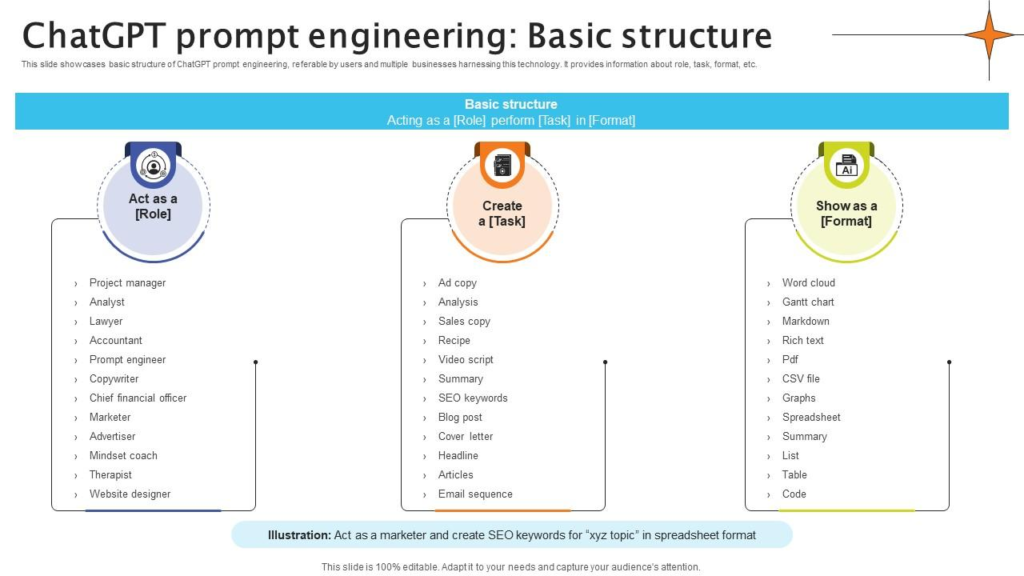
The basic technique is this: instead of using ChatGPT to complete a task directly, first use it to design the perfect prompt for that task — then use that prompt. For example, type: “Act as an expert prompt engineer. Write me the most effective possible ChatGPT prompt to help me create a detailed social media content calendar for a fitness brand targeting women aged 25–40.” ChatGPT will return a prompt that’s structured with roles, context, constraints, format instructions, and examples — everything a great prompt needs.
You can take this even further. Ask it to write prompts specifically optimized for other AI tools: “Write me a Midjourney prompt for a photorealistic image of a modern Japanese café interior at night.” Or ask for variations: “Give me 5 versions of this prompt ranging from minimal to highly detailed.” The meta-prompting rabbit hole goes deep — and every step of it is free, available right now, and gets better the more specific you are.
Key Features:
- Generate prompts for any AI tool
- Ask it to write prompts for Midjourney, DALL·E, Claude, etc.
- Request variations (“give me 5 versions of this prompt”)
- Ask for explanations of why certain prompts work better
- Completely free on the standard tier
Pros:
- Zero additional tools required
- Highly customizable
- Works for any AI platform or task
- Free to use
Cons:
- Requires some back-and-forth to get the best results
- Free tier has usage limits
- Quality depends on how well you frame the meta-request
Pricing: Free (with limits). ChatGPT Plus $20/month.
Best Use Case: Anyone who wants prompt improvement without installing extra tools.
Beginner Friendly: ⭐⭐⭐⭐ — Simple concept; just takes practice to frame the request well.
6.Midjourney Prompt Generator Tools
For Midjourney specifically, several dedicated prompt builder tools have emerged. The most useful ones include:
- MidJourney Prompt Helper — Visual interface where you choose style, mood, lighting, and camera settings to build a complete Midjourney prompt
- Promptomania — Detailed prompt builder for Midjourney and Stable Diffusion with visual previews
- Krea.ai — Real-time AI image generation with built-in prompt suggestions
Best Use Case: Artists, designers, and content creators who want polished Midjourney images without spending hours learning prompt syntax.
Beginner Friendly: ⭐⭐⭐⭐⭐ — Visual builders make the process intuitive even for complete beginners.
7.Canva AI Prompt Tools
Canva’s AI features include a built-in text-to-image generator with a guided prompt interface. For creators who already design in Canva, this is the most seamless way to generate AI images — the prompt tool helps you build your request with style suggestions and example outputs.
Key Features:
- Guided prompt building with style suggestions
- Magic Write for text generation in designs
- Dream Lab image generator with prompt examples
- Built directly into the design workflow
Pros:
- No switching between platforms
- Prompt suggestions make it very beginner-friendly
- Generated images slot directly into designs
- Free plan available
Cons:
- Less powerful than dedicated prompt tools
- Limited customization vs. Midjourney or DALL·E
- AI credits limited on free plan
Pricing: Free plan available. Canva Pro $15/month for unlimited AI features.
Best Use Case: Social media creators and marketers who want prompt-assisted image generation directly inside their design tool.
Beginner Friendly: ⭐⭐⭐⭐⭐
8. Originality.ai Prompt Helper
Originality.ai is primarily known as an AI content detection tool, but its prompt helper feature assists content creators and marketers in generating optimized prompts for producing original, human-like content with AI. It’s particularly useful for writers who need to stay on the right side of AI detection while still using AI tools.
Key Features:
- Prompt templates for creating original-sounding content
- Focus on avoiding over-reliance on AI patterns
- Content detection + prompt refinement in one platform
- SEO-focused prompt suggestions
Pros:
- Unique focus on originality and content quality
- Helpful for bloggers and content marketers
- Combines detection and generation guidance
- Useful for understanding what makes AI content sound human
Cons:
- Primary product is detection, not prompt generation
- Fewer prompts than dedicated libraries
- Best value for professional content teams
Pricing: Free trial available. Paid plans from $14.95/month.
Best Use Case: Content marketers, SEO writers, and agencies who need AI-assisted content that reads naturally and passes quality checks.
Beginner Friendly: ⭐⭐⭐ — More useful for intermediate to advanced content creators.
6. AI Prompt Tools for Image Generation
If your main goal is generating better images with tools like Midjourney, DALL·E, or Stable Diffusion, here’s a quick guide to what makes image prompts different:
Effective image prompt structure: [Subject] + [Setting/Environment] + [Style/Medium] + [Lighting] + [Camera/Composition] + [Quality modifiers]
Example: “A lone astronaut standing on Mars at golden hour, surrounded by red rocky terrain, painted in the style of a vintage 1970s science fiction paperback cover, warm cinematic lighting, wide-angle lens, highly detailed, 8K”
Best tools specifically for image prompts:
- PromptHero — Browse real prompts for real results
- Midjourney Prompt Helper — Build visually with sliders and dropdowns
- Promptomania — Detailed builder for multiple image AI tools
- DALL·E in ChatGPT — Ask ChatGPT to write your image prompt
7. Prompt Tools for Students and Marketers
For students, the best prompt tools are ones that help with research, essay structuring, summarization, and study materials:
- AIPRM — Has academic writing and research prompt templates
- FlowGPT — Search “study,” “essay,” or “homework help” for proven prompts
- ChatGPT self-prompting — Ask it to be your tutor, study partner, or essay reviewer
For marketers, focus on tools with business and content templates:
- AIPRM — Best-in-class for SEO, copywriting, and content marketing prompts
- PromptPerfect — Optimizes marketing prompts for better copy output
- FlowGPT — Great for ad copy, email sequences, and social media prompts
- Canva AI — For social graphics with AI-assisted visual prompts
8. Free vs. Paid AI Prompt Tools
Here’s a straight comparison to help you decide:
Free tools are perfect when you:
- Are just starting out and learning prompt engineering
- Need occasional help (not daily professional use)
- Want to browse community prompt libraries
- Use ChatGPT’s self-prompting technique
Paid tools are worth it when you:
- Use AI tools daily for professional work
- Need unlimited prompt optimizations
- Want private prompt libraries for your team
- Require consistent, high-quality marketing or SEO outputs
Best completely free options: FlowGPT, PromptHero, AIPRM free tier, ChatGPT self-prompting Best value paid tools: PromptPerfect Pro ($9.99/mo), AIPRM Plus ($9/mo)
9. Tips for Creating Better AI Prompts
Here are the most impactful habits to develop:
1. Be specific about the format you want. Instead of “write a blog post about SEO,” try “write a 1,200-word beginner-friendly blog post about on-page SEO, with H2 headings, bullet points, and a conversational tone.”
2. Give context and a role. “Act as an experienced digital marketing consultant with 10 years of experience. Write a…”
3. Specify your audience. “Write this for a 25-year-old first-time homebuyer with no financial background.”
4. Use examples. “Write a product description in the style of this example: [paste example]”
5. State what you don’t want. “Don’t use jargon. Avoid lists. Don’t start with ‘In today’s world.'”
6. Break complex tasks into steps. Instead of one massive prompt, use a series of focused prompts that build on each other.
7. Ask for options. “Give me 5 different versions of this headline, ranging from professional to playful.”
8. Iterate deliberately. After each output, tell the AI exactly what to change rather than starting over from scratch.
FAQ
Q1: What is the best free AI prompt generator for beginners?
FlowGPT is the easiest starting point — it’s a free community library of ready-to-use prompts across every category. You don’t need to write anything; just browse, pick a prompt, and paste it into ChatGPT. AIPRM is a close second for anyone who creates content or does SEO work.
Q2: Do AI prompt generators actually improve results?
Yes, measurably so. A well-structured prompt can be the difference between a generic two-paragraph response and a detailed, perfectly formatted output that saves you an hour of editing. Tools like PromptPerfect have shown significant improvements in output quality simply by restructuring how a request is phrased.
Q3: Is prompt engineering a skill worth learning in 2026?
Absolutely. Prompt engineering has become one of the most in-demand digital skills across content creation, marketing, software development, and research. Even basic prompt skills dramatically improve how much value you extract from AI tools every day — and dedicated prompt generators help you learn those skills faster.
Q4: Can I use AI prompt generators for free forever?
Most tools offer a meaningful free tier — FlowGPT and PromptHero are completely free to browse, AIPRM’s free plan gives access to public prompt templates, and ChatGPT’s self-prompting method costs nothing. For heavy professional use, paid plans offer more flexibility, but beginners can get enormous value without spending anything.
Q5: Are there AI prompt generators specifically for Midjourney and image AI?
Yes — PromptHero and Promptomania are both built specifically for image generation prompts. Midjourney Prompt Helper (noonshot.com) is a visual builder that creates complete Midjourney prompts without needing to know any syntax. These are especially useful because image prompts have a very different structure from text prompts.
The Future of AI Prompt Engineering
We’re standing at a genuinely fascinating moment in the evolution of human-computer interaction.
For decades, using computers meant learning their language — commands, code, syntax. Then graphical interfaces made computers more intuitive. Now, AI is doing something even more radical: making computers understand our language, in all its nuance and imprecision.
But here’s the thing — we’re not quite at the point where AI perfectly reads our minds. The best results still go to people who know how to communicate clearly and specifically with AI systems. That’s exactly why prompt engineering, and the best free AI prompt generators that support it, have become so valuable.
Tools like PromptPerfect, AIPRM, FlowGPT, and PromptHero are genuinely lowering the barrier to great AI outputs. They’re teaching users good habits, sharing community knowledge, and making the learning curve far less steep.
But the horizon looks even more exciting. The next generation of AI tools will understand context across long conversations, learn your personal communication style over time, and require increasingly less “engineering” to produce great results. Prompt generators themselves will become smarter — anticipating what you need and optimizing in real time.
Until that future fully arrives, the creators, students, marketers, and builders who master prompting will have a real edge. They’ll get more done, produce better work, and extract more value from the same AI tools everyone else is using.
The good news? You don’t need to be a technical expert to start. Pick one tool from this list, try it today, and notice the difference in your outputs.
The best AI prompt isn’t written by a machine. It’s written by a curious human who knows what they want — and has learned how to ask for it.