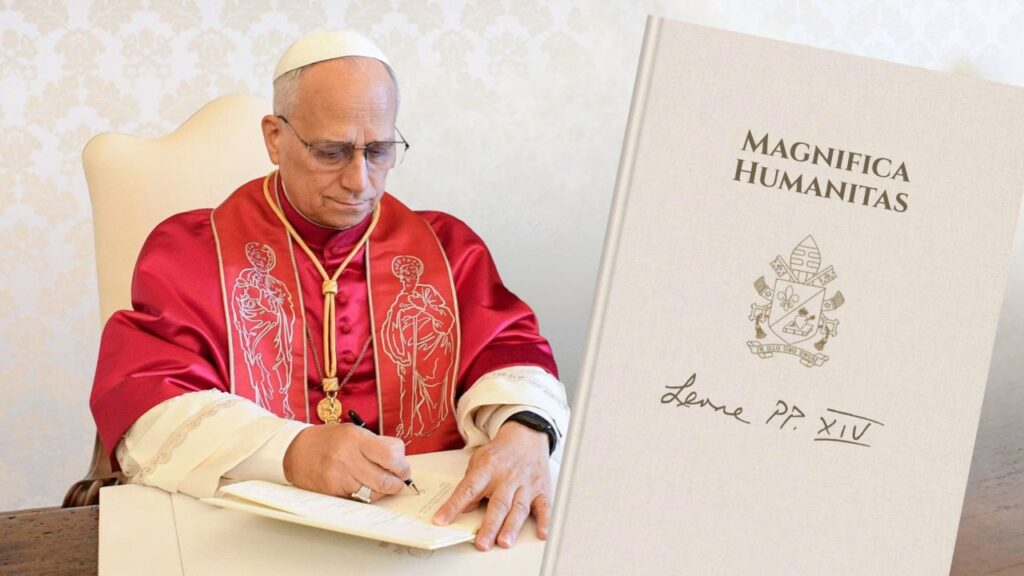
Pope Leo XIV made history this week by releasing his first major papal document, Magnifica Humanitas, which translates to “Magnificent Humanity.” On the surface, it’s about artificial intelligence. But read deeper, and it’s a sweeping call to protect ordinary people from those who hold enormous technological — and therefore social — power.
The 200-page encyclical, presented alongside Anthropic co-founder Chris Olah at the Vatican on May 25, argues that when powerful technology is built and controlled by a small group of people, it can never truly serve everyone. “When such power is concentrated in the hands of a few, it tends to become opaque and evade public oversight,” Leo writes, warning of new forms of inequality, manipulation, and exclusion that follow.
Not Just About AI
What makes this document remarkable is its honesty about what’s really at stake. Pope Leo draws a direct line from today’s AI race back to the Industrial Revolution — and to Pope Leo XIII’s landmark 1891 letter, Rerum Novarum, which addressed the same concentration of wealth and power in a different era. The problems aren’t new. The scale is.
The encyclical calls out how AI tends to amplify the advantages of those who already have resources, expertise, and access to data — allowing elites to shape what people read, how they vote, and how markets move. Notre Dame Law professor Paolo Carozza, who is also chair of the Meta Oversight Board, echoed this concern, noting that AI-driven misinformation has “corroded our capacity to recognize what’s true,” with serious consequences for democracy.
A Call to Slow Down — and Think
Pope Leo isn’t anti-technology. He’s anti-recklessness. He specifically calls for an end to the AI arms race — the relentless push by companies and governments to build bigger, more powerful systems in pursuit of dominance. “To disarm means discrediting the assumption that technical power automatically confers the right to govern,” he writes.
His vision is grounded in human dignity: AI development should involve the communities it affects, be guided by clear oversight, and always keep human conscience at the center. He warns against what he calls the “Babel syndrome” — the dangerous illusion that everything, including human experience, can be reduced to data and performance metrics.
Why It Matters Now
The encyclical arrives at a charged political moment. Just days earlier, President Trump reportedly delayed signing an executive order that would have required government oversight of new AI models before release — a decision linked to pressure from tech investors. Leo’s message lands as a counter-narrative: accountability isn’t the enemy of innovation. It’s the condition for innovation that actually benefits people.
For anyone — religious or not — who worries about unchecked technological power, the Pope’s letter is a clear, thoughtful, and timely reminder: the question was never just what AI can do. It’s who it does it for.