
OpenAI’s Codex began 2026 as a capable AI coding assistant. By mid-year, it had transformed into something much bigger: a full-blown AI work agent platform that can plan tasks, run parallel workflows, fix security vulnerabilities, and now serve knowledge workers who’ve never written a line of code in their lives.
That shift isn’t just a product update. It’s a signal of where the entire US AI technology industry is headed — toward a world where AI doesn’t just assist workers, but autonomously handles chunks of their jobs.
For US tech companies, enterprise software buyers, and the millions of developers who depend on these tools every day, understanding what Codex has become in 2026 is no longer optional. It’s essential.
What Is OpenAI Codex? A Quick Refresher
If you only know Codex as the model that powered early versions of GitHub Copilot back in 2021, it’s time for an update. That original Codex was deprecated in 2023. The product that carries its name today is an entirely different beast.
The modern Codex — relaunched as a cloud research preview in May 2025 — is an AI coding agent built on OpenAI’s most advanced reasoning models. Rather than just completing lines of code as you type, it reads entire codebases, understands context across multiple files, executes shell commands, runs tests, and submits pull requests for human review.
In short, it works the way a junior software engineer works: given a task, it figures out a plan, executes it step by step, checks its own output, and hands you the result.
🔗 Learn more: OpenAI’s official Codex documentation
What Changed in 2026: The Agent Era Begins
The pace of Codex’s evolution in 2026 has been striking, even by Silicon Valley standards.
February 2026 brought the release of a dedicated desktop Codex app for macOS, later extended to Windows. The app was explicitly designed to manage multiple AI agents running simultaneously — a clear sign OpenAI was moving beyond single-task completions toward longer, parallel workstreams.
That same month, OpenAI upgraded the underlying model twice in a single week. GPT-5.3-Codex arrived first, followed by GPT-5.3-Codex-Spark — a lower-latency variant that reportedly ran about 15 times faster than earlier Codex versions, thanks to being the first production model deployed on Cerebras hardware.
March 2026 saw OpenAI launch Codex Security — a dedicated agent for finding and fixing software vulnerabilities. It wasn’t just a scanner. It analyzed code repositories, tested potential flaws in a sandbox to rule out false positives, ranked findings by real-world severity, and proposed specific code fixes that developers could push directly to production.
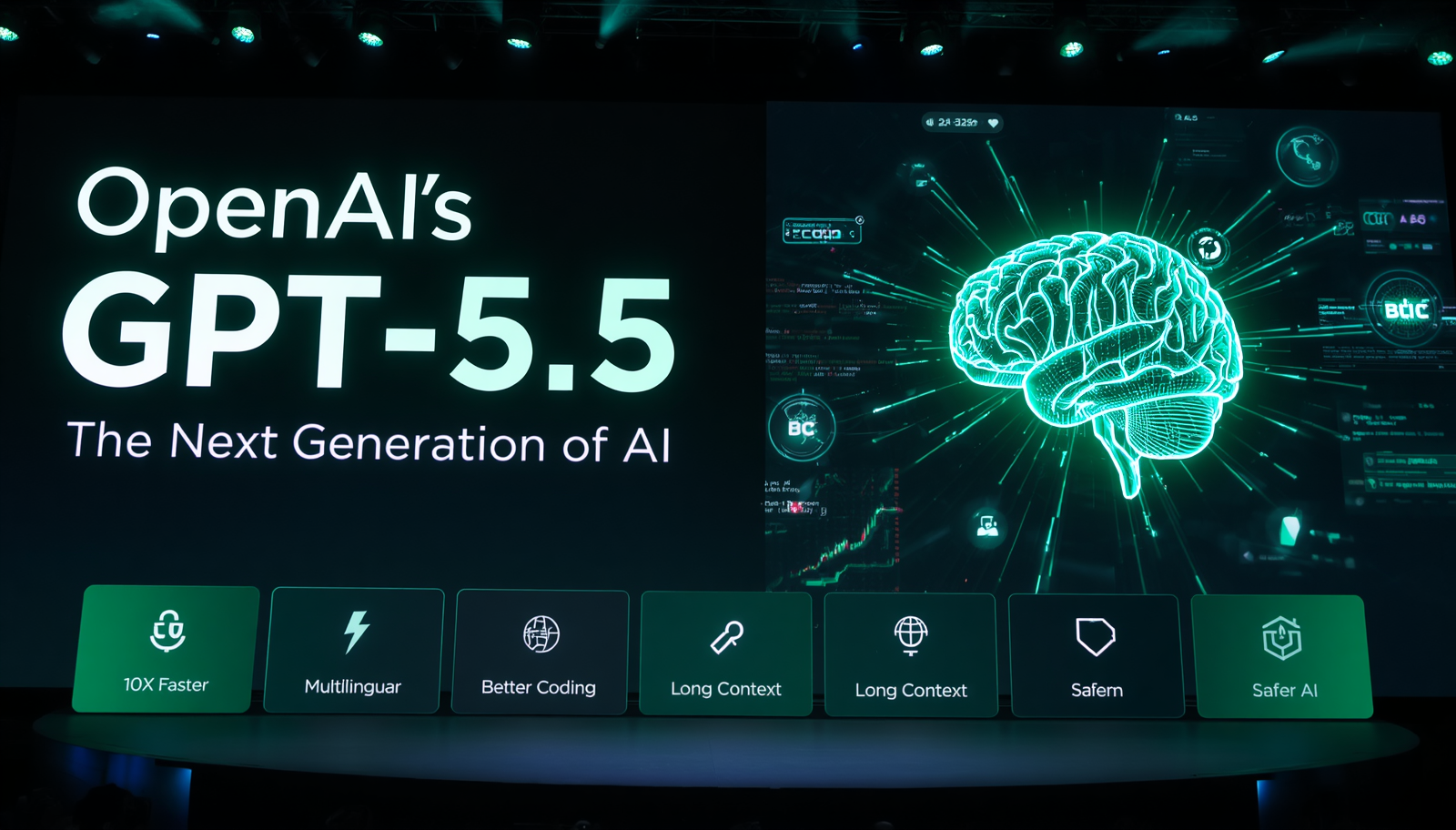
April 2026 marked the arrival of GPT-5.5 as the recommended model powering Codex, alongside persisted “goals” that let agents run across longer sessions without losing context. Industry analysts flagged this as the moment Codex formally crossed from a coding tool into an agentic work platform.
By June 2026, OpenAI had launched six role-specific plugins — covering data analytics, creative production, sales, product design, equity investing, and investment banking — along with a new feature called Codex Sites, which lets the agent output its work as a fully deployed, hosted web application.
Key Features of OpenAI Codex as a Full AI Work Agent
Here’s what the platform can do as of mid-2026:
- Parallel agent management — Run multiple agents on different tasks simultaneously from a single interface, across the desktop app, CLI, IDE, and cloud
- Long-horizon task execution — Persist goals across extended sessions; Codex works in the background and returns when done
- Codex Security — Detects, ranks, and proposes fixes for software vulnerabilities, with sandbox testing to reduce false positives
- Role-specific plugins — Specialized agents for sales, design, finance, data analytics, and more — targeting non-developer knowledge workers
- Codex Sites — Turns agent output into a deployed, live internal web application with a prompt
- IDE and platform integrations — Native in VS Code, JetBrains, Apple’s Xcode, and GitHub’s Agent HQ
- Multi-agent workflows — Agent teams can delegate to sub-agents, enabling complex, branching task execution
- Enterprise admin controls — Workspace-level plugin management, permission profiles, and activity dashboards for IT and security teams
Impact on US Developers and Tech Companies
The numbers tell a compelling story. By March 2026, Codex had crossed 2 million weekly active users. OpenAI cited roughly 4 million weekly active developers by the time GPT-5.5 launched in April — a staggering growth rate for a product that started as a research preview less than a year earlier.
More telling is who those users are. Knowledge workers — people who aren’t developers but work in offices — now represent roughly 20% of Codex’s user base, and according to an OpenAI report shared with Axios in June, that segment is growing more than three times faster than the developer segment.
For US tech companies, this reframes the value proposition entirely. Codex is no longer just a tool for your engineering team. It’s increasingly positioned as productivity infrastructure for entire organizations.
Large enterprises are already taking note. Over 10,000 NVIDIA employees received access to Codex across both engineering and non-engineering functions — a telling signal that the platform has moved well beyond its developer-only roots.
🔗 Read more: Gartner 2026 Magic Quadrant for Enterprise AI Coding Agents — OpenAI named a Leader
How Codex 2026 Compares to Earlier Versions
The contrast with the original 2021 Codex couldn’t be more stark.
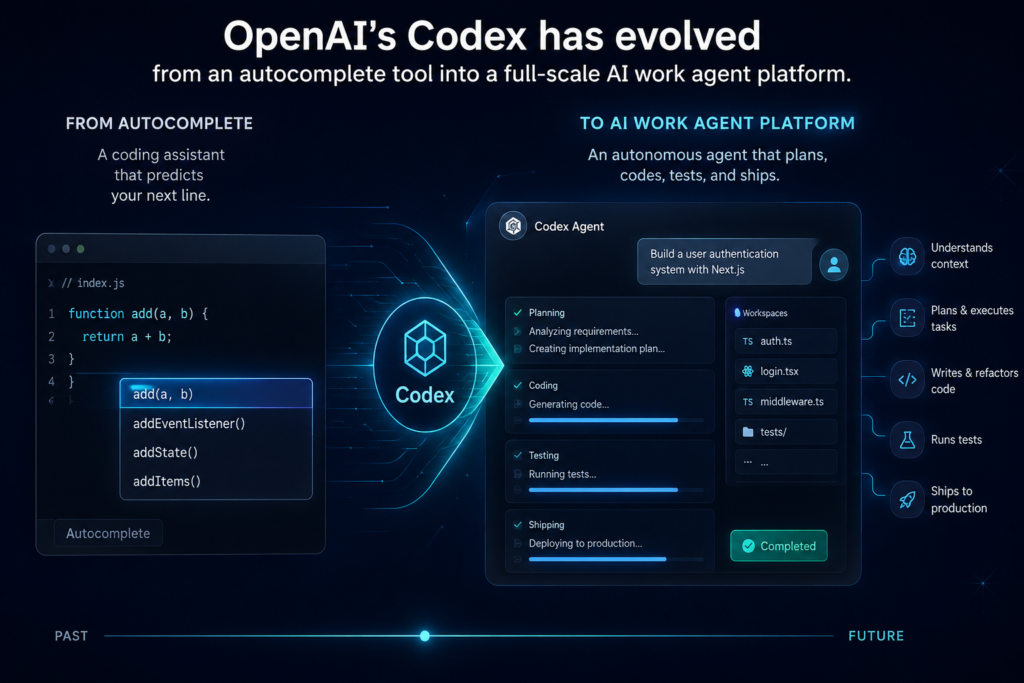
The 2021 model was fundamentally a completion engine — given a comment or a partial function, it predicted what code should come next. It was impressive for its time, but it was passive. It waited to be prompted, filled in a gap, and stopped.
The 2026 Codex is an execution engine. It receives a goal, devises a multi-step plan, runs code in a sandboxed environment, checks test results, revises its approach when something fails, and loops until it produces a verified output. The agent loop — plan, execute, verify, fix — is the core of how it works.
The underlying models have also changed completely. The original ran on the first-generation Codex model. Today’s platform runs on GPT-5.5, a model purpose-built for agentic work, with context understanding far beyond what was possible in 2021.
One practical difference that matters to US developers: Codex now operates on a 272,000-token context window — meaningful for most projects, though still shorter than some competitors.
Competition in the US AI Market
Codex doesn’t operate in a vacuum. The US AI technology market for coding agents has become genuinely competitive, with several serious players.
Anthropic’s Claude Code is widely seen as Codex’s closest rival. According to recent benchmarks, Claude Code with Claude Opus 4.8 leads the industry on SWE-bench Verified with an 88.6% score, while Codex CLI with GPT-5.5 leads Terminal-Bench 2.1 at 82.7%. Neither dominates every category — the honest answer is that the two platforms have different strengths.
GitHub Copilot, owned by Microsoft, remains deeply embedded in developer workflows. Interestingly, GitHub has opened its platform to both Claude and Codex as third-party agents — available to Copilot Pro+ and Enterprise customers — signaling a strategic shift toward an open agent ecosystem rather than a closed one.
Google has entered the coding agent space with its Antigravity product, and has confirmed plans to bring its agents into GitHub, VS Code, and the Copilot CLI. Apple deepened its integration with Codex through Xcode 26.3, allowing developers to use the agent directly inside Apple’s development environment.
The broader market now includes Cursor, Kiro, Windsurf (recently rebranded to Devin Desktop), and several open-source tools. By mid-2026, the AI coding agent landscape has matured from a single dominant player to a genuine, contested market.
🔗 Explore: Comparing AI Coding Agents in 2026
Real-World Use Cases in US Companies
The way US companies are actually using Codex in 2026 breaks down across a few distinct patterns.
For startups, the value is speed. A small team with two or three engineers can effectively operate with the output of a larger engineering team by running parallel Codex agents on different features simultaneously — multiple pull requests in progress at once without context switching.
For enterprise software teams, the appeal is handling the work nobody wants to do. Writing tests for legacy code, refactoring modules, updating documentation, identifying security vulnerabilities — these are high-value but time-consuming tasks that Codex can take on autonomously and return results for human review.
For SaaS companies, the Codex Sites feature is opening a new category of internal tooling. Teams can now prompt an agent to build a live internal dashboard or reporting tool without involving the engineering queue at all — a workflow that would previously have required weeks of back-and-forth.
For non-technical roles, the new job-specific plugins are enabling workflows that used to require developer support. A sales analyst can ask Codex to pull data, build a model, and surface the result as an interactive web page — without writing SQL or Python.
Risks, Concerns, and Job Impact in the US Market
The growth of Codex as an AI work agent brings real questions that the US tech industry is only beginning to grapple with.
On security and governance, the speed of adoption has outpaced formal controls at many organizations. The Codex Sites feature, for example, launched in public preview with no published usage caps, no monitoring dashboard, and no formal approval workflow — a combination that creates real risk for companies that roll it out without establishing guardrails first.
On code quality and reliability, Codex remains a tool that requires human review. OpenAI’s own architecture positions agents as preparing work for human approval, not bypassing it. But as agents become more capable and faster, the practical reality is that many teams are reviewing agent output less carefully than they would review a colleague’s code — a risk that hasn’t fully registered in enterprise security conversations yet.
On jobs, the picture is complicated. The clearest near-term impact is not mass layoffs but a shift in what developers spend their time on. Routine implementation work — writing boilerplate, creating test suites, fixing well-understood bug classes — is increasingly handled by agents. The work that remains for human developers tends to be higher-level: architecture decisions, product judgment, and reviewing what agents produce.
The more unsettling question, which industry analysts are beginning to raise, is what happens when knowledge worker tasks — data analysis, internal reporting, basic design work — shift to agents as well. The 20% of Codex users who are non-developers, growing at three times the developer rate, is a trend worth watching.
Future Outlook: Where AI Agents in the US Tech Industry Are Headed
The trajectory of Codex points toward something that most organizations haven’t fully internalized yet: the shift from AI as a productivity tool to AI as a workforce participant.
OpenAI’s own framing has moved in this direction. Workspace agents — shared, team-wide agents that can own entire workflows, follow team processes, and be deployed by one person and used by many — are now part of Codex’s enterprise offering. Credit-based pricing for these agents begins in July 2026.
The longer-term direction is toward multi-agent systems: networks of specialized agents that collaborate, delegate, and report to each other, with humans managing at the workflow level rather than the task level. OpenAI has already introduced multi-agent v2 configuration in recent Codex releases, and the architectural direction is clear.
For US tech companies, the strategic question is shifting from “should we use AI coding assistants?” to “how do we structure our teams and workflows around AI agents?” That’s a harder question, and most organizations are still working out the answer.
🔗 Further reading: OpenAI’s blog on Codex as an enterprise platform
Conclusion
OpenAI Codex in 2026 is not the tool that shipped in 2025. It’s not even the same category of product. What started as an AI coding assistant has become a full AI work agent platform — one that writes and ships code, hunts security vulnerabilities, runs parallel workstreams, builds internal web apps, and now serves salespeople and investment analysts alongside the developers it was originally built for.
Whether that evolution benefits or disrupts the US tech workforce will depend on choices that companies, teams, and policymakers are still making. But the product itself has moved further and faster than most observers anticipated — and for anyone building software, managing engineering teams, or running a US technology business in 2026, catching up with what Codex has become is an urgent priority.
Frequently Asked Questions (FAQ)
Q1: Is OpenAI Codex available to US developers right now?
Yes. Codex is available through ChatGPT Plus ($20/month), Pro ($200/month), Business, Enterprise, and Education plans. It’s accessible via the Codex desktop app (Windows and macOS), the Codex CLI, IDE integrations (VS Code, JetBrains, Xcode), and through the ChatGPT web interface. For a limited time, OpenAI has also included Codex access with free and Go-tier ChatGPT accounts.
Q2: How is the 2026 version of OpenAI Codex different from the original?
The original 2021 Codex was a code-completion model — it filled in code based on prompts and was deprecated in 2023. The 2026 Codex is a full agentic system: it understands entire codebases, plans multi-step tasks, executes shell commands, runs tests, checks its own results, and submits pull requests. It operates on GPT-5.5 and is built for autonomous, long-running work rather than single-step completions.
Q3: How does OpenAI Codex compare to Anthropic’s Claude Code for enterprise use?
Both are serious contenders. On current benchmarks, Claude Code leads on SWE-bench Verified (88.6% with Claude Opus 4.8), while Codex leads on Terminal-Bench (82.7% with GPT-5.5). Practically, Codex benefits from tight integration with the broader ChatGPT ecosystem and enterprise admin tools, while Claude Code offers a larger context window (1M tokens vs. Codex’s 272K) and strong parallel sub-agent capabilities. Enterprises are evaluating both, and many are using both.
Q4: What does Codex Security do, and is it different from existing security scanning tools?
Codex Security, launched in March 2026, goes further than traditional static analysis tools. It analyzes an entire repository’s architecture, tests potential vulnerabilities in a sandbox to filter false positives, ranks findings by real-world severity, and generates specific code patches with plain-language explanations. Developers can review and push fixes directly from the interface. It’s currently available in research preview for ChatGPT Enterprise, Business, and Education customers.
Q5: Should US developers be worried about Codex replacing their jobs?
The current evidence points to transformation rather than wholesale replacement, at least in the near term. Routine implementation tasks — writing tests, refactoring modules, fixing common bugs — are increasingly automated. Higher-level work — architecture, code review, product judgment — remains firmly in human hands. The more significant question is what happens to non-developer knowledge workers as Codex’s role plugins and Codex Sites mature. That’s a genuine open question, and 2026’s growth numbers suggest the transition is happening faster than most anticipated.
Sources: OpenAI | TechCrunch | Axios | Gartner 2026 Magic Quadrant | GitHub Changelog | AI Business