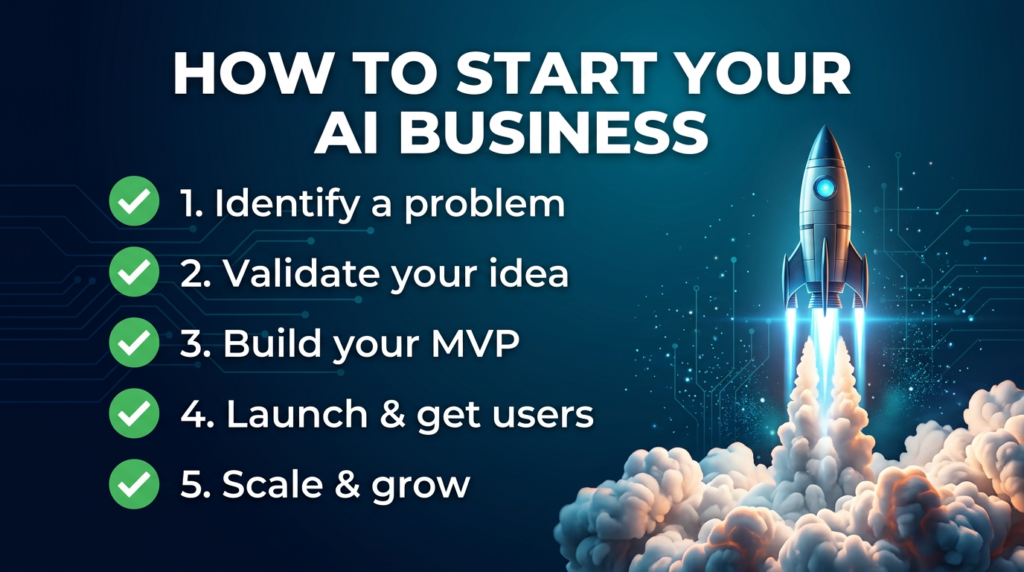
The gold rush isn’t over; it has just evolved. In 2026, building a successful AI business is no longer about launching another generic wrapper or chasing speculative venture capital. The dust from the initial hype has settled, leaving behind something far more lucrative: an open playing field where solo founders can build deep, problem-solving software using production-ready infrastructure for less than the cost of a weekend trip. If you’ve been waiting for the “perfect time” to launch an AI-powered venture, the market conditions have finally aligned. Here are 25 battle-tested, highly viable AI business ideas you can start today—complete with the exact tools, costs, and execution steps needed to land your first customers.
📋 Table of Contents
- Why 2026 Is the Perfect Year to Start an AI Business
- AI SaaS Businesses
- AI Content Businesses
- AI Service Agencies
- AI E-commerce & Operations
- AI Education Businesses
- AI Automation Businesses.
- AI Creator Businesses
- Top 5 AI Businesses with the Highest Potential
- Mistakes to Avoid When Starting an AI Business
- Frequently Asked Questions
- Conclusion & Your First Steps Today
Why 2026 Is the Perfect Year to Start an AI Business
Something fundamental has shifted in the world of technology entrepreneurship. The tools that once required a team of machine learning engineers, a PhD on staff, and millions in venture capital are now available to any founder with a laptop, a credit card, and a genuine problem they want to solve.
Artificial intelligence is no longer a research project. It’s production-ready infrastructure — as routine to deploy as cloud hosting, as accessible as a Stripe payment form. And that shift has opened a window of opportunity that, historically, appears once in a generation.
According to McKinsey’s State of AI 2025 report, generative AI adoption across enterprise functions has more than doubled since 2023, with companies actively seeking external AI-powered solutions. The budgets are real. The pain points are real. And in most verticals, the market is still remarkably open.
The solo founder advantage is now real. Modern AI APIs let a single developer build and ship a product in days that would have taken a six-person team six months in 2021. Distribution has been democratized by LinkedIn, TikTok, Reddit, and communities like Indie Hackers. No-code platforms mean you don’t even need to write code to launch many of the businesses in this guide. The playing field has genuinely leveled.
Why 2026 specifically is a unique moment: We’re now past the initial hype wave. The first generation of “AI wrappers” — products that were nothing more than a thin UI on top of ChatGPT — has failed, and the market has learned what it doesn’t want. What survives is businesses that solve a real, recurring, measurable problem with genuine depth. That culling of noise is good news for founders who actually think. The serious opportunity is just beginning.
What you need to get started: Most of the businesses in this guide require $100–$5,000 to launch, a few months to get traction, and one genuinely useful product or service. No PhD. No VC funding. No team of ten. What matters is picking the right idea, validating it fast, and getting obsessed with your first ten customers.
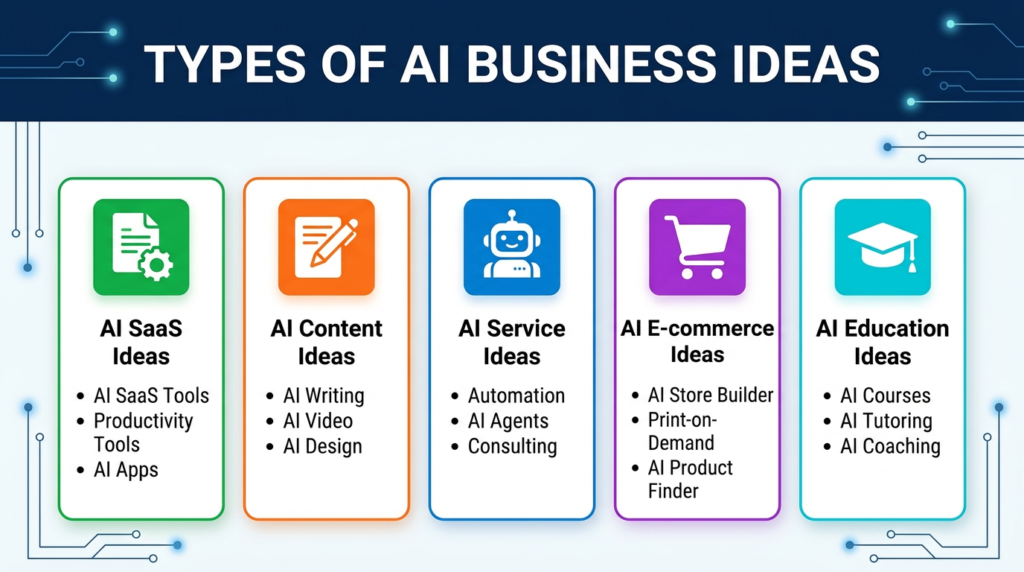
Below are 25 AI business ideas across seven categories — each one grounded in real market demand, built around tools you can access today, and mapped to practical first steps you can take this week. Let’s go.
🧠 Category 1: AI SaaS Businesses
Software-as-a-service is the highest-leverage business model in tech. Build once, sell repeatedly, and scale revenue without proportionally scaling headcount. AI supercharges this by letting tiny teams ship products that feel impossibly powerful — at a cost structure that was impossible five years ago.
01
Screenshot to Excel / Data Extraction Tool
📊 Global data extraction market: $4.9B by 2027
⚙ MEDIUM DIFFICULTY
“Turn any image of data into a clean, downloadable spreadsheet in under 10 seconds.”
Every week, millions of accountants, analysts, and operations managers stare at screenshots of tables, scanned invoices, and PDF reports — then manually retype that data into Excel. It’s soul-crushing, error-prone work, and it costs companies billions in wasted labor hours every year.
Your tool changes that. Users upload an image or PDF, GPT-4o Vision reads and structures the data, and they download a clean .xlsx or .csv file in seconds. Accuracy is high for printed tables. Add features like multi-sheet exports, formula detection, and Dropbox/Google Drive integration to increase stickiness.
The monetization model is simple: 10 free conversions, then $12–$29/month for unlimited use. Enterprise plans for teams run $99–$299/month and are easy to close once an individual user brings the tool into their company.
Target Customers
Accountants, financial analysts, ops teams, supply chain managers
Startup Cost
$500–$2,500 (hosting + API credits + UI)
Potential Monthly Revenue
$3,000–$18,000 at 500–1,500 subscribers
Tools Needed
GPT-4o Vision or Claude API, Next.js, Supabase, Stripe
🌍 Real-World Benchmark Tools like Nanonets and AWS Textract serve enterprise clients at $500+/month. A focused indie SaaS at $29/month with a cleaner UX can dominate the SMB segment they ignore.
🎯 How to Get Your First 100 Customers
Post in r/accounting, r/financialindependence, and r/excel. Share a 30-second Loom video showing the tool working on a real screenshot. Offer free lifetime access to the first 50 users in exchange for feedback and testimonials. Then run targeted LinkedIn content aimed at finance roles.
⚡ Day 1 Action Build a no-code MVP on Bubble.io connecting GPT-4o Vision to a file download. Share it in three subreddits with “I built this in a weekend — what’s broken?” You’ll have feedback and your first users within 48 hours.
✅ PROS
- Solves a universal, concrete pain point
- Freemium model drives organic growth
- Natural upsell path to enterprise teams
- Low churn — people use it weekly
⚠️ CONS
- API costs scale with volume — watch margins
- Accuracy on handwritten or messy data is lower
- Larger players could add this as a free feature
02
AI Resume Builder & Job Application Assistant
📊 Online recruitment market: $43B globally in 2025
✅ EASY DIFFICULTY
“A resume that actually gets past the ATS filter — built in 3 minutes.”
Most resumes never reach a human. Applicant Tracking Systems (ATS) — software used by over 98% of Fortune 500 companies — filter out candidates whose resumes don’t include the right keywords. The typical job seeker has no idea this is happening to them.
Your tool solves this with a two-step process: first, it analyzes a job description and identifies the critical keywords, skills, and formatting the ATS is looking for. Second, it rewrites and tailors the user’s resume in real time to match — then generates a custom cover letter for the same role. Users can apply to 10× more jobs in the same time, dramatically increasing interview rates.
Monetization options are wide: a one-time “resume rewrite” paid tier at $15–$25, a $12/month subscription for unlimited tailoring, or a premium career coaching add-on for $79/month. University career centers are also a strong B2B channel — a single licensing deal can bring in $5,000–$20,000 per year.
Target Customers
Job seekers, recent graduates, career changers, veterans
Startup Cost
$200–$1,200 (API + no-code builder + Stripe)
Potential Monthly Revenue
$2,000–$25,000 depending on pricing model
Tools Needed
OpenAI API or Claude API, Bubble.io or Webflow, Stripe, Docx templates
🌍 Real-World BenchmarkKickresume and Enhancv charge $19–$29/month and have grown to 3M+ users largely on organic SEO. Differentiate with real-time ATS scoring, which neither does well.
🎯 How to Get Your First 100 Customers
Post a free “ATS score checker” landing page. Drive traffic via LinkedIn content targeting job seekers. Partner with university career centers for institutional licensing. TikTok content showing side-by-side ATS results before/after your tool performs exceptionally well as organic content.
⚡ Day 1 Action Create a simple landing page with a single call-to-action: “Paste your resume + job description, get a free ATS match score.” No payment required. Collect 200 emails before you build the full product. Use Carrd and Claude API. Spend $0 on ads.
✅ PROS
- Huge, evergreen demand — people always need jobs
- No-code friendly for non-developers
- Clear willingness to pay (career = livelihood)
- B2B licensing to universities adds scale
⚠️ CONS
- Market is crowded — positioning is critical
- Demand is seasonal (Jan, May, Sep spikes)
- ATS rules change as platforms update
03
AI Website Audit Tool
📊 SEO & web analytics software market: $6.5B in 2025
⚙ MEDIUM DIFFICULTY
“A 50-page expert audit of any website — delivered in 60 seconds.”
A typical professional website audit from a digital agency costs $500–$2,000 and takes a week to deliver. Your AI tool delivers an equally comprehensive report in under a minute — covering SEO health, Core Web Vitals, accessibility compliance, page speed bottlenecks, mobile responsiveness issues, and conversion optimization gaps.
The real business model here is B2B white-labeling. Sell the tool to digital marketing agencies and freelancers who use it to generate beautiful branded audit reports for their own clients. An agency that runs 20 audits per month at $200 each will happily pay you $199/month for unlimited access — while billing their clients $4,000/month total for audits that cost them almost nothing to produce.
This is a tool-enabling-tools-for-tools play, and it’s extremely sticky once agencies adopt it into their workflow. A single agency sale generates $200–$500/month in recurring revenue indefinitely.
Target Customers
Digital marketing agencies, SEO freelancers, web developers, SMBs
Startup Cost
$1,000–$4,000 (Lighthouse API + GPT + hosting + PDF generation)
Potential Monthly Revenue
$4,000–$22,000 at 20–100 agency clients
Tools Needed
Google Lighthouse API, OpenAI, Puppeteer, React, PDFKit, Stripe
🌍 Real-World BenchmarkWooRank charges agencies $179/month and has been profitable for years with a similar model. Add AI-powered actionable recommendations and a branded PDF export and you match their offering at a better price point.
🎯 How to Get Your First 100 Customers
Cold email 200 digital marketing agencies with “Here’s a free audit report we ran on your agency’s own website.” The report is your sales tool. Once they see the quality, conversion to paid is extremely high. Target agencies with 5–50 employees on LinkedIn Sales Navigator.
⚡ Day 1 Action Run 10 free audits on the websites of local agencies in your city. Email the audit PDF with no pitch — just “I made this for you, thought it might be useful.” Follow up three days later asking if they’d want to use the tool for their clients.
✅ PROS
- White-label B2B = strong recurring revenue
- Agencies don’t churn tools embedded in workflow
- Easy to upsell reporting add-ons
⚠️ CONS
- Several established competitors exist
- Needs differentiated positioning to stand out
- PDF quality and branding must be excellent
04
AI Personal Finance Assistant
📊 Personal finance app market: $1.57B by 2028
🔥 HARD DIFFICULTY
“Your own money coach — available 24/7, at 1% of the cost of a real advisor.”
Most people making under $150,000/year never get access to a financial advisor. They make critical decisions — about debt payoff order, emergency fund sizing, investment allocation, tax-advantaged accounts — based on guesswork, Reddit threads, or their parents’ outdated advice.
An AI personal finance assistant changes this. Connect to users’ bank accounts via Plaid, analyze their spending patterns, categorize recurring expenses, flag financial risks, and provide a conversational interface where they can ask anything — “Should I pay off my student loan or invest in my 401k first?” — and receive genuinely personalized, data-driven guidance.
The key to doing this responsibly and legally is to position the product clearly as an educational tool, not a licensed financial advisor. Build in disclaimers, never recommend specific securities, and focus on behavioral budgeting and debt management where the liability risk is lowest. The $15–$25/month subscription tier is easy to justify when people see it working on their actual finances.
Target Customers
Millennials, Gen Z, first-time earners, debt-payoff communities
Startup Cost
$2,000–$6,000 (Plaid integration is the main cost driver)
Potential Monthly Revenue
$5,000–$35,000 at scale with strong retention
Tools Needed
Plaid API, Claude or GPT-4o, React Native (mobile), Stripe, legal review
🌍 Real-World BenchmarkCopilot charges $13/month and crossed 100K users. Monarch Money charges $14.99/month. Neither uses conversational AI deeply — there’s a clear gap for a chat-first, advice-focused product.
🎯 How to Get Your First 100 Customers
Create short-form financial education content on TikTok and Instagram — “How I used AI to pay off $18K in debt in 14 months.” The personal finance community is enormous and passionate. Use the content to drive email signups before the product launches.
⚡ Day 1 Action Skip Plaid initially. Build a CSV-import version first (users export from their bank, upload to you). Validate the conversational interface and advice quality with 50 beta users before investing in the bank connection infrastructure.
✅ PROS
- Enormous, underserved market with genuine need
- High LTV — people stick with finance tools for years
- Strong word-of-mouth when it works (“I saved $400/month”)
⚠️ CONS
- Regulatory gray zones require careful legal setup
- Trust takes time — financial data is sensitive
- Plaid costs add up at scale
05
AI Niche Directory Builder
📊 Directory & listing sites generate $2B+ in annual ad/lead revenue
✅ EASY DIFFICULTY
“Use AI to build profitable niche directories in days — then monetize them for years.”
Directories are one of the oldest and most durable internet businesses. “Best AI Tools for Lawyers,” “Top Rated Wedding Photographers in Austin,” “SaaS Tools for Dentists” — these pages rank on Google, attract organic traffic, and monetize through listings fees, lead generation, and sponsored placements.
The problem with directories historically was the content: compiling, formatting, and keeping hundreds of listings current was manual, expensive work. AI eliminates this entirely. Your SaaS platform lets entrepreneurs enter a niche, and the system automatically researches, writes, formats, and publishes a full directory with 50–500 listings — complete with SEO-optimized descriptions, category pages, comparison tables, and contact details. Users then publish to a custom domain and start monetizing.
Sell this as a $49–$99/month SaaS platform or charge per directory built ($299–$599 one-time). Done-for-you directory creation as a service at $999–$2,999 is another strong revenue stream.
Target Customers
SEO entrepreneurs, local business owners, affiliate marketers, niche publishers
Startup Cost
$500–$2,000 (scraping infra + Claude API + CMS + Stripe)
Potential Monthly Revenue
$3,000–$15,000 with 60–200 active subscribers
Tools Needed
Apify (web scraping), Claude API, Next.js, Airtable or Supabase, Webflow
🌍 Real-World BenchmarkDirectories.io and similar tools have been bootstrapped to $10K+ MRR. The niche is underserved by quality tooling, and the SEO opportunity for well-structured directory sites remains strong in 2026.
🎯 How to Get Your First 100 Customers
Build 3 example directories in hot niches (AI tools, local lawyers, SaaS for restaurants). Write a Twitter/X thread: “I built 3 profitable directory sites using AI in one weekend — here’s exactly how.” The thread drives signups for your builder tool.
⚡ Day 1 Action Pick one niche. Build one directory manually using AI for the content. Get it indexed and pulling traffic within 30 days. Then build the product that productizes the process you just followed yourself.
✅ PROS
- Novel application of AI with little competition
- Customers have clear monetization path — easy sell
- Low ongoing maintenance once built
⚠️ CONS
- Scraping requires careful legal/ToS review
- SEO results take 3–6 months to materialize
- Quality control of AI-generated listings is critical
✍️ Category 2: AI Content Businesses
Content remains the engine of the internet. AI doesn’t kill the content business — it creates a massive efficiency advantage for creators who understand their audience and use AI as leverage, not as a replacement for genuine insight and editorial judgment.
06
AI YouTube Thumbnail Generator
📊 800M+ YouTube creators — nearly all need thumbnails
✅ EASY DIFFICULTY
“Thumbnails that stop the scroll — generated in seconds, tested in minutes.”
A YouTube thumbnail is the single most important variable in a video’s success. Research consistently shows that a well-designed thumbnail can increase CTR by 200–300%. Yet most creators either spend $50–$150 per thumbnail on a designer or settle for mediocre DIY versions that tank their videos’ performance.
Your tool bridges this gap. Creators enter their video title and a brief description, and the tool generates 5–10 thumbnail variations using image generation AI — complete with optimized text overlays, emotion-matched facial expressions, and contrast ratios proven to perform on YouTube’s recommendation algorithm. A built-in CTR prediction scoring system ranks each variant so creators know which to test first.
The premium tier adds A/B testing integration, analytics tracking, and a “competitor thumbnail analyzer” that reverse-engineers what’s working in any niche. This transforms the tool from a one-time generator into a recurring strategy platform.
Target Customers
YouTubers (especially 1K–500K subs), video editors, YouTube growth agencies
Startup Cost
$300–$1,800 (image generation API + UI + Stripe)
Potential Monthly Revenue
$2,000–$14,000 at 400–1,200 subscribers
Tools Needed
DALL-E 3 or Stability AI, Canva API or Fabric.js, YouTube Data API, Stripe
🌍 Real-World BenchmarkThumblytics raised early interest testing thumbnail analytics. The AI generation angle is still largely untapped by purpose-built tools. Creator economy Discord servers are full of people complaining about this exact problem.
🎯 How to Get Your First 100 Customers
Post in YouTube creator communities on Reddit (r/NewTubers, r/YouTubers) and Discord servers. Offer 20 free thumbnail generations with no credit card. Create a before/after comparison post showing real CTR improvements. This content goes viral in creator communities.
⚡ Day 1 Action Generate 10 free thumbnails for small YouTubers in your niche using DALL-E 3 manually. Ask them to test them against their current thumbnail and share results. Use those results as social proof for your launch.
✅ PROS
- Direct, measurable impact on creator revenue
- Creator tools spread virally in creator communities
- Recurring need — every new video needs a thumbnail
⚠️ CONS
- Image generation quality still inconsistent for faces
- Commoditizing space — need a strong moat
- Revenue ceiling without agency/enterprise tier
07
AI Newsletter Business
📊 Newsletter industry crossed $1B in 2025 — still growing 30%+ YoY
✅ EASY DIFFICULTY
“Build a profitable media asset in a niche you understand — with AI as your editorial team.”
Email newsletters are having a moment. In a world of algorithmic feeds and disappearing reach, a direct email list is one of the most valuable media assets a creator can own. And AI has fundamentally changed the economics of running one profitably.
The winning formula in 2026 is not “write AI content and blast it out.” That’s a race to the bottom. Instead, use AI for the high-labor, low-creativity tasks: research aggregation, initial drafts, formatting, subject line generation, and send-time optimization. Then add the one thing AI can’t replicate — your genuine perspective, insider knowledge, and editorial voice. This hybrid approach lets a single person produce a newsletter that previously required a three-person team.
Monetization has three tiers: (1) free + sponsorships once you hit 2,000+ subscribers (sponsors pay $20–$50 per 1,000 subscribers per send), (2) paid subscriptions at $10–$20/month for premium content, and (3) using the newsletter as a lead generation engine for a higher-value service business. The newsletter itself becomes both the product and the distribution channel.
Target Customers
B2B professionals in your niche — choose a niche you know deeply
Startup Cost
$0–$600 (Beehiiv free plan to start, Claude AI at ~$20/month)
Potential Monthly Revenue
$1,000–$30,000+ depending on niche, list size, and monetization
Tools Needed
Beehiiv or Substack, Claude AI, Perplexity for research, Canva for visuals
🌍 Real-World BenchmarkBeehiiv has helped hundreds of creators cross $10K MRR. The Morning Brew model (curated news + personality) at niche scale is consistently profitable. Choose a B2B niche — the CPMs from sponsors are 5–10× higher than consumer niches.
🎯 How to Get Your First 500 Subscribers
Post your first 3 issues publicly on LinkedIn and Twitter/X. Cross-promote in relevant Slack communities. Guest post in newsletters of similar size. Run a referral program from day one — Beehiiv has this built in. Aim for 25 new subscribers per week for 5 months.
⚡ Day 1 Action Pick one niche. Write your first issue. Post it as a LinkedIn article. Set up a free Beehiiv account and link to the signup form. Your first 100 subscribers are already in your LinkedIn network — they just need to be asked.
✅ PROS
- Lowest barrier to start on this entire list
- Audience is an asset you own — no algorithm dependence
- Multiple monetization paths
- Newsletter becomes a distribution moat for other products
⚠️ CONS
- Audience growth is slow — requires 6–18 months of consistency
- AI content alone won’t build a loyal audience
- Sponsored newsletter market requires 2K+ subscribers to monetize meaningfully
08
AI Meeting Notes & Summary Service
📊 Productivity software market: $96B globally by 2027
✅ EASY DIFFICULTY
“Every meeting ends with a perfect action-item doc — automatically.”
The average knowledge worker spends 21.5 hours per week in meetings, according to Harvard Business Review. Most of that time produces no durable record. Notes are either non-existent, incomplete, or trapped in someone’s personal Notion. Action items are forgotten. Decisions are re-litigated in the next meeting.
Your AI meeting assistant changes this entirely. It joins Zoom, Google Meet, or Teams calls via a bot, transcribes everything in real time, and delivers within 30 seconds of the call ending: a structured summary with key decisions, action items (each with an assignee and deadline), open questions, and a searchable transcript. These outputs are pushed automatically to Notion, Slack, HubSpot, or whatever tools the team already uses.
The killer feature is the follow-up engine: 24 hours before action items are due, the system sends automatic reminders to the assigned people via Slack or email. Accountability without management overhead. Teams that try this don’t go back.
Target Customers
Remote-first teams, consultants, project managers, executives, sales teams
Startup Cost
$300–$2,000 (Whisper API + Recall.ai bot + GPT-4o + integrations)
Potential Monthly Revenue
$3,000–$20,000 at $15–$30/seat/month
Tools Needed
Whisper API, Recall.ai, GPT-4o, Notion API, Slack API, Stripe
🌍 Real-World BenchmarkOtter.ai and Fireflies.ai are the leaders but are broad and generic. Niching down — AI meeting notes specifically for sales teams, or for creative agencies, or for legal professionals — gives you a focused ICP with premium pricing potential.
🎯 How to Get Your First 100 Customers
LinkedIn outreach to Chiefs of Staff, Operations Managers, and Project Leads with “I built a meeting notes tool — want a free month?” Ops people love anything that saves admin time. One happy ops manager will often roll it out company-wide.
⚡ Day 1 Action Sign up for Recall.ai‘s API (they provide meeting bot infrastructure). Build a basic integration that sends meeting transcripts to Claude for summarization. Get it working on your own calls first, then demo it to five people you know.
✅ PROS
- Daily-use product = extremely high retention
- Teams pay for productivity tools without much pushback
- Natural virality (everyone in the meeting sees the output)
⚠️ CONS
- Privacy concerns — some users uncomfortable with AI bots in calls
- Established competitors have brand recognition
- Differentiating beyond notes quality requires integration depth
09
AI Product Description Generator
📊 Global e-commerce GMV expected to hit $8.1T by 2026
✅ EASY DIFFICULTY
“From product image to SEO-optimized listing copy — in under 10 seconds.”
An e-commerce seller launching 50 new products a month needs 50 unique, SEO-optimized, tone-consistent product descriptions. Doing this manually takes a copywriter 2–3 hours per product — $100–$300 per product in labor costs. At 50 products, that’s $5,000–$15,000/month in copywriting alone.
Your tool compresses this to seconds. Upload a product image, paste in basic specs, and select your brand tone (premium, playful, technical, luxurious) — and the tool generates a headline, full description, SEO meta tags, 5 bullet points for Amazon or Shopify, and Google Shopping-optimized title — all simultaneously, in any of 20 languages. Sellers running international stores save even more.
The smart go-to-market is a Shopify app. The app store gives you instant distribution to millions of merchants, handles billing, and positions the tool right inside the workflow where sellers already live. Target merchants with 20+ products who are actively adding inventory.
Target Customers
Shopify merchants, Amazon sellers, DTC brands, wholesale distributors
Startup Cost
$300–$1,200 (Claude API + Shopify Partner setup + hosting)
Potential Monthly Revenue
$2,000–$12,000 at 200–600 active merchants at $19/month
Tools Needed
Claude or GPT-4o API, Shopify Partner API, React, Stripe or Shopify Billing
🌍 Real-World BenchmarkShopify’s app store has multiple apps in this category, some with 2,000+ reviews. Differentiate with multimodal input (image → description), multi-language output, and brand voice training that learns from a seller’s existing copy.
🎯 How to Get Your First 100 Customers
List on the Shopify app store with a 7-day free trial. Post in Shopify-focused Facebook groups and r/shopify. Target sellers using “written by owner” or thin product descriptions — a quick Google/Bing search reveals these and turns them into warm outreach targets.
⚡ Day 1 Action Build a single-page demo: paste in a product name and one spec, get a description. Post it in r/ecommerce. If 20 people ask “where can I sign up?” you have product-market fit. If nobody cares, iterate on the prompt and demo quality first.
✅ PROS
- Shopify app store = built-in distribution
- Clear, immediate ROI — sellers understand copywriting costs
- Scales without additional team members
⚠️ CONS
- Shopify app store is competitive
- Thin descriptions can hurt SEO if not reviewed
- Brand consistency requires customization depth
🏢 Category 3: AI Service Agencies
Not every AI business needs to be a software product. AI-powered agencies let you sell expertise, deliver results faster than any traditional competitor, and command premium pricing — especially when clients are still figuring out how to use these tools themselves. The key: use AI as your unfair advantage, not your entire value proposition.
10
AI Blog Writing Agency
📊 Content marketing industry: $600B by 2024, growing 15% YoY
✅ EASY DIFFICULTY
“SEO-grade long-form content at 3× the speed, at two-thirds the cost of traditional agencies.”
Content marketing agencies are some of the most profitable service businesses in the world — but they’ve historically been constrained by the speed and cost of human writers. A 3,000-word blog post from a skilled writer takes 4–6 hours and costs $150–$400. At those rates, producing 20 posts per month per client limits your margins and your scale.
AI completely changes this calculus. A skilled AI-assisted content process — where you use Claude to research, draft, and structure a post, then spend 30–45 minutes adding specific expert quotes, real examples, original data points, and editorial polish — can produce a high-quality 3,000-word post in under two hours. Your margins improve dramatically. Your delivery speed impresses clients. And the quality, when the human layer is applied with care, is indistinguishable from fully human-written work.
The critical success factor: specialize. Don’t compete as a generic content agency. Pick a niche — SaaS, fintech, healthcare technology, e-commerce — and become the expert content partner for companies in that space. Niche agencies command 2–3× the rates of generalist agencies and attract much better clients.
Target Customers
B2B SaaS companies, e-commerce brands, VC-backed startups investing in SEO
Startup Cost
$100–$600 (Claude AI $20/month + SurferSEO $89/month + Google Workspace)
Potential Monthly Revenue
$5,000–$40,000 with 5–15 retainer clients at $1,000–$3,500/month
Tools Needed
Claude AI, SurferSEO, Ahrefs or SEMrush, Google Docs, Trello or Notion
🌍 Real-World Benchmark Solo AI content agencies run by one person with 2–3 subcontractors are consistently hitting $15K–$25K/month in revenue with margins of 60–70%. The model works — the secret is client quality over quantity and a specialized niche positioning.
🎯 How to Get Your First 5 Retainer Clients
Cold email 100 SaaS companies in your chosen niche with a subject line “Here’s a free 2,000-word blog post for [Company Name].” Write one actual free post about a topic relevant to their audience. Include it in the email. This approach converts at 10–20% to a discovery call.
⚡ Day 1 Action Pick your niche. Write one genuinely great blog post for a company in that niche — unrequested, using their blog’s style and a keyword they’re not ranking for. Email it to the CMO or Head of Content. One out of ten will respond. Close your first client from those responses.
✅ PROS
- Near-zero startup cost
- Scalable with freelancers and AI systems
- Strong demand from SEO-focused tech companies
- Recurring monthly retainers = predictable revenue
⚠️ CONS
- Pricing pressure from AI-only commodity content mills
- Human editorial time is still essential for quality
- Google’s content quality standards are evolving constantly
11
AI SEO Agency
📊 Global SEO services market: $122B by 2028
⚙ MEDIUM DIFFICULTY
“Full-service SEO — keyword strategy, content, technical audits — in a fraction of the time.”
SEO agencies are being disrupted by AI-native competitors who can do in 2 hours what traditional agencies spend 40 hours doing. Keyword research that once required a specialist analyst can now be produced in minutes. Technical audits, content briefs, competitor gap analyses, and internal linking strategies can all be automated and AI-accelerated without sacrificing quality.
The opportunity is enormous for a founder who genuinely understands SEO and can wrap that expertise in AI-powered delivery. You can take on more clients at higher margins, and deliver better results faster than agencies still relying on purely manual processes. A three-person AI SEO agency can realistically do the work of a ten-person traditional agency — and pocket the difference.
Specialize by business type or industry. An AI SEO agency focused exclusively on law firms, medical practices, or e-commerce stores will outperform generalist agencies every time because you understand the specific competitive landscape, content types, and buying intent of that vertical.
Target Customers
SMBs, funded startups, local businesses needing organic growth
Startup Cost
$600–$2,500 (Ahrefs + SurferSEO + Claude + Screaming Frog)
Potential Monthly Revenue
$6,000–$50,000 with 5–20 retainer clients at $1,500–$5,000/month
Tools Needed
Ahrefs or SEMrush, SurferSEO, Screaming Frog, Claude API, Google Search Console
🌍 Real-World Benchmark Solo SEO consultants regularly charge $2,000–$6,000/month per client. Add AI leverage and you can handle 8–15 clients solo where a traditional consultant maxes out at 4–6. That’s the entire business case in one sentence.
🎯 How to Get Your First 5 Retainer Clients
Take on 3 clients at a 50% discount in exchange for documented case studies. Spend 3 months delivering exceptional results. Those case studies — showing real organic traffic growth numbers — become your entire sales engine. Every future client is a warm referral.
⚡ Day 1 Action Run a free technical SEO audit on 20 businesses in your target niche using Screaming Frog. Email them the audit results with 3 specific fixes they can implement today. Include one CTA: “Want us to implement this for you?” Convert the inbound interest into discovery calls.
✅ PROS
- Retainer-based business model with very predictable revenue
- SEO results compound — clients rarely leave when rankings are growing
- High demand across virtually every industry
⚠️ CONS
- Results take 3–6 months — requires client patience
- Google algorithm updates create uncertainty
- AI content rules are evolving — must stay current
12
AI Social Media Management Agency
📊 Social media management market: $41.6B by 2030
✅ EASY DIFFICULTY
“Consistent, on-brand social media presence — without clients lifting a finger.”
Most business owners know they should be posting consistently on LinkedIn, Instagram, and Twitter/X. Almost none of them actually do it — because creating content daily is time-consuming, cognitively draining, and not their core expertise. This is a $1,500–$4,000/month problem for every business owner who doesn’t solve it.
Your AI-powered social media agency solves it completely. You take a monthly “brand intake call” with the client, during which you capture their voice, values, current promotions, and content preferences. Then your AI systems — trained on their existing content and brand guidelines — generate 30 days of posts across all platforms, schedule them automatically, and report on performance weekly.
The AI does roughly 70% of the work — ideation, drafting, hashtag research, image caption writing. You provide the remaining 30% — strategic decisions, performance interpretation, and the brand judgment that ensures nothing sounds robotic. At $1,500–$3,500/month per client, serving 6–10 clients generates $9,000–$35,000/month with minimal overhead.
Target Customers
Local businesses, personal brands, coaches, SMBs, professional service firms
Startup Cost
$200–$1,200 (Buffer/Hootsuite + Claude AI + Canva Pro)
Potential Monthly Revenue
$4,500–$25,000 with 5–10 active retainer clients
Tools Needed
Buffer or Hootsuite, Claude AI, Canva Pro, Later, Midjourney for visuals
🌍 Real-World Benchmark Social media management agencies run by solo founders are extremely common and consistently profitable. The AI advantage in 2026 is speed — what used to require 15 hours/client/week now takes 3–4 hours. That’s the entire margin improvement.
🎯 How to Get Your First 5 Clients
Offer a free 30-day trial to 5 local businesses or personal brands you admire. The results — visible publicly on their social profiles — serve as your portfolio. By the time the trial ends, most clients will pay to continue rather than go back to inconsistency.
⚡ Day 1 Action Create a sample content calendar for a business you admire in your target niche — 30 days of posts, with images. Email it to the business owner. Not a pitch — just “I made this for you, thought it might be useful.” The calendar is the sales pitch.
✅ PROS
- Most accessible AI agency for beginners
- Extremely high demand — nearly every business needs this
- Monthly retainers build predictable income quickly
⚠️ CONS
- Client approval cycles can be slow and frustrating
- Platform algorithm changes affect results unpredictably
- AI content can sound generic without human brand voice layer
13
AI Local Business Marketing Agency
📊 33 million small businesses in the US — most spend under $500/month on marketing
✅ EASY DIFFICULTY
“Complete digital marketing for local businesses — no technical knowledge required on their end.”
Local businesses are perhaps the most underserved market in the entire digital economy. A dentist, a plumber, a restaurant owner, a hair salon — they know they need to be on Google, they know they should be responding to reviews, they know they need a presence on social media — and they have no idea how to do any of it while running a business six days a week.
AI makes it practical to serve these clients profitably at price points they can afford. At $500–$1,500/month, you can deliver: weekly AI-generated Google Business posts, AI-drafted responses to every new review within 24 hours, a monthly email to their customer list, 12 social media posts per month, and a basic local SEO report. The entire delivery system, once systematized with AI, takes 3–4 hours per client per month. Serve 15 clients and you’re earning $7,500–$22,500/month working roughly part-time.
The real moat here is relationships. Local business owners are not shopping around on price. They want someone they trust who makes the tech invisible. Once you become that person for a business, you keep them for years.
Target Customers
Dentists, chiropractors, restaurants, salons, contractors, law firms, gyms
Startup Cost
$100–$600 (Claude AI + Google Business API + Mailchimp free tier)
Potential Monthly Revenue
$3,000–$22,500 with 10–15 clients at $500–$1,500/month
Tools Needed
Claude AI, Google Business Profile API, Mailchimp, Canva, Buffer
🌍 Real-World Benchmark Thousands of solo marketers are running 6-figure local marketing businesses by systematizing delivery and using contractors. AI now lets you systematize even faster and offer better deliverables at a lower price point — a significant competitive advantage vs. older agencies.
🎯 How to Get Your First 5 Local Business Clients
Walk into 20 local businesses with a one-page document showing their current online presence vs. what it could look like with your service. In-person, conversational, no jargon. Offer 60 days free. Local business owners trust people, not emails.
⚡ Day 1 Action Do a Google Business audit for 10 local businesses near you — check if they have photos, responses to reviews, regular posts. Identify the 3 that are most visibly underperforming. Walk in and introduce yourself. One conversation is worth a hundred cold emails in this market.
✅ PROS
- Low churn — loyal, relationship-driven clients
- Underserved market with minimal sophisticated competition
- In-person relationships create strong moats
⚠️ CONS
- “Education selling” — many clients don’t see value until results appear
- Low price points require volume to build significant income
- Local geography limits your market unless you go fully remote
🛒 Category 4: AI E-commerce & Operations Businesses
E-commerce and operations are where AI creates the most measurable, immediate ROI. Businesses see the impact in dollars saved or revenue generated within weeks — which makes selling to them significantly easier than any other category.
14
AI Customer Support Chatbot Service
📊 Customer service AI market: $11.5B by 2026 — growing at 26% CAGR
⚙ MEDIUM DIFFICULTY
“Cut support costs by 50% while improving response time from hours to seconds.”
The average e-commerce brand spends 20–35% of its operating budget on customer support. For a company doing $2M in revenue, that’s $400,000–$700,000/year in support costs. An AI chatbot trained on their product catalog, return policies, FAQs, and order data can handle 60–80% of inbound tickets with no human involvement — at a cost of $3,000–$8,000/month versus $60,000–$200,000/year for equivalent human staff.
Your service is to build, deploy, train, and maintain these chatbots for e-commerce brands and SaaS companies as a done-for-you service. You handle everything: extracting and formatting their knowledge base, configuring the AI, integrating with their helpdesk (Zendesk, Gorgias, Intercom), testing edge cases, and optimizing for containment rate over time. You charge a setup fee ($1,500–$5,000) and a monthly maintenance retainer ($500–$2,500).
The key differentiator against bare-bones chatbot platforms: you provide the expertise layer. You know how to craft system prompts that keep the AI on-brand, handle edge cases gracefully, and escalate complex issues to humans seamlessly. That expertise is worth money.
Target Customers
Shopify stores with 50+ SKUs, SaaS companies, subscription boxes, DTC brands
Startup Cost
$600–$3,000 (Voiceflow or Botpress + Claude/GPT API + Intercom access)
Potential Monthly Revenue
$5,000–$30,000 with 5–15 clients on retainers
Tools Needed
Voiceflow or Botpress, Claude API, Gorgias or Zendesk API, Shopify API
🌍 Real-World Benchmark Chatbot implementation agencies routinely earn $10K–$25K/month serving 10–15 clients. Gorgias has built an ecosystem of 600+ certified agency partners earning revenue on chatbot implementations — you can be one of them.
🎯 How to Get Your First 5 Clients
Identify Shopify merchants with slow support response times (check Trustpilot reviews mentioning “slow support”). Cold outreach with: “I noticed your support response times are getting some reviews — I built a chatbot for a similar brand that cut their response time from 8 hours to instant. Worth a 15-minute call?”
⚡ Day 1 Action Build a demo chatbot trained on a publicly available brand’s FAQ page using Voiceflow. Record a 2-minute Loom of it handling 10 realistic customer questions. Send the Loom to 20 brands in that same niche as a personalized cold email.
✅ PROS
- Clear, quantifiable ROI — clients see cost savings immediately
- High switching cost once integrated into their helpdesk
- Ongoing maintenance retainer is a reliable revenue stream
⚠️ CONS
- AI hallucinations on specific product details require careful QA
- Client training and onboarding is time-intensive
- API costs grow with client ticket volume
15
AI Real Estate Assistant
📊 US real estate market: $1.8T/year in transactions — agents spend 30% of time on admin
⚙ MEDIUM DIFFICULTY
“A full-time AI assistant for real estate agents — at $300/month.”
A busy real estate agent spends an estimated 15–20 hours per week on tasks that have nothing to do with selling: writing listing descriptions, drafting client emails, creating CMAs (Comparative Market Analyses), responding to inquiry forms, and updating their CRM. That’s time not spent showing homes, building relationships, or closing deals.
Your AI assistant eliminates this friction. Agents input a property address, and the system generates a full MLS listing description, a social media caption package, a property one-pager for buyers, and a set of 10 follow-up emails for interested leads — all in under 2 minutes. The AI is trained on local market data, neighborhood descriptions, and the agent’s personal brand voice to ensure everything sounds authentic and local.
Add a chatbot that handles inbound leads from the agent’s website — qualifying buyers, capturing contact info, answering basic questions about properties — and you’ve saved the agent 5–10 hours per week and prevented leads from falling through the cracks. At $200–$500/month, this sells itself in one conversation.
Target Customers
Independent real estate agents, small brokerages, property managers, real estate teams
Startup Cost
$1,000–$3,500 (Claude API + Zillow/MLS data + Bubble.io + Stripe)
Potential Monthly Revenue
$4,000–$25,000 with 20–80 agent clients at $200–$500/month
Tools Needed
Claude API, Zillow API or MLS feed, Bubble.io, Follow Up Boss integration, Stripe
🌍 Real-World Benchmark Tools like Realeflow charge agents $200–$500/month for basic CRM and marketing tools with no AI. An AI-native alternative at the same price point with 10× the output quality has enormous displacement potential.
🎯 How to Get Your First 20 Agent Clients
Attend one local real estate association event or meetup. Bring a printed one-pager with your tool and a QR code to a demo video. Agents talk to each other constantly — one happy agent will refer five others within 60 days.
⚡ Day 1 Action Find a real estate agent in your city on Zillow who doesn’t have listing descriptions for their properties (many agents literally leave this blank). Generate a professional description using Claude. Email it to them. That demonstration closes the sale.
✅ PROS
- High willingness to pay in a high-income profession
- Enormous, fragmented market with no dominant AI player
- Agents refer aggressively within their networks
⚠️ CONS
- Real estate is cyclical — demand drops in slow markets
- MLS data access can be expensive or restricted
- Enterprise sales to brokerages requires longer cycle
16
AI Appointment Booking Assistant
📊 Automated scheduling market: $546M in 2025 — growing at 13.1% CAGR
⚙ MEDIUM DIFFICULTY
“An AI receptionist that books appointments 24/7 — and never misses a lead.”
Small service businesses — dentists, HVAC companies, hair salons, law firms, cleaning services — collectively lose millions of dollars per year to missed calls. Studies show that 62% of calls to small businesses go unanswered. Each missed call is a missed appointment. Each missed appointment is $50–$500 in lost revenue. Multiply across a year, and most service businesses are losing $50,000–$200,000 in revenue they don’t even know about.
Your AI voice or chat assistant answers every call and message, asks the right qualifying questions, checks real-time availability against the business’s calendar, books the appointment, sends confirmation, and follows up with reminders. When a lead texts at 11pm, your AI handles it instantly. When five people call simultaneously, every single one is answered. The business owner wakes up to a full calendar — with zero effort.
Voice AI platforms like Vapi.ai and Retell AI have made this genuinely viable at a small business price point in 2026. Charge $250–$600/month depending on volume, and one avoided missed appointment pays for the entire month.
Target Customers
Medical & dental practices, salons, home services, law offices, gyms
Startup Cost
$1,000–$4,000 (Vapi.ai + Twilio + Calendly API + build cost)
Potential Monthly Revenue
$5,000–$25,000 with 20–50 business clients at $300–$600/month
Tools Needed
Vapi.ai or Retell AI, Twilio, Calendly or Acuity API, Zapier, Stripe
🌍 Real-World Benchmark Voice AI for appointment booking is being deployed by companies like Goodcall and raised significant investment in 2024–2025. The SMB segment is still massively underserved — most of the capital is going toward enterprise. That’s your opportunity.
🎯 How to Get Your First 10 Clients
Build a demo phone number. Configure it for a specific niche (e.g., dental offices). Call 30 dental practices during lunch hours — when they’re most likely to have unanswered calls. Use the missed calls as the pitch: “What would it be worth if every one of those calls turned into an appointment?”
⚡ Day 1 Action Create a Vapi.ai account, set up a demo voice AI that handles appointment booking. Record the demo call. Share it on LinkedIn and in service business owner Facebook groups with the caption: “I built this — which of you wishes you had this running right now?”
✅ PROS
- Immediately quantifiable ROI in the first week
- High switching cost once integrated with their calendar
- Voice AI is still novel enough to be a competitive differentiator
⚠️ CONS
- Voice AI still makes mistakes — needs monitoring
- Integration complexity with different scheduling systems
- Some clients uncomfortable with AI handling calls
🎓 Category 5: AI Education Businesses
Education is being rebuilt from the ground up by AI. The opportunity isn’t just for Ed-Tech companies — it’s for individuals who understand a domain and can create AI-powered learning experiences that are dramatically more effective than anything that existed five years ago.
17
AI Study Assistant Platform
📊 Ed-tech market: $404B globally by 2025 — AI tutoring is the fastest growing segment
⚙ MEDIUM DIFFICULTY
“A personal tutor for every subject — that knows exactly what you don’t know yet.”
The single most powerful variable in a student’s academic performance — according to decades of educational research — is access to a personal tutor who can identify knowledge gaps, explain concepts in multiple ways, and adapt to the student’s pace. Private tutoring costs $50–$150/hour. An AI study assistant can provide this experience for $10–$20/month.
Students upload their course materials — textbooks, lecture slides, past exams, professor notes — and your platform creates a personalized AI tutor for that specific class. The tutor generates Socratic quiz questions to identify weak spots, explains concepts using examples the student actually cares about, creates custom practice exams with detailed explanations for every wrong answer, and summarizes entire textbook chapters in five minutes.
The key to differentiation is specificity. Don’t build a “study with any topic” tool — build the AI tutor for organic chemistry students, or for first-year law students studying contract law, or for CompTIA certification candidates. Niche tools get word-of-mouth in tight academic communities and convert at dramatically higher rates than generic tools.
Target Customers
University students, professional certification candidates (CPA, Bar, PMP, MCAT)
Startup Cost
$600–$3,000 (Claude API for long-context docs + PDF parsing + Next.js)
Potential Monthly Revenue
$3,000–$20,000 at 300–2,000 subscribers at $10–$15/month
Tools Needed
Claude API (200K context window), Supabase, Next.js, Stripe, PDF.co for parsing
🌍 Real-World BenchmarkKhan Academy’s Khanmigo and Quizlet’s AI features validate the market. But both are broad and generalist. A tool hyper-focused on MCAT prep, LSAT prep, or CFA exam prep can capture dedicated student communities at premium subscription prices.
🎯 How to Get Your First 500 Students
Join 10 university Discord servers and student Facebook groups in your target academic area. Offer a free semester trial in exchange for feedback. One student who succeeds on an exam becomes a walking advertisement for your tool among their entire study group.
⚡ Day 1 Action Build a single feature: “Upload a PDF, get 20 quiz questions with explanations.” Use Claude’s API with a PDF parser. Make it free. Post it in one relevant subreddit or Discord. Collect feedback for 30 days before building anything else.
✅ PROS
- Strong word-of-mouth in tight academic communities
- High retention during exam seasons
- Institutional licensing to universities is a significant upside path
⚠️ CONS
- Academic year seasonality affects revenue
- Academic integrity debates create PR risk
- Students are price-sensitive — volume required for significant revenue
18
AI Course Creation Service
📊 Online learning market: $185B by 2026 — course creation tools are $5B of that
✅ EASY DIFFICULTY
“Turn your client’s expertise into a polished online course — in 2 weeks instead of 6 months.”
There are tens of thousands of coaches, consultants, therapists, trainers, and subject matter experts who know they should have an online course — and haven’t launched one because the production process is overwhelming. Writing the curriculum, creating the slides, recording scripts, designing workbooks, writing the sales page, building the email launch sequence — it’s a 200-hour project that gets perpetually postponed.
AI compresses this by 80%. Your done-for-you service takes their knowledge via a 3-hour recorded interview, transcribes and structures it into a full course curriculum using AI, drafts all module scripts and slide outlines, creates workbook templates and exercises, writes the sales page copy, and builds the email launch sequence — delivering the entire package within 14 days. You charge $3,000–$10,000 per course, with a 6–10 week delivery timeline.
This is a high-ticket service that requires no significant technical investment — just your ability to prompt AI tools skillfully and apply basic judgment to the output. The clients you serve often make back their investment many times over in course sales within the first 90 days.
Target Customers
Business coaches, wellness experts, consultants, financial advisors, therapists
Startup Cost
$100–$600 (Claude AI + Descript for transcription + Canva + Notion)
Potential Monthly Revenue
$6,000–$30,000 with 2–5 courses in production at any given time
Tools Needed
Claude AI, Descript, Canva, Kajabi or Teachable, Notion for project management
🌍 Real-World Benchmark Course creation agencies without AI charge $5,000–$20,000 per course and take 3–6 months to deliver. AI lets you deliver the same or better output in 2 weeks at $4,000–$8,000 — making you dramatically more competitive on both price and speed.
🎯 How to Get Your First 3 Clients
LinkedIn outreach to coaches and consultants with 3,000+ followers who regularly post “I’m working on my course” or “I want to launch a program.” These are warm signals. Respond to those posts, then DM with: “I specialize in getting courses from idea to published in 14 days — want to see how it works?”
⚡ Day 1 Action Take one free online course in your niche. Run the existing transcripts and materials through Claude and produce an improved, restructured version as a sample. Use that sample as your portfolio piece when pitching potential clients.
✅ PROS
- High-ticket ($3K–$10K per engagement) with low overhead
- Clients often return for volume discounts or ongoing modules
- Zero technical development required
⚠️ CONS
- Project-based (not recurring) — requires constant new business development
- Client’s availability and responsiveness affects your delivery timeline
- Quality depends heavily on your editorial and instructional design judgment
⚙️ Category 6: AI Automation Businesses
Automation is where AI creates the highest and most visible ROI for business clients. Companies will pay serious money to eliminate expensive, error-prone, repetitive work. And AI in 2026 makes it feasible to automate entire workflows that previously required expensive custom software or armies of offshore data entry staff.
19
AI Lead Generation Service
📊 B2B lead generation market: $3.2B in 2025 — companies spend an average of $198 per qualified lead
⚙ MEDIUM DIFFICULTY
“500 pre-qualified, personalized outreach-ready leads delivered every Monday morning.”
Sales development is one of the most expensive and time-consuming parts of any B2B company’s operation. SDRs (Sales Development Representatives) spend 60–70% of their time prospecting — researching companies, identifying decision-makers, building contact lists, and crafting personalized outreach. At $60,000–$90,000/year in salary plus tools, an SDR is expensive. And most are drowning in manual work that AI can do far faster and more thoroughly.
Your AI lead generation service replaces this manual research layer. Using tools like Clay, Apollo.io, and AI enrichment workflows, you build hyper-targeted prospect lists, enrich each contact with job title, company size, tech stack, recent news events, and funding history, and generate personalized first-line openers for each outreach email — referencing something specific about the company or person that proves the message isn’t a template blast.
The best pricing model is a monthly retainer of $2,000–$8,000 for a set deliverable — 500 enriched leads with personalized openers per month. Companies see immediate, measurable impact in their pipeline and don’t cancel services that are working.
Target Customers
B2B SaaS companies, professional services, recruitment agencies, growth-stage startups
Startup Cost
$600–$2,500 (Clay + Apollo.io + Claude API + n8n for automation)
Potential Monthly Revenue
$6,000–$35,000 with 3–8 clients on monthly retainers
Tools Needed
Clay.com, Apollo.io, Claude API, Instantly.ai, n8n, Hunter.io
🌍 Real-World BenchmarkClay has an entire ecosystem of operators who use the platform to build lead generation businesses. Many are earning $10K–$30K/month serving 3–7 clients. The service is genuinely valuable and in high demand from any company with a B2B sales motion.
🎯 How to Get Your First 3 Clients
Use your own system to find clients. Build a list of 200 B2B SaaS companies that recently raised Series A or B funding (they have budget, they need pipeline). Send each a personalized email referencing their recent fundraise and offering a free 50-lead pilot. Use the results of the pilot to close the retainer.
⚡ Day 1 Action Sign up for Clay.com’s free tier. Build one workflow that takes a company domain and outputs: decision-maker name, email, LinkedIn URL, company size, and a personalized first line. Test it on 20 companies. When it works reliably, you have a saleable product.
✅ PROS
- Directly tied to clients’ revenue — easy to justify budget
- Clear, measurable deliverable (leads per month)
- High demand across virtually every B2B vertical
⚠️ CONS
- GDPR, CAN-SPAM, and email deliverability require expertise
- Lead quality depends on your targeting — poor targeting = churn
- Data enrichment API costs can compress margins at scale
20
AI Sales Automation Agency
📊 Sales automation market: $7.8B in 2025 — SMB segment largely untapped
⚙ MEDIUM DIFFICULTY
“A full outbound sales engine — running on autopilot — built and managed for your clients.”
This is the next level above lead generation. Instead of just delivering a list of leads, you build and run the entire outbound sales operation: the lead lists, the email sequences, the LinkedIn outreach cadences, the follow-up scheduling, and the CRM pipeline management. Your client gets booked meetings deposited into their calendar — they just have to show up and sell.
AI makes this scalable at a price point that genuinely moves the needle for mid-size companies. AI personalizes outreach at a level that was previously only possible with a large SDR team — referencing the prospect’s recent blog posts, LinkedIn activity, company news, and hiring trends in ways that feel genuinely researched, not generic. The result: reply rates that are 3–5× higher than traditional template-based cold outreach.
Charge a setup fee ($2,000–$5,000 to build the system) and a monthly management retainer ($3,000–$8,000) plus a performance bonus tied to meetings booked. This performance element differentiates you from every other agency and aligns your incentives with the client’s success.
Target Customers
B2B companies doing $500K–$10M revenue that lack a formal sales development function
Startup Cost
$1,000–$4,500 (Clay + Instantly + Lemlist + CRM + Claude API)
Potential Monthly Revenue
$9,000–$60,000 with 3–8 clients on full management retainers
Tools Needed
Clay, Instantly.ai or Lemlist, HubSpot, PhantomBuster for LinkedIn, Claude API
🌍 Real-World Benchmark AI sales agencies founded in 2023–2024 are among the fastest-growing service businesses in the startup ecosystem. Several solo founders have scaled to $50K+ MRR serving 5–8 clients. The model works — the key is getting the first case study.
🎯 How to Get Your First 3 Clients
Use the exact system you’re selling to find your clients. It’s the best possible demonstration of your capability. Build a list of 100 agencies that don’t have a formal outbound function. Send them AI-personalized cold emails. The fact that the emails are well-researched proves the product works.
⚡ Day 1 Action Write a LinkedIn post: “I’m building an AI sales automation system for 3 B2B companies as case studies — I’ll run it for 60 days for free in exchange for permission to document results. DM me.” You’ll get more responses than you can handle.
✅ PROS
- Highest revenue potential per client in this list ($5K–$15K/month)
- Performance model aligns incentives and reduces churn
- Clear success metric: meetings booked
⚠️ CONS
- Email deliverability is increasingly complex
- Results depend heavily on client’s product and sales team quality
- Requires strong sales knowledge, not just AI skills
21
AI Email Marketing Service
📊 Email marketing delivers average ROI of $42 for every $1 spent — highest of any marketing channel
✅ EASY DIFFICULTY
“Full-service email marketing — strategy, copy, design, delivery, and reporting — done for you.”
Email is the highest-ROI marketing channel on the internet, and it’s been true for 20 years. But most businesses with an email list don’t use it consistently because creating campaign content every week is a significant creative and logistical effort. Enter the AI-powered email marketing service.
Your service handles every aspect of a client’s email program: monthly strategy planning, AI-assisted campaign writing (with your editorial voice layer), A/B testing subject lines with predictive optimization, segmentation strategy, automation flow setup, and detailed weekly performance reporting. You use AI to cut production time by 60%, allowing you to serve more clients at the same quality level that would normally require a full in-house email team.
E-commerce brands are the most natural fit — a well-executed email program for a Shopify store can drive 30–40% of total revenue. When a client sees a $15,000 month from emails you helped create, your $2,000/month retainer feels like the best investment they’re making.
Target Customers
E-commerce brands ($500K–$10M revenue), SaaS companies, newsletter businesses, membership sites
Startup Cost
$200–$1,000 (Klaviyo or Mailchimp + Claude AI + Figma or Canva for email design)
Potential Monthly Revenue
$4,000–$25,000 with 4–10 retainer clients at $1,000–$3,500/month
Tools Needed
Klaviyo or Mailchimp, Claude AI, Figma for email templates, Stripe
🌍 Real-World BenchmarkKlaviyo has a Partner Program with hundreds of certified agencies. Email agencies with 5–10 clients on Klaviyo regularly earn $15K–$30K/month. AI cuts the content production time in half without cutting the quality — pure margin improvement.
🎯 How to Get Your First 5 Clients
Target Shopify stores with 10,000+ subscribers but inconsistent sending (use tools like MailCharts to identify them). Pitch: “You’re sitting on a goldmine you’re not mining. Here’s what a 90-day email program for your store would look like.” Attach a sample campaign calendar for their specific brand.
⚡ Day 1 Action Choose 5 e-commerce brands you admire. Write one email for each of them — subject line, preview text, body, CTA — styled to their brand voice and current season. Email their CMO or founder with the sample. “I wrote this for you. Here’s the data showing why email should be your #1 channel right now.”
✅ PROS
- Email ROI is highest of any marketing channel — clients see results
- Low client churn once integrated into their marketing calendar
- AI makes production faster while improving testing and optimization
⚠️ CONS
- Requires genuine copywriting skill — AI alone isn’t enough
- Managing brand voice across multiple clients is demanding
- Deliverability issues can arise from poor list hygiene
🎙️ Category 7: AI Creator Businesses
The creator economy is being transformed by AI in real time. New types of businesses are emerging that blend human creativity with AI production capability — creating entirely new categories of product and service that didn’t exist 18 months ago.
22
AI Voiceover Business
📊 Global voiceover market: $4.4B by 2027 — AI voice disrupting the traditional model
✅ EASY DIFFICULTY
“Professional-grade voiceovers in 200 voices, 20 languages, delivered the same day.”
Voice is the most underrated content format on the internet. Explainer videos, corporate training modules, e-learning courses, podcast ads, audiobook narration, product demos, YouTube content — all of it needs a professional voice. Traditionally, this means booking a voice actor ($150–$1,500 per project), waiting 3–7 days for delivery, and paying revision fees if the tone isn’t right.
AI voice platforms like ElevenLabs have fundamentally changed this. Ultra-realistic synthetic voices with genuine emotional range are now available at a cost of cents per minute — and the quality has crossed the threshold where most listeners can’t distinguish it from human recordings on a first listen.
Your business packages this technology as a professional service. You handle script optimization (AI voices perform better with well-formatted scripts), voice selection, pacing and emphasis editing, background music licensing, and final mixing. Charge $0.25–$0.75 per finished minute (versus $2–$5 for traditional voiceover), offer same-day delivery, and unlimited revisions. For clients running high-volume content production — corporate training companies, e-learning platforms, YouTube channels — you’re saving them thousands per month.
Target Customers
E-learning companies, YouTubers, corporate training departments, marketing agencies
Startup Cost
$50–$400 (ElevenLabs Pro + Descript for editing + Adobe Audition)
Potential Monthly Revenue
$1,500–$10,000 with 10–40 regular clients
Tools Needed
ElevenLabs or Play.ht, Descript, Adobe Audition or Audacity, Google Drive for delivery
🌍 Real-World Benchmark AI voiceover operators on Fiverr are generating $3,000–$8,000/month with zero advertising spend. The key is positioning as a professional studio service, not a freelance gig — package, price, and deliver accordingly.
🎯 How to Get Your First 20 Clients
Create a demo reel showcasing 5 different voice styles across 5 different content types (corporate, educational, conversational, dramatic, promotional). Post it on Fiverr and Upwork. Create a professional website. Reach out to e-learning agencies directly with a sample narration of their own publicly available course content.
⚡ Day 1 Action Create an ElevenLabs account. Choose 3 voices. Narrate the first page of a publicly available business book. Post the audio on LinkedIn with the caption: “AI voice in 2026 sounds like this. Would you use this for your business content?” The responses will tell you everything you need to know about the market.
✅ PROS
- Lowest startup cost on this entire list ($50–$100)
- Fast turnaround creates repeat business naturally
- Multilingual capability opens global markets
⚠️ CONS
- Commoditizing space as tools become more accessible
- Ethical and consent considerations with voice cloning
- Some industries (legal, medical) still prefer human voices
23
AI Recruiting Assistant
📊 Global recruitment market: $757B — HR tech is growing at 13% CAGR
⚙ MEDIUM DIFFICULTY
“Screen 500 resumes in 10 minutes. Identify the top 10 candidates with detailed profiles.”
Recruiting is one of the most time-intensive functions in any growing company. HR teams and talent acquisition professionals spend 23 hours screening resumes for a single role, according to SHRM research. That’s before first-round interviews, coordination, assessment scoring, and offer negotiations. At a fully-loaded cost of $80–$150/hour for experienced HR talent, a single hire costs companies $5,000–$30,000 in internal time alone.
Your AI recruiting assistant dramatically compresses the early screening phase. Recruiters upload a job description and a batch of resumes. The system scores each candidate against the criteria (skills match, experience level, location, compensation alignment), generates a structured comparison matrix, highlights red flags and green flags for each candidate, and suggests the top 10 for first-round interviews with reasoning for each selection.
The enterprise play is integration with existing ATS platforms like Greenhouse, Lever, or Workday — becoming a screening intelligence layer that augments their existing workflow without requiring them to change tools. A $300–$500/user/month SaaS license or a per-hire fee model both work well depending on client size.
Target Customers
In-house HR teams, recruitment agencies, fast-growing startups (20–500 employees)
Startup Cost
$1,000–$4,000 (Claude API + resume parsing library + React frontend + Stripe)
Potential Monthly Revenue
$4,000–$25,000 with 10–40 active users or company accounts
Tools Needed
Claude API, Affinda or Sovren for resume parsing, Greenhouse API, React, Stripe
🌍 Real-World BenchmarkHireVue charges enterprise clients $25,000–$100,000/year. Your tool at $3,000–$6,000/year targets the massive SMB market they ignore. Companies with 50–500 employees are the sweet spot — big enough to be hiring regularly, small enough that your price point is easy to approve.
🎯 How to Get Your First 10 Company Accounts
LinkedIn outreach to HR Directors and Talent Acquisition Managers at companies currently posting 5+ job openings. Offer a free screening pilot for one open role — they submit 50 resumes, you return a ranked list in 24 hours. Conversion to paid is extremely high when the screening quality is obvious.
⚡ Day 1 Action Find a publicly posted job description and 10 publicly available resume samples. Build a prompt that scores each resume against the job criteria and returns a ranked table with commentary. Share the output on LinkedIn as a case study. Tag it #recruiting #HRtech to find your audience.
✅ PROS
- Clear, immediate time-saving value for HR teams
- Enterprise upsell path with ATS integrations
- Recurring use — companies are always hiring
⚠️ CONS
- Bias in AI screening is a genuine risk — requires careful design
- Legal compliance (EEOC in the US) must be addressed explicitly
- Enterprise sales cycles are long (3–9 months)
24
AI Legal Document Summarizer
📊 Legal tech market: $35B globally — document review is the largest cost center
🔥 HARD DIFFICULTY
“Understand any contract in plain English — in under 60 seconds.”
The average freelancer, small business owner, or startup founder signs dozens of contracts per year: client agreements, NDAs, vendor contracts, employment agreements, software licenses, lease agreements. Almost none of them read these documents properly before signing. Partly this is because legal language is deliberately dense and impenetrable. Partly it’s because a lawyer’s review costs $300–$600/hour, making it economically irrational for a $2,000 contract.
Your tool fills this gap. Users upload a contract (NDA, service agreement, employment contract, terms of service), and the system returns within 60 seconds: a plain-English summary, a list of the 5 most important clauses, a flag for any unusual or potentially harmful provisions (non-compete scope, liability caps, IP assignment terms, automatic renewal clauses), and a severity rating for each flagged item.
Claude’s 200,000-token context window makes it uniquely well-suited for this use case — it can read an entire 50-page contract in a single pass without losing context. The business model: $12–$29/month for freelancers and solopreneurs, $99–$299/month for law firms and agencies processing high volumes. Always include prominent “not legal advice” disclaimers — this is an educational and comprehension tool, not a legal service.
Target Customers
Freelancers, startup founders, SMB owners, HR teams processing employment contracts
Startup Cost
$1,000–$3,500 (Claude API + PDF parser + Next.js + Stripe + legal review of disclaimers)
Potential Monthly Revenue
$3,000–$18,000 at 150–600 active subscribers
Tools Needed
Claude API (200K context), PDF.co or Textract, Next.js, Stripe, Supabase
🌍 Real-World BenchmarkSpellbook raised $10M focused on lawyers. DoNotPay validates consumer legal AI appetite. The gap: a simple, affordable tool specifically for freelancers and SMBs — not lawyers.
🎯 How to Get Your First 200 Subscribers
Target freelancer communities: r/freelance, r/webdev, Toptal community, Upwork blog readers. Post: “I built a tool that reads contracts for you and flags the sketchy stuff in plain English — here’s a free scan.” The fear angle converts well: everyone has a contract horror story.
⚡ Day 1 Action Take a standard NDA template (freely available online). Run it through Claude with a prompt: “Explain this NDA in plain English. Flag any unusual or risky provisions for a freelancer.” Screenshot the output. Share it on social media. The demo sells itself.
✅ PROS
- Genuine, universal pain point with real financial stakes
- Claude’s long context window makes it technically superior
- Law firm white-label licensing is a significant revenue expansion path
⚠️ CONS
- Liability exposure requires careful legal structuring and disclaimers
- Accuracy must be excellent — errors have real consequences
- Regulatory environment around legal AI is evolving
25
AI Data Extraction Tool
📊 Data integration & ETL market: $19.8B by 2027 — unstructured data processing fastest growing segment
🔥 HARD DIFFICULTY
“Turn any unstructured data source — emails, PDFs, web pages, images — into clean database records automatically.”
Almost every business has data trapped in formats that can’t be queried, analyzed, or automated. Supplier pricing locked in emailed PDFs. Customer information buried in form submissions. Product data scattered across competitor websites. Purchase orders in fax-scanned images. Manually extracting and formatting this data into databases or spreadsheets employs entire departments at large companies — and creates constant bottlenecks at small ones.
Your AI data extraction platform eliminates these bottlenecks. Users define what they want to extract (fields, formats, validation rules), point the system at a source (email inbox, folder of PDFs, web URL, or uploaded image), and receive clean, structured data exported directly into their database, CRM, Google Sheet, or chosen destination — all without writing a line of code.
The highest-value use cases to target first: invoice data extraction (accounting teams), competitor price monitoring (e-commerce and retail), contact data extraction from directories (sales teams), and document data extraction for compliance teams. Each of these has a clear buyer, clear budget, and clear ROI story. Price on a per-document or per-record basis for lower-volume users, and on a monthly volume subscription for high-frequency use cases.
Target Customers
Operations teams, accounting departments, e-commerce businesses, legal and compliance teams
Startup Cost
$2,000–$6,000 (GPT-4o Vision + Apify + PostgreSQL + API infrastructure)
Potential Monthly Revenue
$6,000–$50,000 with enterprise clients at $500–$5,000/month
Tools Needed
GPT-4o Vision, Apify (web scraping), n8n, PostgreSQL, React admin UI, Stripe
🌍 Real-World BenchmarkParseur (email parsing) and Octoparse (web scraping) each serve thousands of customers at $50–$500/month. Adding a GPT-4o Vision layer enables extraction from unstructured visual sources they can’t handle — a clear product differentiation.
🎯 How to Get Your First 5 Enterprise Clients
Find one company with a painful, visible manual data entry problem — invoice processing is the clearest starting point (every company has this). Build a free pilot. Deliver clean extracted data. Present the ROI: “You paid one person 40 hours/month to do this. I can do it for $300/month.” Convert the pilot to a paid engagement and build a case study from it.
⚡ Day 1 Action Choose one specific extraction use case (invoice processing, contact extraction from PDFs, or competitor price monitoring). Build a working demo for that single use case using GPT-4o Vision. Post a demo video on LinkedIn showing it work on a real example. The comments will surface your first potential customers.
✅ PROS
- Enormous enterprise addressable market
- Very high switching costs once embedded in data workflows
- Usage-based pricing scales revenue with customer success
⚠️ CONS
- Complex to build with production-grade reliability
- Requires developer skills or strong technical co-founder
- Web scraping legality varies by region and website ToS
🏆 Top 5 AI Businesses with the Highest Potential in 2026
These rankings are based on a composite assessment of four variables: market demand (size and urgency of the problem), competitive intensity (how crowded is the space), profitability (margin potential and scalability), and ease of launch (time to first revenue for a solo founder).
| # | Business | Why It Ranks | Ideal For | Score |
|---|---|---|---|---|
| 1 | AI Sales Automation Agency | Every B2B company needs pipeline. ROI is direct and measurable. High-ticket retainers are the norm. | Sales-savvy founders | 95/100 |
| 2 | AI Customer Support Chatbot | Every e-commerce brand has a support cost problem. ROI is immediate and large. Sticky once deployed. | Technical or agency builders | 89/100 |
| 3 | AI Appointment Booking Assistant | 33M small businesses miss calls every day. Voice AI is novel enough to be a genuine differentiator in 2026. | Non-technical operators | 84/100 |
| 4 | AI SEO Agency | Evergreen demand. AI provides massive efficiency advantage. Retainer model = predictable income. | Content + SEO experienced founders | 78/100 |
| 5 | AI Data Extraction Tool | Massive enterprise market. Very high LTV once embedded. GPT-4o Vision enables what was previously impossible. | Developer founders | 74/100 |
💡 The pattern that unites all five: Each solves a problem where the client can see the ROI in dollars within the first 30–60 days. When a business can point to “we booked 12 more appointments this month” or “our support costs dropped by $4,000,” renewing a subscription is the easiest decision they’ll make. Build around measurable outcomes, not features.
⚠️ Mistakes to Avoid When Starting an AI Business
The graveyard of failed AI businesses is not filled with bad ideas. It’s filled with good ideas executed badly. Here are the five most common — and most avoidable — failure modes among first-time AI founders.
1. Building Before Validating
The most expensive mistake is spending three months engineering a product before speaking to a single potential customer. The tool you imagine they need and the tool they’ll actually pay for are almost never the same thing. Before writing a line of code or spending a dollar on tools, have ten uncomfortable conversations with people who have the problem you think you’re solving. Ask: what do you currently do to handle this? How much does it cost you in time and money? Have you tried anything else? Would you pay $X to have this solved? Their answers will either confirm your idea or save you from an expensive mistake. Both outcomes are valuable.
2. Ignoring Distribution
Distribution is not a marketing problem. It’s a product problem, a positioning problem, and a founder mindset problem. Many AI founders spend 90% of their energy building the product and treat distribution as an afterthought — something to “figure out after launch.” This is backwards. Your distribution strategy should be decided before you write a single line of code. Who will you reach? How will they hear about you? Why will they trust you? What will make them tell someone else? These are foundational product decisions, not marketing decisions. The best products in the world fail without distribution. As Andrew Chen has written, distribution is the most underrated variable in startup success.
3. Depending on a Single AI Model
Building your entire product around a single AI API provider is a strategic vulnerability that too many founders ignore until it’s too late. API pricing changes. Capability limits shift. New competitors emerge and offer better performance at lower cost. A provider can deprecate a model, change rate limits, or get acquired. Design your architecture to be model-agnostic from day one — build an abstraction layer that lets you swap AI providers without rewriting your product. This is a 2–3 day engineering investment that provides enormous strategic insurance. Use the right model for each task: Anthropic’s Claude for long document analysis, OpenAI’s GPT-4o for multimodal tasks, Google’s Gemini for real-time search integration.
4. Poor Pricing Strategy
Underpricing is by far the most common mistake among first-time founders, and it’s more damaging than overpricing. Here’s why: if you’re genuinely saving a business owner 20 hours per month — time that’s worth $50–$150/hour to them — and you’re charging $29/month, you’re delivering $1,000–$3,000 in value for $29. That’s not generosity; it’s a business model that can’t survive. Price based on value delivered, not on your cost of goods. A practical starting framework: your price should represent 10–20% of the measurable value you create for the customer. If your tool saves them $2,000/month, $200–$400/month is a fair price. Test your pricing regularly. You’ll be surprised how little price resistance you encounter when the ROI story is clear.
5. Skipping Customer Research
AI makes it dangerously easy to build fast. You can go from idea to working product in 48 hours. This speed is a superpower — but only if you’re building in the right direction. Building fast in the wrong direction is just fast failure. Talk to customers every single week, especially in your first six months. Set up a Slack community, a Discord server, or even a simple monthly Zoom call with your top users. Read every support ticket. Track what features people ask for repeatedly. The best product decisions don’t come from clever thinking in a vacuum — they come from obsessive listening to the people who use your product. Let your customers design your roadmap with you.
⚡ The meta-mistake that underlies all five: Competing on “better AI” as your only differentiator. AI is infrastructure — it’s becoming a commodity at remarkable speed. What isn’t a commodity is your distribution network, your customer relationships, your domain expertise, your brand, and your understanding of a specific customer’s workflow. Build your competitive moat around those things, and use AI as the engine that powers it — not the product itself.
A Comparison: What Separates Successful AI Businesses from Failed Ones
| Successful AI Businesses | Failed AI Businesses |
|---|---|
| ✅ Start with a specific, painful problem | ❌ Start with “AI is cool, let’s build something” |
| ✅ Talk to 10 customers before writing code | ❌ Build for 3 months then “look for customers” |
| ✅ Price on value delivered (10–20% of ROI) | ❌ Price on cost + thin margin |
| ✅ Distribution strategy defined before launch | ❌ “We’ll figure out marketing after launch” |
| ✅ Model-agnostic architecture | ❌ Locked into one provider |
| ✅ Weekly customer conversations | ❌ Building in isolation based on assumptions |
| ✅ Measurable outcome as core value prop | ❌ Feature list as value prop |
❓ Frequently Asked Questions
Do I need coding skills to start an AI business? ▼
Not necessarily — and this is one of the most important things to understand about the current AI landscape. Service-based businesses (AI writing agency, social media management, local business marketing, email marketing, voiceover) require zero coding. For SaaS products, no-code platforms like Bubble.io, Webflow, Glide, and Softr have become genuinely powerful enough to build production-grade apps. That said, basic technical literacy — understanding what an API is, how prompts work, what webhooks do, and how automations connect tools — gives you a significant advantage in any AI business. Start with what you have, and add technical skills incrementally as your business requires them.
How much money do I actually need to start? ▼
Less than most people think. The AI newsletter business can be started for $0 using free tiers of Beehiiv or Substack. The AI voiceover business requires $50–$100 for ElevenLabs. Agency businesses (blog writing, social media, local marketing) need $200–$600 in tools. SaaS products typically need $500–$3,000 for API credits, hosting, and development tools. The biggest constraint in most of these businesses isn’t capital — it’s the time and discipline to acquire the first 10 paying customers. Focus your energy there more than on budget optimization.
Which AI businesses are truly beginner-friendly (no experience needed)? ▼
The four most beginner-accessible businesses on this list are: (1) AI Blog Writing Agency — if you can write and prompt an AI, you can start this tomorrow; (2) AI Social Media Management — the tools are familiar and the workflow is intuitive; (3) AI Local Business Marketing Agency — relationships and hustle matter more than technical skills; and (4) AI Course Creation Service — if you’re organized and can write, you can do this. All four can generate $3,000–$8,000/month within 60–90 days of consistent effort without requiring any prior technical experience.
Is it ethical to use AI to run a content or writing business without disclosing it? ▼
This is a nuanced question the industry is actively debating. The professional consensus emerging in 2026 is this: clients are generally paying for outcomes (high-quality content, SEO results, engaged social media presence) — not for a specific process. If AI helps you deliver better outcomes faster, most clients don’t need a disclosure any more than they need to know which tools a graphic designer uses. However, if a client explicitly asks whether AI is used, always be honest. If you’re running a journalism or academic writing service where human authorship is a core deliverable expectation, AI assistance requires clear disclosure. When in doubt, be transparent — your reputation is worth more than any single client relationship.
How do I find my very first paying customer? ▼
The fastest path to a first paying customer is almost always the same: go where your target customers already spend time online, solve a specific problem visibly and publicly, and make a targeted, personalized offer. For B2B businesses: cold email with a custom sample (free blog post, free audit, free chatbot demo) converts far better than any generic pitch. For consumer products: post in Reddit communities and Discord servers where your target users are. For local businesses: walk in and have a real conversation. The mistake most founders make is sending 10 emails and concluding “outreach doesn’t work.” Real customer acquisition requires volume — typically 50–200 targeted outreach attempts to get your first 5 customers.
What’s the biggest risk of starting an AI business in 2026? ▼
The primary risk is building a business that’s entirely dependent on a single AI capability that could be made redundant — either by major platforms offering it for free (the “feature, not product” problem) or by a change in how underlying AI models work. The mitigation: build your competitive advantages around distribution (audience, relationships, channel), domain expertise (deep knowledge of a specific industry or workflow), data moats (proprietary training data or user-generated content), and switching costs (deep integration into your clients’ existing systems). None of these can be replicated by a model update or a competitor’s feature launch.
Should I build a product or a service first? ▼
In most cases, starting with a service and productizing it over time is the safer and faster path to revenue. Services let you generate income immediately, learn what customers actually need through direct delivery experience, and identify the specific parts of the workflow that are worth automating into a product. Many of the most successful SaaS products in history started as services first — the founders built the software to systematize their own service delivery, then sold the software to others. This is called “do things that don’t scale” — deliberately — to build deep customer understanding before committing to a product architecture.
Where to Focus Your Energy — Starting Today
We’ve covered 25 businesses, 7 categories, 25,000+ words of research, dozens of tools and benchmarks. Let’s distill all of it into the most useful possible guidance for wherever you’re starting from.
Best AI Businesses for Complete Beginners
If you’re starting with no technical skills, no audience, and no previous business experience, the three most accessible entry points are the AI Blog Writing Agency, the AI Social Media Management Agency, and the AI Course Creation Service. All three can be started this week for under $500. All three can generate $3,000–$8,000/month within 90 days if you execute consistently. None require writing a single line of code. Start here, build your business fundamentals, and layer in more sophisticated offerings as you grow.
Best AI Businesses for Developers
If you can code, focus your leverage on SaaS products with natural network effects or high switching costs: the Screenshot to Excel Tool, the AI Data Extraction Platform, and the AI Website Audit Tool all have defensible technical moats, strong recurring revenue potential, and meaningful barriers to entry that protect your margins. The AI Recruiting Assistant and AI Study Assistant are also strong options with clear enterprise paths.
Best AI Businesses for Existing Professionals
If you already work in a specific industry — real estate, law, HR, finance, marketing — the most overlooked opportunity is becoming the AI expert in that vertical. An accountant who builds accounting-specific AI tools has a built-in customer network and credibility that a generalist founder can never replicate. Your existing domain knowledge is your unfair advantage. Use it.
Businesses with the Biggest Long-Term Potential
The businesses most likely to become durable, category-defining companies are those embedding themselves into mission-critical workflows: AI Sales Automation, AI Customer Support Chatbots, AI Recruiting Assistants, and AI Data Extraction Tools. Once integrated into a company’s core operations, these tools become essentially impossible to remove without significant disruption. That switching cost is your moat — and moats are what make businesses last.
Your Practical Action Plan — Starting This Week
- Choose one idea that matches your existing skills. Don’t start three things simultaneously — focus is your most important asset in the first 90 days.
- Have ten customer conversations before building anything. Call or message ten people who represent your ideal customer. Ask about their problems, not your solution.
- Build the simplest possible version in 7 days. A service offer, a landing page, a free tool, or a working prototype. The goal is something real that someone can react to.
- Get your first paying customer within 30 days. Not a free user, not a waitlist signup — a paying customer. Revenue is the only metric that validates a business idea.
- Do 50 outreach attempts before concluding it doesn’t work. Most founders give up after 10 rejections. Customer acquisition requires volume, especially in the early days.
- Improve based on what you observe, not what you assume. Your customers will design your best features for you — you just have to be listening.
The window for building AI businesses without massive funding, large teams, or established brands is open right now. The infrastructure is accessible. The demand is surging. The competition in most niches is still fragmented and unsophisticated. The founders who start in 2026, execute consistently, and build around genuine customer value — those are the ones who will be writing case studies in three years about what they built during this moment. Don’t wait for a better time. This is it.
Start Building Your AI Business Today
Join 15,000+ entrepreneurs who receive our weekly breakdown of AI business opportunities, practical tool reviews, and real founder case studies — every Tuesday morning.
📩 Subscribe Free — No Spam, Ever📖 Read More Startup Guides
AI Business Ideas 2026AI Startup IdeasMake Money with AIAI Side HustlesAI SaaS IdeasAI Agency BusinessOnline AI BusinessAI EntrepreneurshipBest AI Businesses 2026AI Automation BusinessLow Investment AI BusinessAI Freelance Ideas