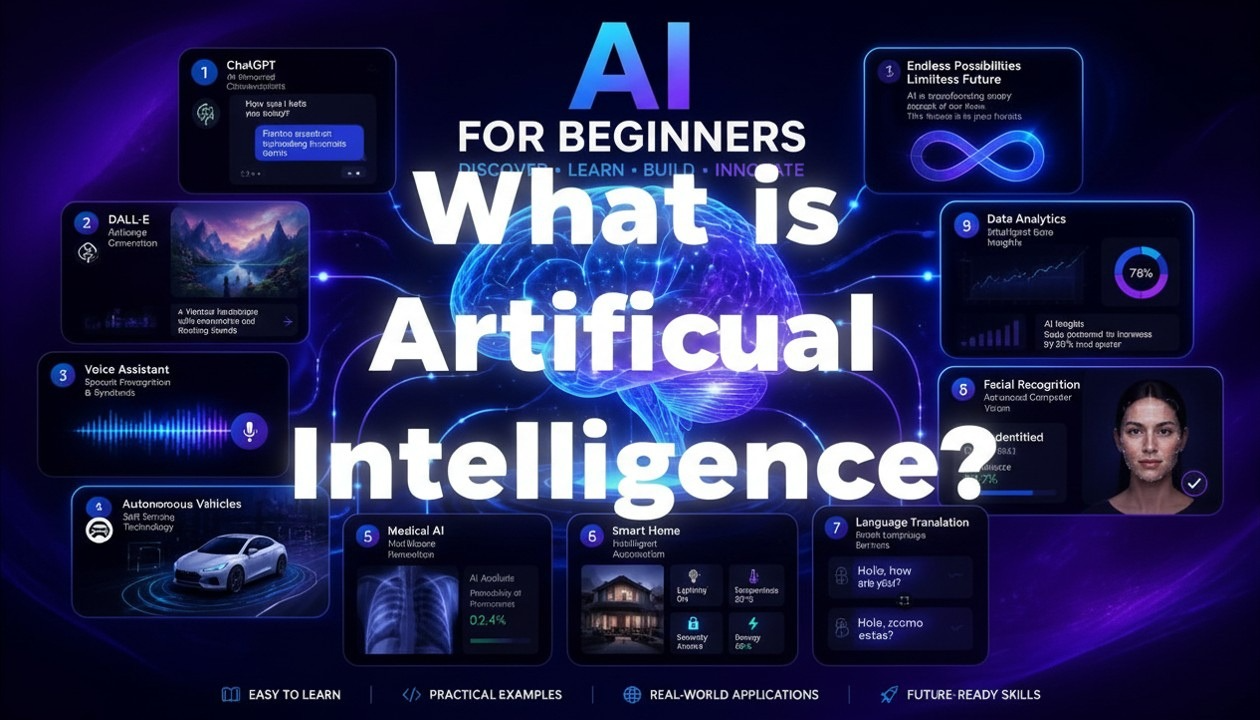
You’ve probably heard “AI” tossed around a hundred times this week alone. But what actually is it — and why does it feel like it’s suddenly everywhere?
What Is AI?
Artificial Intelligence, or AI, is simply the ability of a computer or machine to do things that would normally require human intelligence. Things like understanding language, recognizing faces, making decisions, translating text, or even writing emails.
Think of it this way: when you ask Siri “What’s the weather today?” and she actually answers you correctly — that’s AI at work. When Netflix recommends a show you end up loving on a Friday night, that’s AI too. It’s not magic. It’s not science fiction. It’s just really, really clever software.
The term “Artificial Intelligence” was officially coined back in 1956 by computer scientist John McCarthy, but the ideas behind it go back even further. For most of its history, AI was mostly academic — something scientists studied in labs. Then, somewhere around 2010, things started accelerating fast. And now? AI is in your phone, your car, your search engine, and probably your favorite app.
How Does AI Actually Work?
Here’s where people get lost, so let’s keep it simple.
Most modern AI doesn’t work the way humans think. It doesn’t “understand” things the way you do. Instead, it learns from patterns in data.
Imagine you want to teach a child to recognize a dog. You’d show them hundreds of pictures — big dogs, small dogs, fluffy dogs, weird-looking dogs — and eventually they’d get it. AI learns in a similar way, except instead of a child, it’s an algorithm, and instead of pictures, it’s often millions of data points.
This type of AI learning is called Machine Learning (ML) — a subset of AI where computers learn from experience without being explicitly programmed for every situation.
There’s also a deeper layer called Deep Learning, which uses structures loosely inspired by the human brain (called neural networks) to recognize complex patterns — like speech, images, and even emotions in text.
A Quick Breakdown of the AI Family Tree: Artificial Intelligence (AI)
│
├── Machine Learning (ML)
│ │
│ ├── Deep Learning (DL)
│ │ │
│ │ └── Generative AI
│ │ ├── Text Generation
│ │ ├── Image Generation
│ │ ├── Music Creation
│ │ └── Video Generation
│ │
│ └── Traditional ML
│ ├── Prediction
│ ├── Classification
│ └── Recommendation Systems
│
└── Other AI Systems
├── Robotics
├── Expert Systems
└── Computer Vision
- Artificial Intelligence — The big umbrella term
- Machine Learning — AI that learns from data
- Deep Learning — ML that mimics brain-like structures
- Generative AI — Creates new content (text, images, music)
You’ve probably used generative AI already. ChatGPT, Google Gemini, Adobe Firefly — these all fall under that last category.
The Different Types of AI (And What They Can Do)
Not all AI is the same. Here are the three main types, explained without the jargon:
1. Narrow AI (The AI We Use Every Day)
This is AI built to do one specific thing really well. Spotify’s recommendation engine? Narrow AI. Your email spam filter? Also narrow AI. It’s not conscious or “smart” in a general sense — it just excels at its one job.
Virtually every AI tool you use today falls into this category.
2. General AI (The Stuff of Science Fiction… For Now)
General AI, also called AGI (Artificial General Intelligence), would be a machine that can think and reason across any topic, just like a human. It doesn’t exist yet — but it’s what a lot of researchers are working toward, and what plenty of philosophers are worried about.
3. Super AI (Theoretical Territory)
This is AI that surpasses human intelligence in every way. It’s a concept for now, not a reality. Movies love this one (hello, Terminator and Ex Machina), but we’re nowhere near it.
Real-World Examples of AI You’ve Already Used
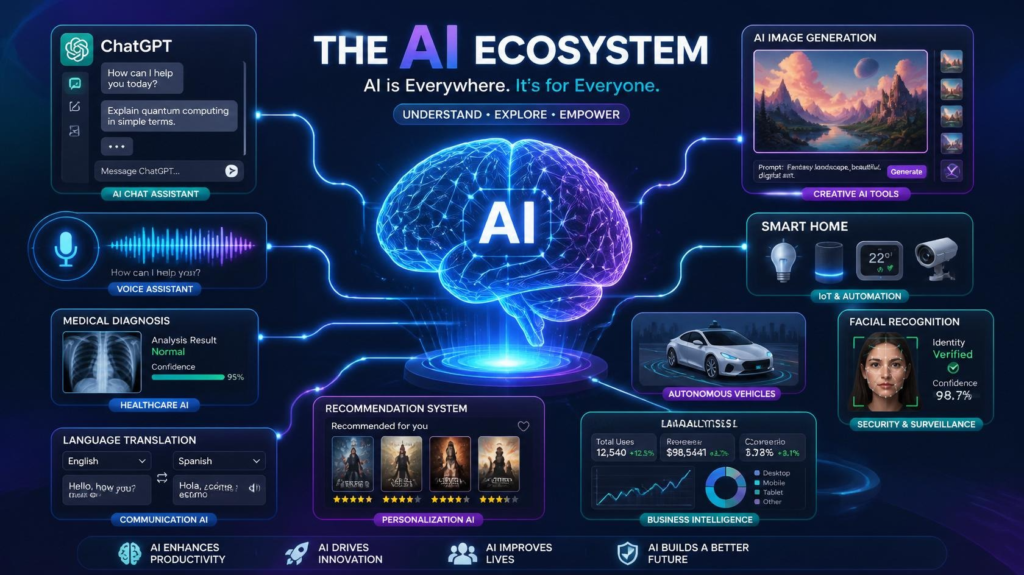
AI can feel abstract until you realize it’s baked into your daily life. Here are some you’ve definitely encountered:
- Google Search — AI ranks results and predicts what you’re looking for before you finish typing.
- Face ID on your iPhone — Deep learning recognizes your face in milliseconds.
- Amazon recommendations — “Customers also bought…” is entirely AI-driven.
- Fraud detection — Your bank uses AI to flag unusual transactions on your account.
- Autocorrect and autocomplete — That “helpful” feature that occasionally embarrasses you? AI.
- Virtual assistants — Alexa, Google Assistant, Siri. All AI.
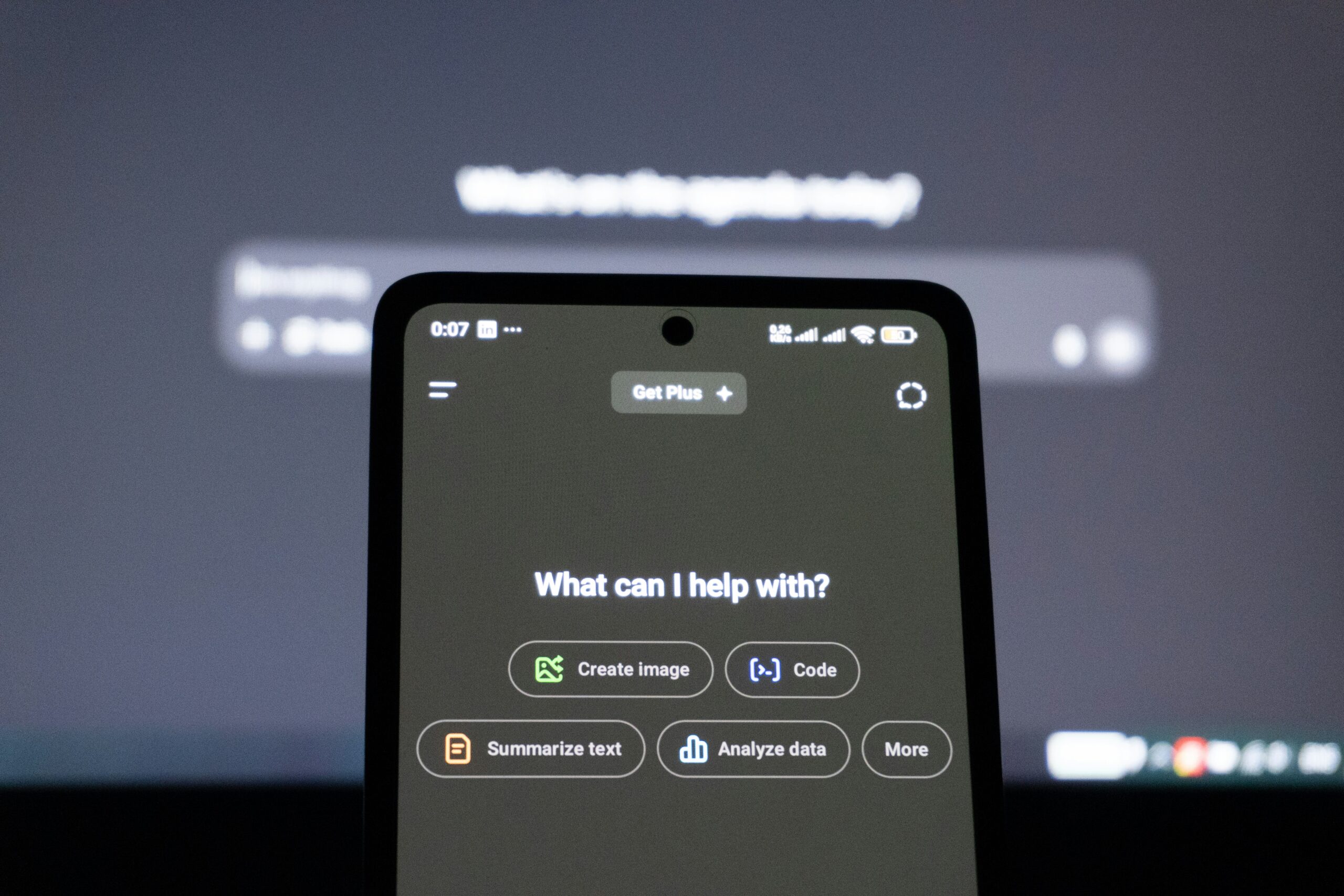
- AI writing tools — Tools like ChatGPT and Claude that help write, summarize, and brainstorm.
The point is: you don’t need to be a tech person to benefit from AI. It’s already doing things for you in the background.
Why Is Everyone Talking About AI Right Now?
Honestly? Because it got really good, really fast.
For decades, AI was limited. It could play chess. It could identify spam. Cool, but not exactly life-changing for most people.
Then came a wave of breakthroughs:
- 2012: Deep learning dramatically improved image recognition.
- 2017: A new architecture called the Transformer revolutionized how AI handles language.
- 2022–2023: Large Language Models (LLMs) like GPT-4 and Claude arrived — and suddenly anyone could have a conversation with an AI that felt eerily human.
That last part is what changed everything. AI stopped being a tool only engineers could use. It became accessible to everyone — writers, teachers, doctors, students, small business owners. The barrier dropped to zero.
The Good, The Bad, and the “We’re Still Figuring It Out”
AI isn’t all sunshine and productivity gains. Here’s an honest look at both sides.
The Good Stuff:
- Medical breakthroughs: AI can detect certain cancers from scans earlier than human doctors.
- Accessibility: Real-time transcription and translation tools help millions of people communicate better.
- Productivity: Repetitive tasks — writing first drafts, sorting data, answering FAQs — get done faster.
- Education: Personalized learning tools adapt to how each student learns.
The Concerns Worth Taking Seriously:
- Job displacement: Some roles are being automated, and not everyone can easily transition.
- Bias in AI: If AI is trained on biased data, it can produce biased results — a real problem in hiring, lending, and law enforcement.
- Misinformation: AI can generate convincing fake text, images, and even video (deepfakes).
- Privacy: AI systems often require vast amounts of personal data.
None of these problems are unsolvable — but they do require thoughtful policies, regulation, and honest conversation. The tech community, governments, and everyday users all have a role to play.
So… Should You Be Worried or Excited?
Both, probably — and that’s okay.
The honest answer is that AI is a tool. Like electricity or the internet before it, AI itself isn’t inherently good or bad. What matters is how we build it, regulate it, and use it.
If you’re a student, AI can help you learn faster. If you’re a professional, it can handle your busywork so you can focus on what actually matters. If you’re a creative, it can spark ideas when you’re stuck.
The people who will thrive in an AI-powered world aren’t necessarily the ones who build AI — they’re the ones who know how to work with it intelligently.
AI Is a Beginning, Not an Ending
Here’s the takeaway: Artificial Intelligence isn’t some far-off, scary robot future. It’s here, it’s practical, and it’s already part of your life whether you’ve noticed or not.
Understanding the basics — what AI is, how it learns, what it can and can’t do — puts you in a much better position than most people. You don’t need a computer science degree to be AI-literate. You just need curiosity and a willingness to engage with it thoughtfully.
The best time to start learning about AI was five years ago. The second best time? Right now.
FAQ: What People Actually Ask About AI
Q: Is AI the same as robots? Not exactly. AI is the software — the “brain.” Robots are physical machines. Some robots use AI to function, but most AI today lives in software, not physical hardware.
Q: Can AI think for itself? Current AI doesn’t “think” in the way humans do. It processes data and generates responses based on patterns it’s learned. It has no consciousness, desires, or awareness.
Q: Will AI take my job? AI will likely change many jobs, but “eliminate” is more complicated. Some tasks will be automated; new roles will emerge. Adapting and learning to use AI tools is one of the smartest career moves right now.
Q: Is AI safe to use? For most everyday applications — yes. But it’s smart to be cautious about sharing sensitive personal information with AI tools, and to verify important AI-generated information before acting on it.
Q: Do I need to learn to code to use AI? Nope. Most consumer AI tools require zero coding knowledge. If you can type a question, you can use AI.
Q: What’s the difference between AI and ChatGPT? AI is the broad field. ChatGPT is one specific AI product — a chatbot made by OpenAI. It’s like asking the difference between “cars” and “a Toyota Camry.”
Found this helpful? Share it with someone who keeps nodding along when AI comes up in conversation but secretly has no idea what it means. We’ve all been there.