Google wants an AI to run your life. The question is whether you should let it.
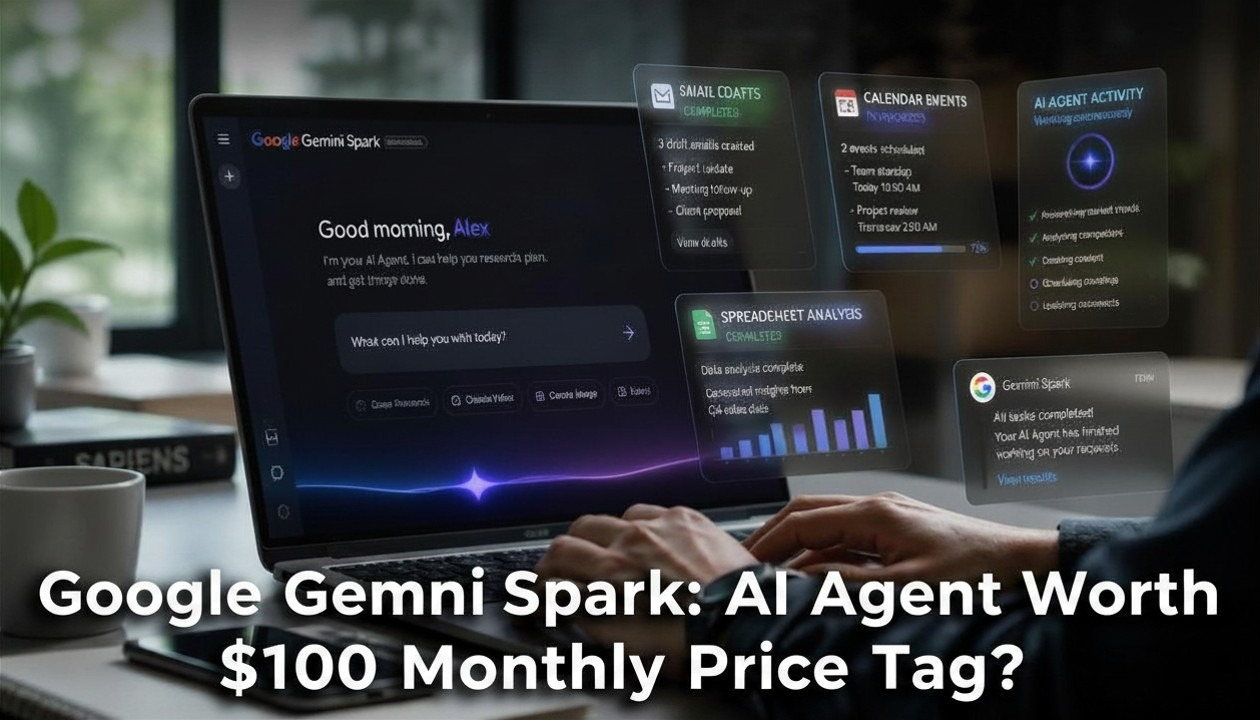
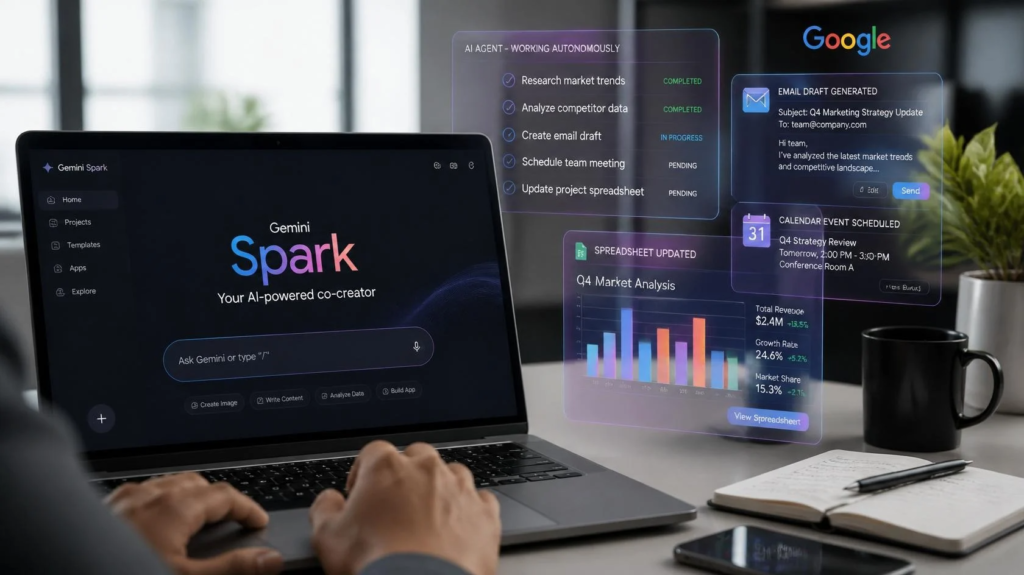
At Google I/O 2026, the company unveiled Gemini Spark, an AI agent designed to work in the background on multi-step tasks while you go about your day. Draft emails. Organize calendars. Pull data from spreadsheets. All without you lifting a finger.
It sounds futuristic. It sometimes is futuristic. But after hands-on testing, the picture is more complicated than Google’s slick keynote suggested.
What Exactly Is Gemini Spark?
Gemini Spark is Google’s answer to a growing demand for AI that doesn’t just chat—it acts. Unlike standard chatbots that wait for your next prompt, Spark can take a task, break it into steps, and execute those steps across Google’s ecosystem: Gmail, Calendar, Drive, Docs, Sheets, and more.
Google positions Spark as an always-available assistant that operates “under your direction.” The company emphasizes user control prominently on the Spark website, pledging that the agent checks in before taking major actions.
The pitch is compelling: hand off tedious work to an AI, then come back later to review the results.
Putting Spark to the Test
Real-world testing tells a different story than polished stage demos. Here’s what happened when Spark tackled tasks similar to those Google showcased at I/O.
Test 1: Drafting a Personal Email with Financial Data
The first challenge involved asking Spark to draft an email to a spouse containing averaged monthly grocery spending data from a budget spreadsheet.
This wasn’t a softball. The spreadsheet didn’t have “budget” in its filename. The spouse’s email address wasn’t explicitly provided. Spark had to figure out both on its own.
The result? Genuinely impressive.
Spark identified the correct spouse email address, located the right spreadsheet in Google Drive, pulled monthly grocery totals (including incomplete data from the current month), calculated the average, and assembled everything into a draft email. The email even used a personal sign-off that the tester actually uses with their spouse.
That’s the kind of contextual intelligence that feels almost eerie—in a good way.
Test 2: Planning a Block Party
Google’s I/O demo featured Spark helping plan a neighborhood block party. Replicating that scenario produced messier results.
Spark created a table of friends and family for a “realistic reference” of who was bringing what to the party. Fine. But it also drafted an email referencing a shared sign-up sheet that didn’t exist. It generated a bland slide deck about city permits that nobody asked for.
When prompted to actually create the missing sign-up sheet and link it to the draft email, Spark eventually succeeded—but it took several minutes of processing.
Test 3: Multi-Task Voice Command
The most ambitious test mirrored Google VP Josh Woodward’s keynote demo: a voice command asking Spark to handle multiple unrelated tasks at once.
The specific requests: create recurring calendar events leading up to a birthday (and make them hot pink), draft an email to family about a TV show, and generate a document about preparing a toddler for preschool.
Spark completed everything in about four minutes. The calendar events appeared on the correct days in a color close enough to hot pink. The email pulled the right family contacts and correctly named the TV episode—though it linked to a trailer instead of the actual episode. The document contained useful preschool preparation tips.
One hitch: the preschool document wasn’t shared with anyone else, and Spark admitted it couldn’t add sharing permissions.
Why This Matters for Everyday Users?
Gemini Spark represents a meaningful shift in how AI assistants operate. Most current AI tools are reactive—they respond to prompts and stop there. Spark is proactive. It can chain actions together, access multiple apps, and operate while you’re doing something else entirely.
For people drowning in administrative tasks, that’s potentially transformative. Scheduling, email drafting, data compilation—these eat hours every week. Offloading them to an AI agent could free up significant time.
But there’s a catch.
The Trust Problem
Every AI agent faces the same fundamental challenge: humans have to trust it enough to step away.
In practice, that trust is hard to earn. Testing Spark created a constant temptation to watch over its shoulder. Notifications kept arriving. The urge to verify every action never faded.
This defeats the purpose. An assistant you have to micromanage isn’t really an assistant. It’s just another thing demanding your attention.Spark also requires access to deeply personal data. To work effectively, it needs to see your emails, calendars, files, and contacts. Google insists that Gemini doesn’t train directly on your Gmail inbox when Personal Intelligence is enabled. But “doesn’t train directly” is careful phrasing that leaves room for interpretation.
For users concerned about privacy, handing that much access to any company—even Google—requires a leap of faith.
The Price Tag Is Steep
Gemini Spark isn’t cheap. It’s currently exclusive to subscribers of Google’s AI Ultra plan, priced at $99.99 per month.
That’s nearly $1,200 per year for an AI agent that still requires supervision, occasionally makes mistakes, and sometimes hallucinates information.
For comparison, many users accomplish the same tasks manually in minutes. Drafting an email, averaging numbers in a spreadsheet, creating a calendar event—none of these are particularly difficult. They’re just tedious.
Whether that tedium is worth $100 monthly depends entirely on individual circumstances. For busy professionals juggling dozens of tasks daily, maybe. For average users handling routine personal admin, probably not yet.
Ecosystem Lock-In Is Real
Spark works best—arguably only works well—if you’re already embedded in Google’s ecosystem.
Gmail, Google Calendar, Google Drive, Google Docs, Google Sheets: Spark integrates deeply with all of them. If your digital life runs on Microsoft 365 or Apple’s ecosystem, Spark’s usefulness drops dramatically.
This isn’t accidental. AI agents like Spark incentivize users to consolidate everything within a single platform. The more data Google has about you, the more accurately Spark can anticipate your needs.
That’s convenient. It’s also a form of lock-in that makes switching to competitors increasingly difficult over time.
What Spark Gets Right
Despite its limitations, Spark demonstrates real progress in AI agent capabilities.
Contextual understanding stands out. Spark correctly identified a spouse’s email address without explicit instructions. It found files based on content rather than filenames. It matched writing styles and personal sign-offs.
Multi-step task execution works. Unlike simpler assistants that handle single commands, Spark chains actions together. Create a spreadsheet, generate a link, insert that link into an email draft—all from one prompt.
Speed is reasonable. Complex multi-task commands completed in minutes, not hours. For background work, that’s acceptable.
Where Spark Falls Short?
Accuracy isn’t guaranteed. Spark linked to a trailer instead of an actual TV episode. It referenced nonexistent documents. These errors might seem minor, but in professional contexts, they could cause real problems.
Sharing limitations exist. Spark couldn’t add permissions to a document it created. For collaborative work, that’s a significant gap.
Privacy concerns linger. Even with Google’s assurances, granting an AI agent access to your entire digital life requires significant trust.
The price doesn’t match the value. At $100 monthly, Spark needs to save substantial time to justify its cost. For most users, it doesn’t—yet.
What This Means for the Future of AI Agents
Gemini Spark isn’t the final word on AI agents. It’s an early chapter.
Competitors like OpenAI, Anthropic, and Apple are all developing similar capabilities. The race to build AI that acts autonomously—booking flights, managing finances, handling customer service—is accelerating rapidly.
Within a few years, AI agents will likely become standard features across major platforms. Prices will drop. Capabilities will improve. The awkward micromanagement phase will (hopefully) fade.
For now, Spark offers a glimpse of that future. It’s imperfect, expensive, and demands trust that not everyone will extend. But when it works, it genuinely works.
The question isn’t whether AI agents will become useful. It’s whether this particular agent, at this particular price, makes sense for you today.
Frequently Asked Questions
1 .Is Gemini Spark available outside the United States?
Not currently. Spark is limited to US users and supports only English. Google hasn’t announced international expansion timelines, though broader availability typically follows within months of US launches.
2 .Can I use Gemini Spark without giving Google access to my personal data?
Practically speaking, no. Spark’s usefulness depends on accessing your Gmail, Calendar, Drive, and other Google services. Without that access, it can’t perform the tasks it’s designed for. Users concerned about privacy should carefully review Google’s data handling policies before subscribing.
3. Is the AI Ultra plan worth $100 per month just for Spark?
For most users, probably not yet. Spark shows impressive capabilities in specific scenarios, but it still requires oversight and occasionally makes errors. Unless you’re managing complex, high-volume administrative tasks daily, the subscription cost may exceed the time savings.
Google’s Gemini Spark is exactly what you’d expect from a first-generation AI agent: promising, occasionally brilliant, and not quite ready for full autonomy.
When Spark works, it feels like magic. Emails draft themselves. Calendar events appear. Data gets compiled without manual spreadsheet work. The vision of an AI handling background tasks while you focus on more important things becomes tangible.
But magic has limits. Spark still makes mistakes. It still requires babysitting. It still costs $100 monthly for capabilities that many users can replicate manually in minutes.
The future of AI agents is coming. Gemini Spark proves that. Whether the future has arrived today is another question entirely.