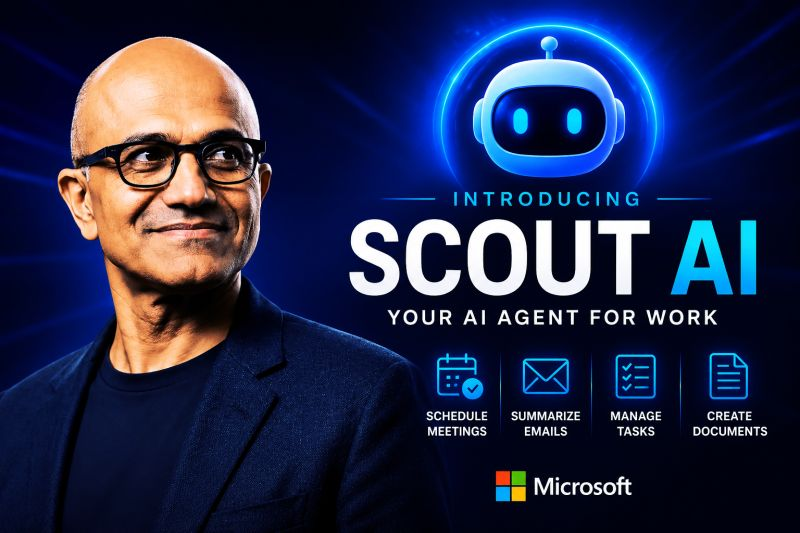
Microsoft’s new Autopilot Agents, led by Scout, go beyond chatbots to autonomously manage tasks across Microsoft 365. Here’s what it means for the future of work.
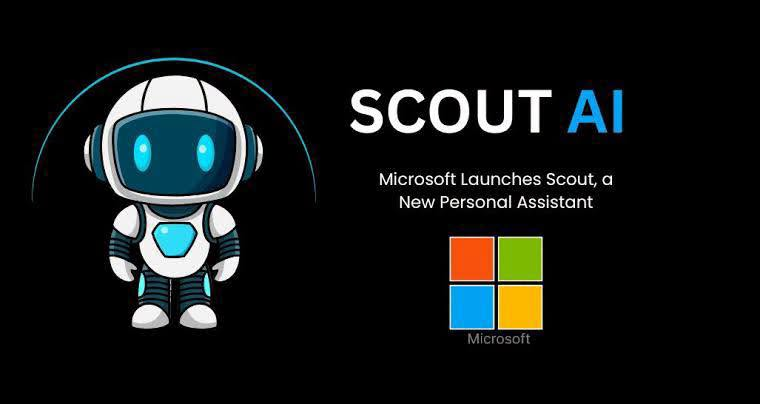
Microsoft’s Autopilot Agents Are Here — And They Don’t Wait to Be Asked
For years, the promise of AI in the workplace looked like this: you type a question, the AI answers it. You ask it to draft an email, it drafts one. You close the window, it stops thinking.
That model is officially giving way to something more ambitious — and more consequential.
Microsoft has unveiled a new category of AI systems called Autopilot Agents, designed not to respond to requests, but to work independently in the background, tracking your projects, monitoring your communications, identifying what’s at risk, and taking action — all without you having to prompt them each time.
The first of these agents, named Microsoft Scout, is already being integrated across the Microsoft 365 suite. And if it works as advertised, it could permanently change what “going to work” actually means.
What Is Microsoft Scout — and What Can It Actually Do?
Scout is not a chatbot. That distinction matters more than it might first appear.
Traditional AI assistants — whether that’s Microsoft Copilot, ChatGPT, or Google’s Gemini — operate on a request-response model. A human asks; the AI answers. The initiative always lies with the person.
Scout flips that dynamic. Instead of waiting for you to ask whether a project deadline is at risk, Scout monitors the relevant emails, Teams threads, calendar entries, and SharePoint documents itself — and tells you proactively when something needs attention.
Concretely, Scout can:
- Monitor project deadlines across Teams and Outlook and flag items slipping behind schedule
- Summarize meeting discussions and surface unresolved action items automatically
- Reserve focus time on your calendar before high-priority deadlines crowd it out
- Organize incoming information across Outlook and OneDrive so critical communications don’t get buried
- Identify risks in ongoing projects by cross-referencing discussions, documents, and timelines
Microsoft says Scout achieves this through what it calls Work IQ technology — a system that learns how an individual employee and their team actually operate, what their priorities are, and how work typically flows through their organization. Over time, Scout is meant to get better at distinguishing what matters from what doesn’t.
The Difference Between an AI Assistant and an Autonomous Agent
This distinction sits at the heart of why Microsoft’s announcement has drawn so much attention across the enterprise technology space.
An AI assistant is a tool. You pick it up when you need it, put it down when you don’t. Its value is bounded by how often and how skillfully you use it.
An autonomous AI agent is something closer to a colleague. It has ongoing responsibilities. It monitors things while you’re in meetings, on vacation, or simply focused on something else. It doesn’t need to be reminded to check in.
The analogy Microsoft is quietly drawing — though carefully — is to a highly capable executive assistant who never sleeps, never gets overwhelmed, and has perfect recall of every email, document, and conversation in your digital workspace.
The practical gap between those two models is enormous. Most knowledge workers today spend a significant portion of their day not doing their actual job, but managing information: triaging email, updating project trackers, chasing status updates, preparing summaries. If an autonomous agent can absorb a meaningful portion of that load, the productivity implications are significant.
McKinsey research has estimated that knowledge worker productivity stands as one of the largest addressable opportunities in generative AI — with the potential to automate or augment tasks representing trillions of dollars in labor value globally.
The Competitive Landscape: Microsoft Is Not Alone
Microsoft is moving fast, but it’s not moving alone.
OpenAI has been building toward agentic capabilities with its Operator product, which allows AI to take actions in web browsers on a user’s behalf. Google has been rolling out agent-style features inside Workspace, with its Gemini models increasingly capable of acting across Gmail, Docs, and Calendar with minimal human direction. Salesforce has made agentic AI central to its Agentforce platform, targeting sales and customer service workflows specifically. And Anthropic has been advancing its Claude models with an explicit focus on long-horizon, multi-step task completion that underpins agent-style behavior.
What Microsoft has that most competitors can’t easily replicate is distribution. With Microsoft 365 already deployed across hundreds of millions of enterprise users worldwide, Scout doesn’t need to convince organizations to adopt a new platform. It arrives inside software they already use every day.
That integration advantage is formidable. An autonomous agent embedded inside Outlook and Teams operates in the actual environment where work happens — not as a separate tool that requires data to be exported or workflows to be rebuilt.
Privacy, Security, and the Questions Microsoft Must Answer
Autonomous AI agents operating across email, calendar, messaging, and file storage raise serious questions that Microsoft will need to address clearly — and continuously.
Who has access to what Scout sees? How is sensitive information handled when Scout summarizes a confidential negotiation or flags a personnel issue? Can employees opt out, or is Scout’s monitoring an organizational-level decision made by IT administrators?
These aren’t hypothetical concerns. Enterprise AI deployments have already run into friction over data residency, regulatory compliance, and employee privacy rights — particularly in regulated industries like healthcare, finance, and legal services.
Microsoft has built its enterprise AI credentials in part on its commitment to data security and compliance, and Scout will need to operate within those frameworks. But the autonomous nature of these agents — the fact that they act without a human specifically initiating each action — introduces new accountability questions that the industry is still working through.
The question of who is responsible when an autonomous agent makes a mistake — schedules the wrong meeting, flags the wrong project as at-risk, or surfaces confidential information to the wrong person — is one that legal and compliance teams at large enterprises will scrutinize closely.
Could AI Agents Become Digital Coworkers?
The phrase “digital coworker” has been floating around AI discourse for a couple of years, but it has historically felt more like marketing language than a technical reality. Autopilot Agents are the most credible step yet toward making that concept tangible.
A genuine digital coworker — in the sense that Microsoft appears to be envisioning — would have persistent context, ongoing responsibilities, the ability to act (not just advise), and the capacity to learn from outcomes over time. Scout, as described, checks most of those boxes.
What it doesn’t yet have — or at least what Microsoft hasn’t yet claimed — is genuine judgment in ambiguous situations, the ability to navigate interpersonal dynamics, or accountability in the way a human employee has accountability.
But the trajectory is clear. Each generation of these systems will become more capable, more trusted with higher-stakes actions, and more deeply embedded in organizational workflows.
The Next Five Years: How Autonomous Agents Will Reshape Office Work
Looking ahead, autonomous AI agents are likely to follow a pattern familiar from other major technology transitions: slow adoption at first, concentrated in early-mover organizations, followed by a rapid normalization phase where the technology becomes a baseline expectation rather than a competitive advantage.
Over the next five years, several shifts seem probable:
Task ownership will evolve. Knowledge workers will increasingly define their role not by the tasks they perform, but by the decisions they make and the judgment they apply. Routine coordination, information synthesis, and status monitoring will migrate to agents like Scout.
The definition of “doing nothing” changes. When you’re away from your desk, an agent is still working. The concept of downtime — or more precisely, of work stopping when a person stops — becomes less applicable to roles where agents are active.
New management challenges will emerge. Managers will need to oversee not just people, but agents — understanding what the AI is doing, auditing its outputs, and knowing when to override it. “Managing AI” will become a distinct skill set within organizations.
Competitive pressure will accelerate adoption. Companies that deploy autonomous agents effectively and early will likely see measurable efficiency gains. That will create pressure on competitors to follow — not because the technology is mandated, but because the productivity gap will be difficult to ignore.
Regulatory frameworks will catch up — eventually. Governments and industry bodies are already beginning to grapple with AI accountability. Autonomous agents that take actions in the workplace will be a focal point of that regulatory attention, particularly in the European Union and, increasingly, in the United States.
Microsoft Scout may be the first name most people associate with this shift. It almost certainly won’t be the last.
The age of AI that waits to be asked is ending. The age of AI that gets to work is beginning.
6. FAQ Section
Q: 1.What is Microsoft Scout?
Microsoft Scout is an autonomous AI agent built into Microsoft 365. Unlike traditional AI assistants, it proactively monitors emails, meetings, deadlines, and documents — and takes actions like reserving calendar time or surfacing risks without needing to be prompted.
Q: 2.How is Scout different from Microsoft Copilot?
Copilot responds when you ask it to do something. Scout operates continuously in the background, monitoring your work environment and acting on your behalf within pre-approved boundaries — much like an always-on digital assistant rather than an on-demand chatbot.
Q:3. What is Work IQ technology?
Work IQ is Microsoft’s term for the underlying system that allows Scout to learn an individual employee’s priorities, workflows, and communication patterns — enabling the agent to become more accurate and useful over time.
Q: 4.Is Microsoft Scout available now?
Microsoft has announced Scout as part of its Autopilot Agents initiative, with integration planned across Microsoft 365 applications including Outlook, Teams, SharePoint, and OneDrive. Availability timelines for enterprise customers should be confirmed via Microsoft’s official blog.