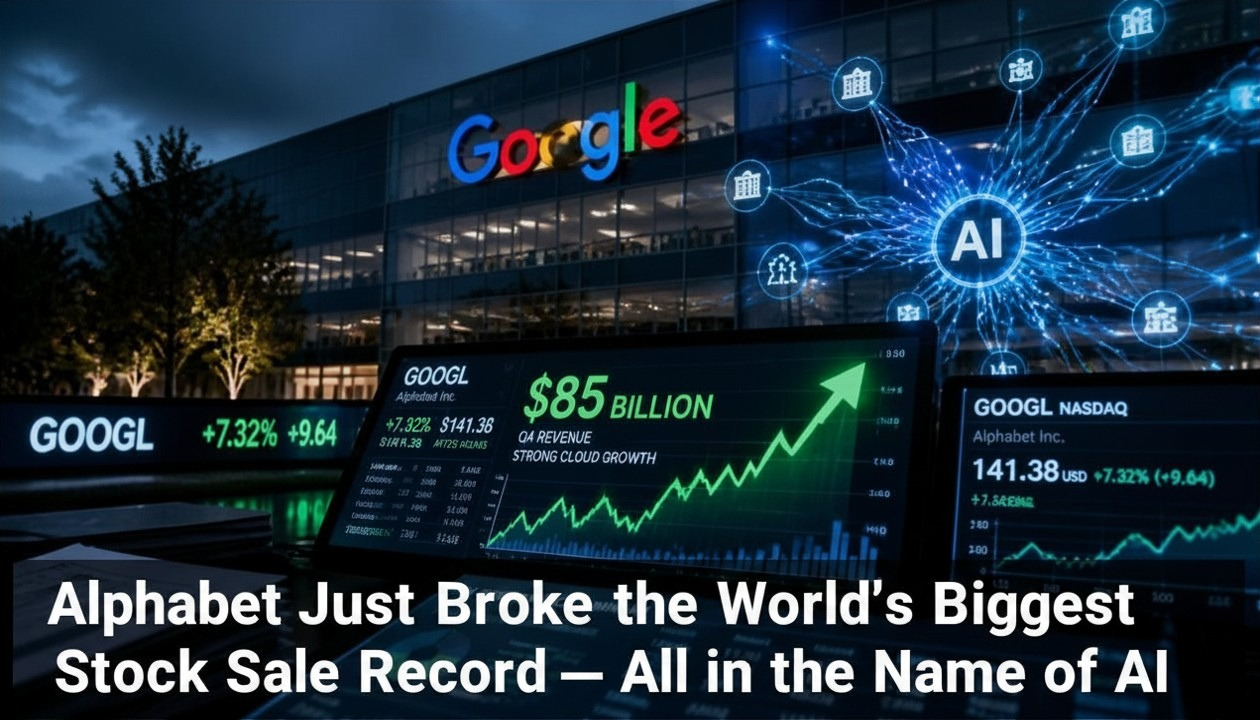
Alphabet Just Broke the World’s Biggest Stock Sale Record — All in the Name of AI
Google’s parent company raised a jaw-dropping $85 billion in a single equity offering. The move isn’t just a milestone for Alphabet — it’s a massive green light for every AI company eyeing Wall Street.
$85B Total raised
$45B First tranche
$10B Berkshire’s buy-in
$70B Previous world record
When the World’s Biggest Tech Company Needs More Cash, You Pay Attention
Think about this for a second: Alphabet — a company that already pockets more than $110 billion in revenue every single quarter — just went to Wall Street and said, “We need more money.” And Wall Street didn’t just respond. It showed up in a stampede.
The company’s stock offering, designed to fund its AI ambitions, became the largest equity raise in recorded financial history. It obliterated the previous record set by Brazilian oil giant Petrobras back in 2010, which had raised $70 billion. Alphabet didn’t just clear the bar — it vaulted past it by $15 billion.
For anyone watching the AI industry closely, this isn’t just a corporate finance story. It’s a signal. A loud, unmissable one.
What Actually Happened: The Deal That Broke the Record Books
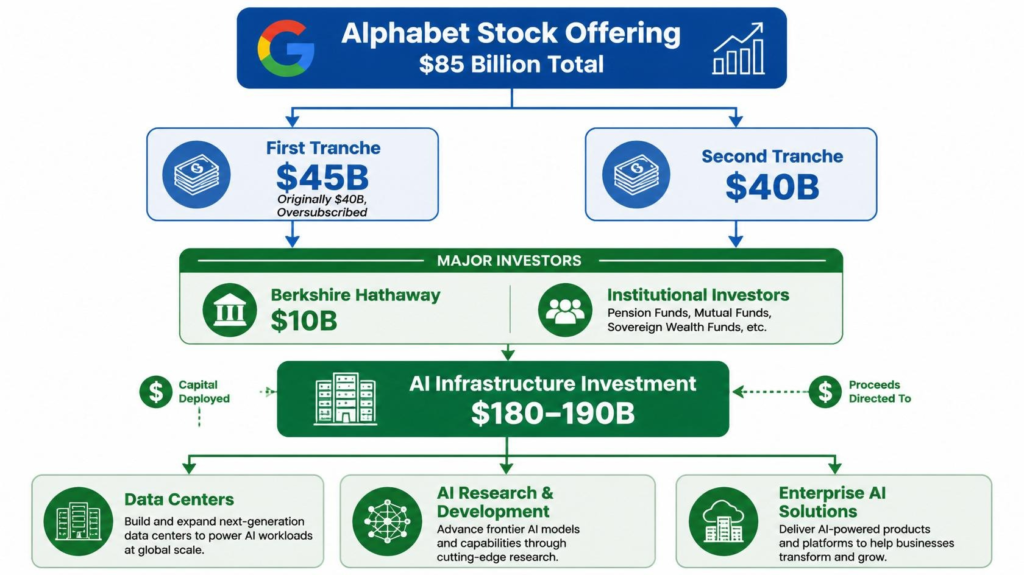
Alphabet originally planned to raise $40 billion in this first round of fundraising. The offering included a mix of share types — two classes of Alphabet stock, plus smaller “depositary shares” designed to be more affordable for everyday investors, not just large institutions.
But demand was so overwhelming that the offering was oversubscribed — meaning more buyers wanted in than there were shares available. The result? Alphabet ended up raising $45 billion in just the first tranche, with CEO Sundar Pichai announcing the news via a post on X.
Among the buyers: Warren Buffett’s Berkshire Hathaway, the firm famously associated with patient, value-based investing, quietly dropped $10 billion into the deal. That alone should make people take notice.
The remaining $40 billion is expected to be raised next quarter, bringing the full total to $85 billion — a number that has no precedent in the history of global equity markets.
“Part of our multi-year investment strategy to meet the AI opportunity ahead and support the demand we’re seeing from enterprises and consumers.” — Sundar Pichai, Alphabet CEO
Why This Matters: It’s Not Just About Google
It would be easy to look at this story and think: “Well, Alphabet is a uniquely healthy business. This doesn’t say much about the rest of the AI world.” And to be fair, that’s partially true. Alphabet posted 22% revenue growth year-over-year in Q1 2026, and its profit margins are enviable by any measure.
But here’s the thing — the money from this offering isn’t going into Google Search or YouTube. It’s earmarked almost entirely for AI. Pichai has said Alphabet plans to pour between $180 billion and $190 billion into AI infrastructure and data centers before the end of 2026. The stock sale is helping fund that ambition.
More importantly, this offering shows that public investors — not just the private venture capitalists who have been quietly funding AI startups for years — are ready to put serious capital on the table. That distinction matters enormously for what’s coming next.
The Ripple Effect: What This Means for the AI IPO Wave
Several of the most-watched IPOs in recent memory are sitting in the pipeline right now. SpaceX, widely expected to break records for both valuation and capital raised, is preparing its public debut. Anthropic — the AI safety company behind Claude — is also gearing up for a listing that analysts expect could rival, or even surpass, SpaceX’s numbers. And OpenAI is reportedly watching from the wings, eyeing its own eventual public offering.
All of these deals depend on one critical variable: the continued appetite of public market investors. Alphabet’s successful raise is essentially a proof-of-concept that the appetite is real, deep, and ready.
When a company as well-known and financially stable as Alphabet attracts this level of demand for an AI-focused offering, it sends a powerful message to every investment committee, fund manager, and institutional allocator deciding whether to back the next big AI IPO. The green light is flashing.
Here’s a quick breakdown of what makes this deal significant beyond the headline numbers:
Record size: At $85 billion total, this beats the previous global equity record by $15 billion — and the first tranche alone ($45 billion) would have already taken the crown.
Berkshire’s involvement: Having one of the world’s most conservative investment firms commit $10 billion signals that AI infrastructure spending is now viewed as stable, long-term value — not just speculative hype.
Public vs. private capital: This is a public market deal, which means it tests Main Street investor confidence in AI, not just Silicon Valley insiders. It passed with flying colors.
Scope of spending: The $180–$190 billion capital expenditure target Alphabet has set for 2026 is almost incomprehensibly large. It represents a generational bet on AI infrastructure being the defining resource of the next decade.
The Big Question Hanging Over the Industry
Here’s where the optimism gets complicated. Across the entire AI industry, an estimated $8 trillion in spending has been committed over the next five years. That’s not a typo — eight trillion dollars. To put it in context, that’s roughly the combined GDP of Japan and Germany.
That capital has to come from somewhere: company revenues, bank loans, and public equity raises like this one. The question isn’t whether investors are excited about AI right now — clearly, they are. The real question is whether that excitement holds for five, seven, or ten years as the costs compound and the returns take time to materialize.
Alphabet’s record raise is a strong positive signal. But even the most bullish AI investors would admit that sustaining this level of public market enthusiasm, across dozens of IPOs and capital raises, over a multi-year horizon, is anything but guaranteed. Every company planning an AI-related public offering should be watching market sentiment very carefully — not just for when to launch, but for how long the window stays open.
Frequently Asked Questions
Why did Alphabet need to raise money if it already earns billions every quarter?
Even highly profitable companies often use equity raises to fund large capital projects without drawing down cash reserves or taking on debt. Alphabet’s planned AI infrastructure spending of up to $190 billion this year alone is so enormous that raising additional capital through a stock offering is a practical way to share both the cost and the risk with investors while preserving financial flexibility.
What is a “depositary share,” and why did Alphabet include them?
A depositary share represents a fraction of a full share of stock, priced to make investing more accessible to smaller buyers who might not be able to afford a full share at its current market price. By including them in the offering, Alphabet was able to broaden the pool of potential investors beyond just large institutional funds.
Does Alphabet’s success guarantee strong IPO markets for other AI companies?
Not automatically. Alphabet is an unusually well-established, profitable business, which makes its offerings more attractive to risk-averse investors. Younger AI companies like Anthropic or OpenAI will face more scrutiny over their path to profitability. However, the strong demand for Alphabet’s offering is a positive indicator that public investors are broadly willing to commit capital to AI — which is a necessary (if not sufficient) condition for those future IPOs to succeed.
Alphabet just made history — not just for itself, but potentially for every company that plans to ride the AI investment wave into public markets. The numbers are staggering, the demand was real, and the participation of conservative giants like Berkshire Hathaway lends the whole thing a credibility that pure AI hype simply can’t manufacture.
But perhaps the most important lesson here isn’t about Alphabet at all. It’s about timing. Right now, public market investors want in on AI. The window is open. The question every startup, every IPO hopeful, and every investment strategist should be asking is: how long will it stay that way?