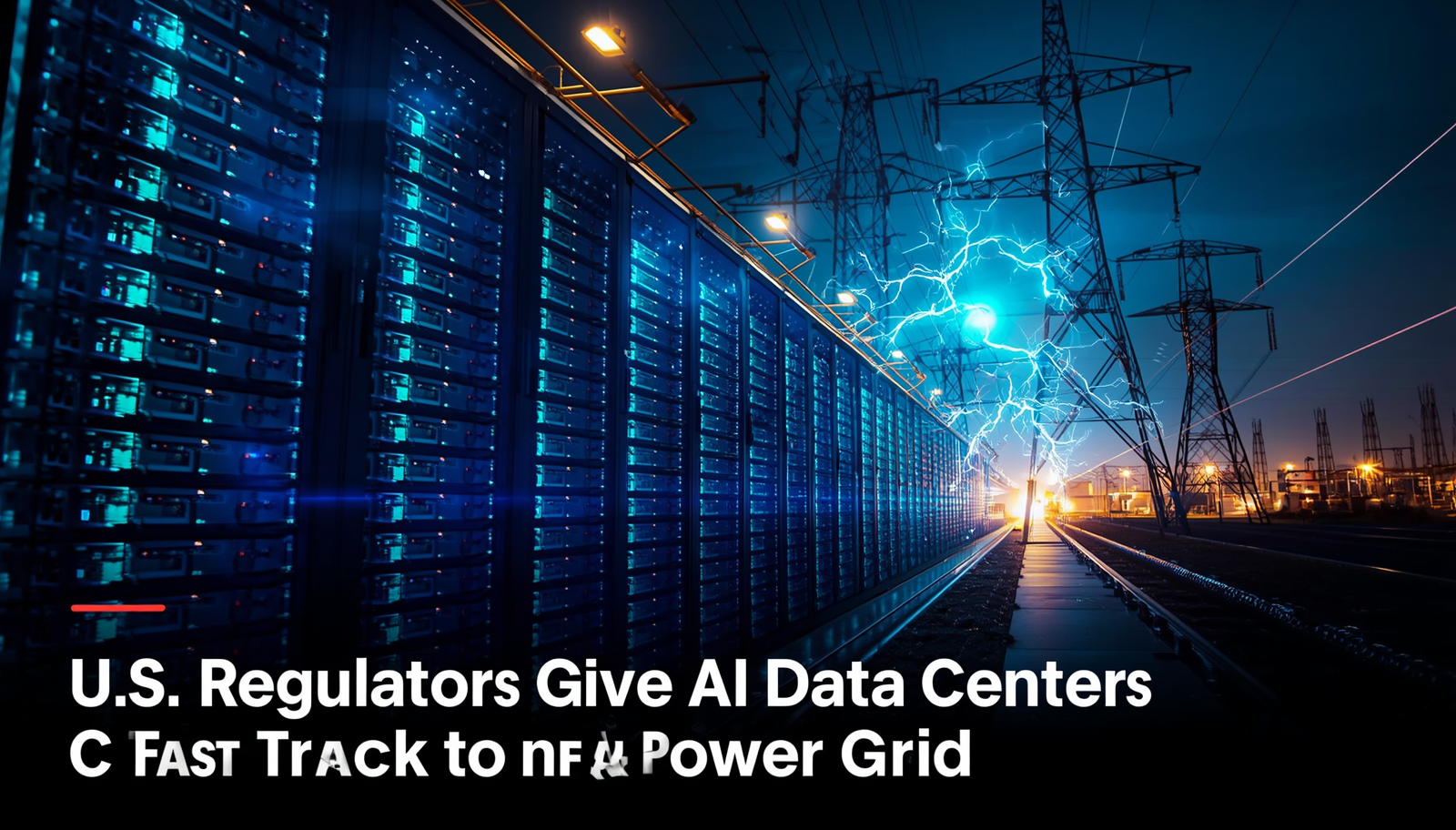
Every time a large language model processes a query, a recommendation engine ranks search results, or a generative AI tool renders an image, somewhere in America a bank of servers draws electricity — a lot of it. The computational machinery behind modern artificial intelligence is voracious by design, and the data centers housing it have quietly become one of the fastest-growing electricity consumers in the country. Now, the agency that oversees the nation’s interstate power system is moving — with uncommon urgency — to tear down one of the biggest obstacles standing between AI’s ambitions and the electrons it needs to run.
The Federal Energy Regulatory Commission announced in April that it intends to complete action on a landmark rulemaking by the end of June 2026, targeting how large electricity users — specifically facilities drawing more than 20 megawatts — connect to the transmission grid. The docket, known as RM26-4-000, traces its origins to an October 2025 directive from Energy Secretary Chris Wright, who instructed the commission to modernize a regulatory process that was designed for a different era of electricity consumption. For an industry where a single hyperscale AI training facility can require hundreds of megawatts, that directive couldn’t have come soon enough.
Why Grid Connections Have Become a Bottleneck
To understand why this rulemaking matters, it helps to understand what “grid interconnection” actually involves. When a new facility — whether a power plant, a factory, or a data center — wants to draw significant electricity from the transmission grid, it doesn’t simply plug in. It must navigate a federally regulated study process in which grid operators assess the technical and financial impact of the new load on the surrounding network. That process triggers a cascade of engineering studies, cost assessments, and in many cases, expensive upgrades to nearby transmission infrastructure.
Historically, this system was calibrated for a world where large new electricity users appeared relatively infrequently and capacity requests were measured in single-digit megawatts. The AI build-out has broken that model. Data center developers are now submitting connection requests for campuses that dwarf anything the grid operators’ queues were designed to process. The result is a backlog that can stretch years — a death knell in an industry where being six months late to market can mean losing competitive ground to a rival.
Regulatory Context FERC’s December 2025 order directed grid operator PJM — which oversees electricity for 65 million people across 13 states — to create three new transmission service options for co-located data center customers, setting a template that the June 2026 rulemaking may extend nationally.
The interconnection backlog isn’t just frustrating for tech companies. It creates planning headaches for utilities trying to predict regional load growth, and it risks destabilizing grid reliability models that depend on knowing how much new demand is coming and when. What the commission is attempting, in short, is to build a faster, more orderly on-ramp for the AI economy without letting the highway turn into gridlock.
AI Is Reshaping What America’s Power Grid Must Do
The scale of what’s coming is genuinely difficult to absorb. According to the International Energy Agency’s most recent projections, global electricity consumption from data centers is on track to roughly double between 2025 and 2030, reaching approximately 945 terawatt-hours — slightly more than Japan’s entire national electricity consumption today. Electricity demand from AI-optimized facilities specifically is expected to triple during that same window.
The United States sits at the center of that growth curve. American data centers are projected to account for nearly half of the country’s electricity demand growth between now and the end of the decade. By 2030, the IEA calculates, the U.S. economy will consume more electricity powering data centers than it does manufacturing aluminum, steel, cement, chemicals, and every other energy-intensive industrial product combined. That is a remarkable structural shift in where American kilowatt-hours go.
945TWh global data center demand by 2030 (IEA)
3×Growth in AI data center electricity use by 2030
35 GWProjected U.S. data center capacity by 2030 (McKinsey)
22%Power demand spike from U.S. data centers in 2025 (CSIS)
Goldman Sachs Research has put even sharper numbers on the trend, projecting a 165% increase in global data center power demand between 2023 and 2030. The National Electrical Manufacturers Association echoes that trajectory, finding that data center expansion will be the primary driver of regional electricity demand growth through the late 2020s, with electric vehicles gradually taking over as the dominant driver in the following decade.
Related Coverage
IEA: Key Questions on Energy and AI (April 2026)FERC Directs PJM to Create New Rules for AI Data Centers (Dec. 2025)FERC Sets June Deadline to Rewrite Large-Load Grid Rules (Power Magazine)
The Case for Grid Modernization — and Who Stands to Gain
One of the more consequential elements buried in the proposed rulemaking is the push for co-location arrangements — pairing data centers directly with nearby generation sources so that the new load can bypass congested transmission corridors entirely. The idea isn’t new, but FERC’s December 2025 order requiring PJM to formalize co-location rules gave it regulatory legitimacy, and the June action on RM26-4-000 appears designed to extend that framework across other regional grid operators nationwide.
For utilities and transmission infrastructure companies, the moment carries genuine opportunity. The wave of data center investment is driving demand for new substations, transformer upgrades, advanced power electronics, and — where co-location takes hold — dedicated generation facilities. NEMA president Debra Phillips has been clear about one constraint: the transformer manufacturing sector faces a shortage of roughly 15,000 workers, a supply-chain pinch that could slow even the most well-intentioned grid expansion plans.
Advanced transmission technologies, including dynamic line ratings, grid-enhancing devices that improve throughput on existing wires, and next-generation switchgear, are also getting a second look from utilities that need to move more power without waiting years for new transmission lines. A regulatory environment that rewards urgency creates a more favorable business case for those capital investments.
The Challenges That Reform Cannot Instantly Fix
Regulatory speed helps, but it doesn’t conjure generating capacity out of thin air. Even if data center developers can navigate interconnection paperwork faster, they still need actual electrons waiting at the other end — and in many regions of the country, the supply of dispatchable generation capacity is tight.
Generating Capacity and Backlogs
Power plant interconnection queues — separate from the load queues this rulemaking targets — have ballooned in recent years, particularly for large natural gas and renewable projects. Clearing those backlogs requires not just regulatory reform but physical construction, which takes time regardless of how quickly approvals move.
Cost Allocation and Ratepayer Risk
The proposed rule leans on a participant-funding model, meaning data center operators seeking expedited connections would bear the full cost of any transmission upgrades their project requires. That structure is designed to prevent existing customers from subsidizing new entrants — but it also raises the capital bar for smaller or less-established data center developers. The question of who ultimately pays for grid reinforcement, and how those costs are distributed among ratepayers, remains politically sensitive.
Regional Constraints
Not all regions face the same pressure. Parts of the Southeast and Southwest are seeing explosive demand growth with limited headroom in the local transmission network. Other regions have more slack. A nationally uniform rule will inevitably fit some markets better than others, and how grid operators translate federal guidance into regional tariffs will determine how much real-world impact this rulemaking delivers.
“The United States leads the world in AI, but that leadership is hitting a hard constraint: the availability of electricity. Even where power is technically available, some AI data centers face years of delay before they can be powered on.” — Institute for Progress, April 2026
How the Tech Industry Is Building Around the Bottleneck
Rather than waiting on regulators, the largest technology companies have already begun treating energy supply as a strategic asset — not a utility cost. The results are reshaping the American energy landscape in ways that would have seemed implausible five years ago.
Nuclear Power
Microsoft brought the shuttered Three Mile Island Unit 1 reactor in Pennsylvania back online in late 2024 under a 20-year power purchase agreement, making it the first nuclear plant restart in the United States in decades. The 835-megawatt facility now powers Microsoft’s AI data center operations. Amazon has committed to acquiring 12 small modular reactors through a partnership with Energy Northwest, targeting nearly a gigawatt of dedicated generation. Google has signed the largest corporate nuclear power purchase agreement in history — a deal with Kairos Power for SMR capacity coming online in the early 2030s — and separately completed its $4.75 billion acquisition of Intersect Power in March 2026 to secure co-located renewable and natural gas generation directly attached to its data center campuses. Meta has issued a request for proposals for up to four gigawatts of new nuclear capacity.
Natural Gas and Renewables
Where nuclear timelines stretch too long, companies are turning to natural gas. Meta is building dedicated gas generation facilities adjacent to its largest AI training campuses. Google, Amazon, and Microsoft have all expanded natural gas contracts despite longstanding carbon commitments — a pragmatic shift driven by the reality that intermittent wind and solar alone cannot reliably power facilities that run around the clock. On the renewable side, tech giants signed 14 geothermal power purchase agreements totaling 635 megawatts in 2025 alone — three times the volume of the prior year — and Google inked a 150-megawatt geothermal deal with Ormat Technologies specifically to anchor its Nevada data center expansion.
More on Tech Energy Strategies
Why Big Tech Is Turning to Natural Gas Despite Climate Pledges (Yale E360)Amazon, Google, Meta and Microsoft Go Nuclear (Trellis)Google’s 150MW Geothermal Deal With Ormat Technologies (CarbonCredits.com)
What This Means for Consumers and Local Economies
The data center expansion is not an abstraction for households and local governments. On the positive side, large campuses create substantial economic activity — construction jobs, permanent technical employment, property tax revenue, and secondary spending in surrounding communities. States have competed aggressively to attract hyperscale investment with tax incentives and streamlined permitting, recognizing the long-term fiscal benefits.
The electricity cost question is more complicated. Data centers that bear the full cost of their transmission upgrades under the participant-funding model are less likely to shift those costs to average ratepayers. But in regions where new data center loads strain existing infrastructure without full cost recovery, utility commissions face pressure to spread those upgrade expenses across all customers. Consumer advocates have urged regulators to establish clear guardrails on that cost allocation, and the June rulemaking is expected to address those concerns directly.
Reliability is the other variable. A grid that is asked to serve dramatically more load without proportional increases in generation and transmission capacity faces higher risk of stress events — particularly during extreme weather. The National Energy Reliability Corporation has signaled that a reliability guideline for large-load operators is forthcoming, with a formal Reliability Standard potentially following in 2026.
Expert Analysis: Can Infrastructure Keep Pace?
The honest answer from energy analysts is: probably, but not easily, and not everywhere. The United States has the capital, the land, and the technical know-how to build the generation and transmission capacity that AI demands. What it has historically lacked is the regulatory speed to approve and connect new infrastructure before market needs outpace planning cycles.
The FERC rulemaking, if finalized on schedule, addresses one leg of that challenge. But the transformer shortage, the construction workforce gap, the power plant interconnection queue, and the political complexity of siting new transmission lines across state lines all represent friction that federal rulemaking cannot dissolve on its own. The IEA executive director’s framing captures the stakes: countries that provide secure, affordable, and rapid access to electricity will hold a structural advantage in the AI era. The United States is trying to be that country — and the June deadline is a meaningful step toward making that case credible.
The more immediate test is whether the framework FERC puts in place is durable enough to survive the inevitable legal challenges from parties who believe it shifts costs unfairly, and flexible enough to accommodate the enormous variation in how different regional grid operators manage their interconnection queues. The PJM compliance filings from early 2026 provide an early signal that at least one major operator can adapt quickly when given clear federal direction.
What Comes Next
The June 2026 agenda meeting at FERC is the immediate waypoint to watch. If the commission meets its self-imposed deadline, the resulting order will establish the national framework for how data centers connect to the grid for years to come. From there, individual grid operators will have compliance windows to translate the federal rules into tariff revisions — a process that typically takes months and generates its own round of stakeholder filings and potential litigation.
Longer term, the trajectory is clear: the electricity system that powered the industrial economy of the 20th century is being asked to carry a fundamentally different kind of load. AI data centers don’t operate like steel mills or automobile plants; they run continuously, they scale nonlinearly, and they concentrate enormous energy demand in specific geographies on accelerated timelines. The regulatory architecture governing how they connect to the grid has to move just as quickly — or the country risks letting a paperwork bottleneck decide the pace of its most consequential technological transition.
Key Takeaways
- FERC has committed to finalizing rules for large-load grid interconnection — including AI data centers — by the end of June 2026, targeting Docket RM26-4-000 with unusual urgency for a federal regulator.
- The IEA projects global data center electricity consumption will reach 945 TWh by 2030 — nearly double 2025 levels — with AI-optimized facilities expected to triple their demand in the same window.
- In the United States, data centers are on track to account for nearly half of total electricity demand growth through the end of the decade, surpassing all energy-intensive manufacturing sectors combined.
- A participant-funding model in the proposed rules would require data center operators to cover the full cost of transmission upgrades, protecting existing ratepayers but raising the capital bar for new entrants.
- Major tech companies — Microsoft, Google, Amazon, and Meta — have already moved to secure dedicated power through nuclear restarts, natural gas campuses, geothermal contracts, and direct generation asset acquisitions, treating electricity supply as a strategic competitive advantage.
- Structural bottlenecks remain: a transformer manufacturing workforce shortage of ~15,000 workers, congested power plant interconnection queues, and regional grid constraints that federal rulemaking alone cannot resolve.
- The National Energy Reliability Corporation is preparing a forthcoming reliability guideline for large-load operators, signaling that the governance framework around data center power consumption is set to deepen significantly in 2026.
Frequently Asked Questions
What is FERC’s rulemaking on large-load interconnection, and why does it matter for AI?
FERC’s Docket RM26-4-000, initiated following a Department of Energy directive from Energy Secretary Chris Wright in October 2025, targets the regulatory process by which large electricity users — defined as facilities drawing more than 20 megawatts — connect to the interstate transmission grid. For AI data centers, which routinely require hundreds of megawatts, the existing interconnection process can produce multi-year delays. A faster, more standardized framework would allow new facilities to come online sooner, reducing a key bottleneck in the U.S. AI infrastructure build-out. FERC has committed to finalizing the rulemaking by the end of June 2026. How much electricity do AI data centers actually use, and how fast is that growing?
According to the IEA’s 2026 analysis, global data center electricity consumption stood at approximately 485 TWh in 2025 and is projected to reach around 945 TWh by 2030 — roughly doubling in five years. AI-focused data centers are growing significantly faster than the overall sector, with electricity demand expected to triple by 2030. In the United States specifically, data centers are on track to account for nearly half of total electricity demand growth between now and the end of the decade, eclipsing all energy-intensive manufacturing sectors combined. What is co-location, and why are regulators and tech companies interested in it?
Co-location, in the grid context, refers to pairing a data center physically adjacent to — or directly on the same site as — a generation facility, such as a natural gas plant, nuclear reactor, or solar-plus-storage installation. By drawing power directly from an on-site source rather than the broader transmission grid, a data center can avoid the congested interconnection queue that affects grid-connected load. FERC’s December 2025 order required PJM to create formal tariff rules for co-location arrangements, and the June 2026 rulemaking is expected to extend a similar framework nationally. Tech companies like Google, through its acquisition of Intersect Power, are pursuing the strategy directly. Will the new FERC rules raise electricity prices for ordinary consumers?
The proposed participant-funding model — which would require data center operators to pay the full cost of any transmission upgrades their connection requires — is explicitly designed to prevent those costs from being shifted to existing ratepayers. However, in regions where data center loads stress infrastructure beyond what individual project cost recovery can address, utility commissions may face pressure to spread some upgrade expenses more broadly. Consumer advocates have pushed for clear guardrails on cost allocation in the final rule. The rulemaking’s approach to this question will be one of its most closely watched elements among state regulators and public utility commissions. What are the biggest risks that could slow the AI energy transition even after regulatory reform?
Several structural constraints could limit the pace of progress even after FERC finalizes its rules. The transformer manufacturing sector faces a shortage of approximately 15,000 workers, according to NEMA, which could slow physical grid upgrades regardless of regulatory speed. Power plant interconnection queues — separate from the load queues this rulemaking addresses — remain congested, limiting how quickly new generation can be brought online. Regional grid constraints vary significantly across the country, meaning a national framework will have uneven real-world impact. And legal challenges from parties disputing cost allocation or jurisdictional questions could delay implementation. The IEA has also flagged a shortage of high-bandwidth memory integral to AI chip production as a near-term bottleneck that could moderate data center build-out projections through at least 2027.