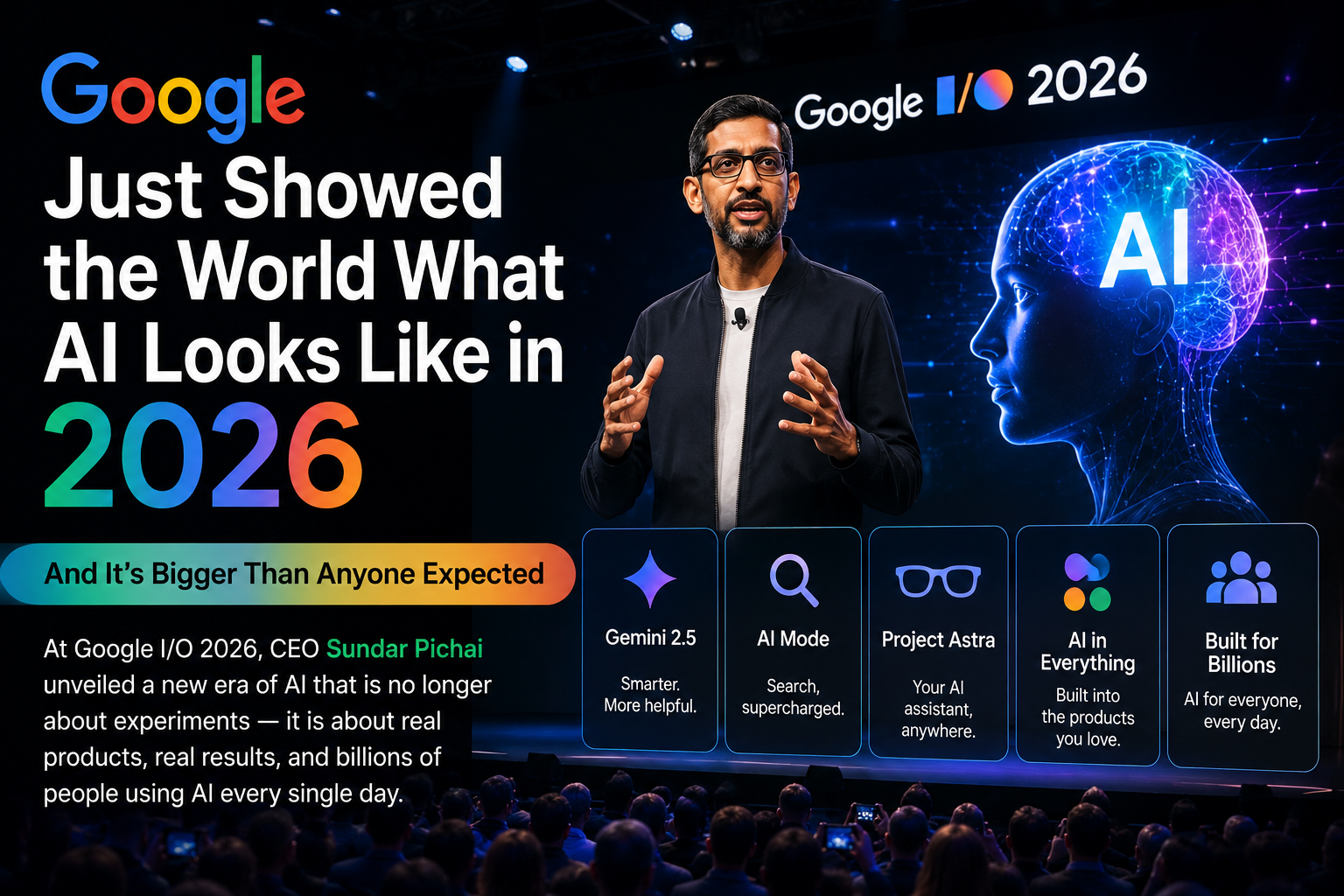
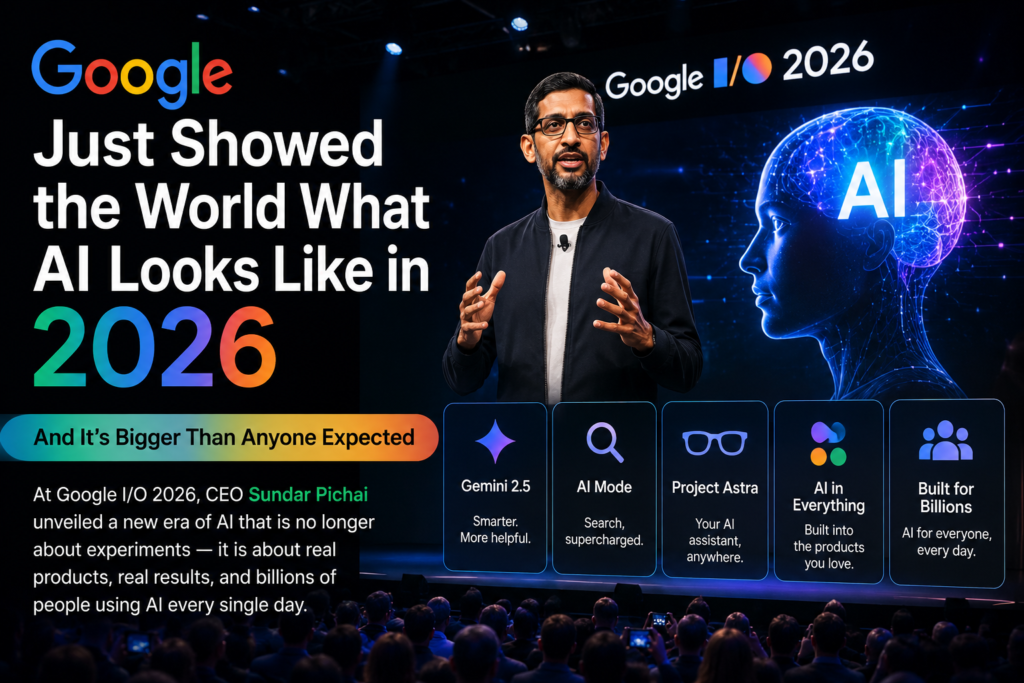
At Google I/O 2026, CEO Sundar Pichai unveiled a new era of AI that is no longer about experiments — it is about real products, real results, and billions of people using AI every single day.
Every year, Google holds its biggest event of the year — Google I/O — where it pulls back the curtain on what it has been building and where it is headed next. This year was different.This was not a showcase of future possibilities. This was Google showing the world that AI has already arrived — in your search bar, on your phone, in your creative tools, and across products used by billions of people daily.
The Numbers That Tell the Whole Story
Before getting into the products, the scale of what Google shared is worth pausing on.
Two years ago, Google’s AI systems were processing 9.7 trillion tokens per month — a token being the basic unit of data its AI models work with, roughly representing a word or part of a word being processed.
Last year that number grew to 480 trillion per month.
Today? Google is processing over 3.2 quadrillion tokens every single month — a 7x jump in just one year.
To put that in plain terms: an almost incomprehensible amount of questions are being answered, problems being solved, and tasks being completed by Google’s AI every single month — and that number is growing faster than ever.
The developer side of the story is just as striking:
- Over 8.5 million developers are now building apps and products using Google’s AI models every month
- Google’s model APIs are processing roughly 19 billion tokens every minute
- In the past 12 months, over 375 major enterprise companies each processed more than one trillion tokens through Google Cloud
This is not a technology in its early days anymore. This is a technology at full scale.
Google Has 13 Products With Over a Billion Users Each
Sundar Pichai opened his remarks by pointing out something that very few companies in history can say: Google now has 13 products with over one billion users each. Five of those products have more than 3 billion users.
The engine behind that growth? Gemini — Google’s family of AI models that now powers nearly everything Google builds.
Google Search Is Not What It Used to Be
Search has always been Google’s most important product. In 2026, it looks fundamentally different.
AI Overviews — the feature that gives you a smart, summarized answer at the top of your search results — now has over 2.5 billion monthly active users. That is more people experiencing generative AI through a single product than through almost anything else in the world.
But the bigger story is AI Mode — what Pichai called Google’s biggest upgrade to Search ever.
AI Mode transforms search from a list of links into an actual conversation. Instead of typing a question, clicking a link, reading a page, going back, clicking another link, and piecing together an answer yourself — AI Mode does all of that for you. It understands follow-up questions, remembers what you asked earlier in the conversation, and connects information across the entire web to give you deeper, more complete answers.
In just one year since launching, AI Mode has already crossed 1 billion monthly active users.
The takeaway is simple: people are not just using Search more because of AI. They are using it differently — less like a search engine and more like a knowledgeable assistant they can have an actual conversation with.
The Gemini App Is Growing at Remarkable Speed
A year ago at Google I/O 2025, the Gemini app had 400 million monthly active users.
Today that number has grown to nearly 900 million — more than doubling in a single year. Daily requests on the app have grown over seven times in that same period.
One of the features driving that growth is Personal Intelligence — a capability that makes Gemini’s responses more tailored and relevant to each individual user based on their preferences, history, and context. The more someone uses it, the more useful it becomes.
And for anyone who has used Gemini’s image generation tools: over 50 billion images have now been created using Google’s Nano Banana image generation models. That number alone says something powerful about how much creative energy people want to express — and how AI is giving them a way to do it.
This Is the Agentic Era — Here Is What That Means
The phrase Pichai kept returning to throughout his remarks was “the agentic Gemini era.” It is worth understanding what that actually means, because it signals a major shift in how AI works.
Until recently, AI tools were mostly reactive — you asked a question, it gave you an answer. You gave it a task, it completed that task.
Agentic AI is different. It can take a goal — something like “plan my trip to Chicago next month” or “find and summarize all the emails about this project from the last 30 days” — and work through multiple steps on its own to get there. It can use different tools, browse the web, check your calendar, and pull from multiple sources — all without you having to guide every single step.
Think of it less like a calculator and more like a capable assistant who can be handed a job and trusted to figure out how to get it done.
This is the direction Google is moving everything — Search, the Gemini app, developer tools, and enterprise products — all toward AI that does not just answer questions but actually gets things done.
Ten Years of Being AI-First — And Just Getting Started
Pichai noted that it has now been ten years since Google pivoted the entire company to be AI-first. That long-term commitment is part of why Google is able to move at the speed it is moving today.
The approach has always been what Pichai calls a full-stack strategy — owning every layer of the process, from custom-built computer chips and secure infrastructure, to world-class AI research, to the consumer products that billions of people use daily. That end-to-end ownership is what allows Google to innovate faster and bring new capabilities to market more quickly than almost anyone else.
What This Means for Everyday People
All of these announcements might sound like big tech numbers and industry jargon. But the real-world impact is straightforward:
If you use Google Search, it is getting smarter, faster, and more conversational. You will spend less time clicking through links and more time getting actual answers.
If you use the Gemini app, it is becoming more personal and more capable. It will understand your needs better the more you use it.
If you create anything — music, art, writing, videos — Google’s generative AI tools are becoming more powerful and more accessible, designed to work alongside human creativity rather than replace it.
If you are a developer or business owner, the tools available to build with AI have never been more capable or more widely supported.
The Bigger Picture
What Google I/O 2026 made clear is that AI is no longer something that is coming. It is already here, already embedded in the products billions of people use every day, and already growing faster than most people realize.
Sundar Pichai said it plainly: the goal has always been to advance Google’s mission and improve people’s lives at scale. AI, in 2026, is the most powerful tool the company has ever had to do exactly that.
The era of asking what AI will eventually be able to do is over. The question now is how quickly people will learn to use what is already available to them.
Source: Google I/O 2026 — Sundar Pichai keynote remarks, May 19, 2026



What?